
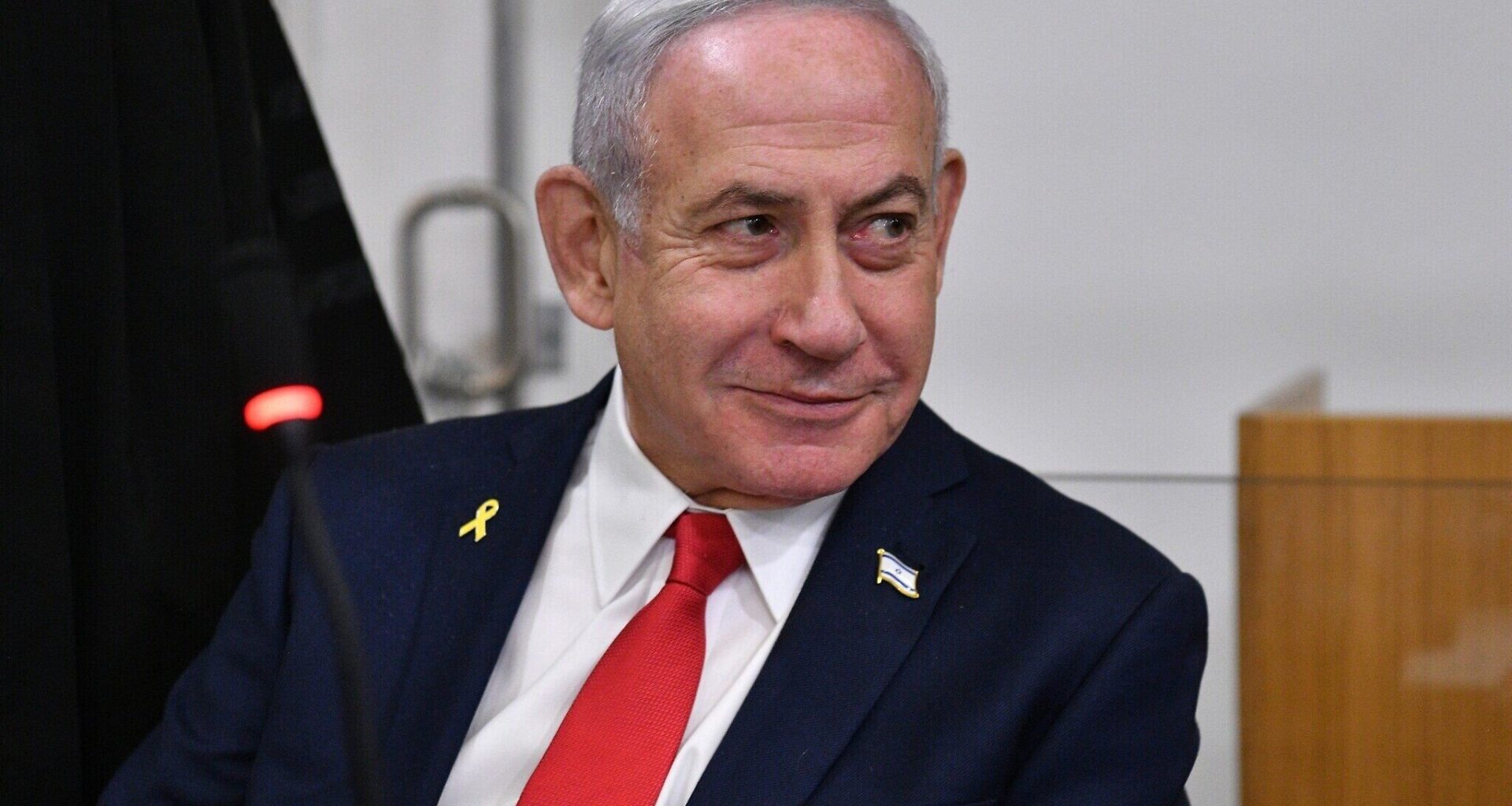
This Editor’s Note was sent out earlier Wednesday in ToI’s weekly update email to members of the Times of Israel Community. To receive these Editor’s Notes as they’re released, join the ToI Community here.
If Israel had term limits for its prime ministers — as it should, since too much power for too long tends inevitably to corrupt — Benjamin Netanyahu would not be on trial.
The filing of the kind of charges for which he was indicted in November 2019 would have waited until he was out of office, French presidential style.
With no term limits, Netanyahu has been able — and duly elected — to serve as prime minister almost uninterruptedly since 2009, as well as for three years in 1996-99. He has also been eligible for prosecution for alleged criminal behavior, having failed in a last-ditch pre-indictment bid to obtain parliamentary immunity.
As of this week, however, he is seeking a presidential pardon for those offenses. He has not been convicted. His trial has been in progress for a frankly ridiculous five and a half years, with more years to go at current pace, and years of potential appeals after that. And he continues, including in his submissions for a pardon, to argue that the process in which he was investigated and indicted was illegitimate, that the charges were fabricated, and that the trial is gradually proving that they are unfounded.
Get The Times of Israel’s Daily Edition
by email and never miss our top stories
By signing up, you agree to the terms
Nonetheless, his very act of seeking a pardon from President Isaac Herzog would appear to constitute, at the very least, an implicit acknowledgment of offense, since, as Basic Law: The President states, “The President of the State has the power to pardon offenders and modify sentences by reducing or commuting them.” (My italics added.)
If he is a self-acknowledged offender — seeking a pardon despite his simultaneous contention that the trial will vindicate him — then Herzog must treat him as such and impose the appropriate punishment, ensuring that the rule of law is applied and seen to be applied to Netanyahu as to any citizen; that justice is done and is seen to be done.
Previous ministers, prime ministers and presidents have gone to jail for their offenses. In Netanyahu’s case, Herzog might determine that the appropriate price, for a serving prime minister who, of his own volition, is seeking a pardon as regards alleged offenses carried out while in office, would at the very least be for him to step down from that office. He would be better off rejecting the request altogether, as the Justice Ministry will likely recommend.
Departing from the norm of requests for presidential pardons, the core of Netanyahu’s submission is not that he strayed and is now remorseful. Quite the contrary. It is that he did not stray, and has nothing to be remorseful about, but that the protracted trial is interfering with his capacity to devote full-time attention to his role as prime minister, and that the “national interest” is therefore being harmed.
He also argued that, liberated from the protracted court proceedings, he would be better able to “mend rifts between different segments of the public, and open the door to lowering the flames of tensions, all for the purpose of strengthening the country’s national resilience.”
Those assertions, formulated in his lawyer’s submissions as potential acts of patriotic duty, are disingenuous. Netanyahu has for years routinely demonized critics and opponents as leftist enemies of the state. He has refused to step down as the prime minister with whom the buck stops for the unprecedented failure to prevent Hamas’s October 7 massacre. He is attempting to deflect all responsibility for that failure onto the military and security agencies and the High Court. He is resisting the establishment of an essential state commission of inquiry into the catastrophe. He is strategically attempting to discredit and destroy the independence and powers of the judicial system. And he is desperately attempting to maintain the unconscionable mass exemption from military service of the ultra-Orthodox community.
More than any Israeli individual, it is he who bears most responsibility for fueling those debilitating rifts he says he wants to heal but proposterously claims he cannot because of the distractions of his defense.
His lawyers also argued on his behalf that, free of the conflict of interest restrictions imposed upon him as an indicted prime minister, he would be able “to deal with additional issues, such as the judicial system and the media.”
That ostensible goodwill offer carried a whiff of menace, since it is his coalition, from almost its first day in office three years ago, that has focused its prime legislative energies on seeking government control over the judicial system. And it is his coalition, right now, that is fast-tracking legislation to impose political oversight on Israel’s free press.
His cabinet secretary indicated on Monday that his request is actually more like a demand, declaring, “There is a greater chance of the sun not rising in the morning than the prime minister confessing to crimes he didn’t commit as part of the pardon request.” By extension, unnamed people in the prime minister’s circle have made clear, he won’t agree to an offender’s punishment such as stepping down. His request for a pardon is not some kind of opening gambit, they have said, to be followed by negotiations on its terms.
What he wants is an unconditional pardon, or nothing. If it is not forthcoming, said Environmental Protection Minister Idit Silman on Sunday night, US President Donald Trump “may be forced to intervene,” with “sanctions and other things” against judicial officials. The US president exhorted Herzog in the Knesset on October 13 to give Netanyahu a pardon, repeated the call in a letter last month describing the case as a “political, unjustified prosecution,” and was reportedly asked by the prime minister in a Monday phone call to again come to his aid.
Netanyahu can continue to seek to prove his innocence in court, as he insists he is in the protracted process of doing. He can also expedite that legal process, rather than dragging it out as he and his lawyers have done to date, both in the conduct of his defense and the repeated requests to cancel and scale back his appearances.
Nobody has compelled him to issue a request for a pardon, implying an acknowledgement that he is an offender while insisting that he is not and indicating no readiness to face the punitive consequences. And in these circumstances, nothing — certainly not the national interest — compels the president to grant it and allow a prime minister to evade the rule of law.
You appreciate our journalism

You clearly find our careful reporting valuable, in a time when facts are often distorted and news coverage often lacks context.
Your support is essential to continue our work. We want to continue delivering the professional journalism you value, even as the demands on our newsroom have grown dramatically since October 7.
So today, please consider joining our reader support group, The Times of Israel Community. For as little as $6 a month you’ll become our partners while enjoying The Times of Israel AD-FREE, as well as accessing exclusive content available only to Times of Israel Community members.
Thank you,
David Horovitz, Founding Editor of The Times of Israel