
Earlier this year Te Waihanga, the New Zealand Infrastructure Commission, invited submissions for Round 2 of its Infrastructure Priorities Programme (IPP), looking to help identify proposals and projects that:
are nationally importantwill meet New Zealand’s strategic objectivesrepresent good value for moneyand can be delivered.
The process is open to everyone, from councils, public agencies, community organisations and the private sector.
While most proposals come from government agencies, councils, and organisations, I made a submission as an individual –unaffiliated with any agency or organisation – making the case for light rail on the Auckland isthmus.
And, as is being announced today, my proposal has been endorsed (at ‘Stage 1’) for identifying a nationally significant issue, under the name Mass Rapid Transit in the City Centre to Māngere corridor.
It’s been pretty awesome to get this into the programme even at ‘Stage 1’. Light rail was my entry point into transport advocacy and, after the current government cancelled all work on the City Centre to Māngere corridor without a replacement workstream in early 2024, is a project that really needs to be restarted. I’ve also been writing a book on the whole story over the last decade, so it’s a topic I know way too much about (although the book has a lot of work to go, but in June I wrote about one thing I’d found).
Regardless this, at least for now, serves as a first step to reigniting this project.
What is the IPP, and what does ‘endorsement’ mean?
The Infrastructure Priorities Programme (IPP) is an independent and standardised process to identify proposals and projects that are nationally important, will meet New Zealand’s strategic objectives, represent good value for money and can be delivered. The IPP is administered by the New Zealand Infrastructure Commission, Te Waihanga.
The IPP is a part of the development of the Commission’s National Infrastructure Plan. Proposals and projects assessed as meeting the criteria under the IPP will be published and included within the National Infrastructure Plan.
When it comes to endorsing projects, the IPP has three stages, which represent various levels of project development:
Endorsements are provided at three stages. Proposals endorsed at Stage 1 were found to identify problems requiring business case development. Those at Stage 2 focus on multiple options to solve the problem ready for detailed design. A Stage 3 endorsement reflects an investment-ready project.
Today, my proposal joins another 24 infrastructure proposals endorsed in Round 2, which along with Round 1’s endorsements means the IPP now has a total of 44 projects on its list.
As per today’s media release:
These include endorsements for Golden Triangle Rail Electrification, Waimakariri Eastern Transport, Auckland Biosolids Servicing, Auckland Level Crossings, and Queenstown Transport proposals as well as hospital projects in Tauranga, Hawke’s Bay and Palmerston North.
“Each endorsed proposal has been rigorously assessed against criteria including strategic alignment with New Zealand’s needs, value for money, and deliverability,” [Te Waihanga Chief Executive Geoff] Cooper says.
“We know that premature project announcements increase the odds of cost overruns and delivery delays. The IPP provides clear assessment of the investment readiness and the appropriate next step for each proposal.”
The endorsed proposals, submitted by both public and private organisations, were assessed by the Commission and reviewed by an independent panel of five leading infrastructure experts.
Notably absent are all the Roads of National Significance (or any NZTA project for that matter). You could argue this says a lot about NZTA and how they think the RoNS might or should be assessed in terms of national significance, strategic import, value for money, and deliverability.
It’s me: ‘Unaffiliated’
What’s actually been ‘endorsed’ for City Centre to Māngere rapid transit?
Given the substantial amount of work that’s already been done along the CC2M corridor, I submitted my proposal at ‘Stage 2’, putting forward light rail on the surface along Dominion Road as the preferred solution (at least for the section from the City Centre to Mt Roskill).
However, while my proposal satisfied requirements that this was a priority problem for New Zealand – and thus the problem itself could be endorsed – Te Waihanga found there was not quite enough information to endorse a particular solution… yet.
The report noted that these two key aspects were missing from my proposition:
complete details on the process for longlisting, which should result in 8-12 discreet/standalone options, andevidence that price was sufficiently considered when filtering to a shortlist.
(You can read the full report here, which goes into it in a lot more detail.)
From my perspective, the major reason this proposal was endorsed at Stage 1 and not at Stage 2 is due to the haphazard process over the last decade of work on isthmus light rail by the various agencies, and in particular, by a lack of quality documentation of the work.
Unfortunately, there isn’t even one single business case to point to that contains a longlist and shortlist of all the options that have been looked at over the years.
For example, most of the work undertaken by Auckland Transport between 2014-2018 was not really documented in a proper business case. Still, that work carefully explored every possible lower-cost option, such as bus-based solutions, to address the central problem of public transport capacity constraints in the City Centre. Their conclusion was that Auckland indeed needed a higher capacity mode, such as light rail.
Surface light rail sliding along George St, Sydney. Could be us; could’ve been us already! photo Patrick Reynolds
However, despite all the work essentially being there to justify a higher-cost and higher-capacity solution like light rail, it isn’t available in a form that’s easy to pick up without having the prior institutional knowledge. Nor does it fit well into the standardised process of the IPP.
Additionally, as the Infrastructure Commission highlights in its report, the more recent work (and business cases) carried out in the 2020s didn’t take the step of quantifying what the ‘problem’ of the CC2M corridor ‘costs’ us – and therefore couldn’t adequately explain why higher-cost options like a tunnelled metro system emerged as ‘preferred’ in those business cases.
Combined with the significant cost of the tunnelled metro option – and evolving political attitudes – it is unlikely any of this more recent work would be progressed, or indeed progressable, any time soon.
Hence Te Waihanga endorsing my proposal at Stage 1: where it is clear there is a problem to be solved, and yet nothing substantial is currently being progressed in the way of a solution…
…or at least, not in the persuasive and quantifiable terms required for a Stage 2 endorsement.
Of course, it’s still a significant step to have won Stage 1 endorsement. It means that at least we as a nation have identified a pressing problem, and that this issue is on the list of things we should solve.
So what’s next?
The next step would be for an actual agency to pick this up – either from central government or Auckland Council – as I have probably reached the limit of what one individual can do.
As Geoff Cooper makes clear in this morning’s media release, receiving endorsement in the IPP doesn’t guarantee funding or prioritisation towards delivery:
“The programme is voluntary and open to anyone, from government agencies and councils to community groups and the private sector. This ensures we are able provide a list of infrastructure needs and solutions from across the country.
“While endorsement doesn’t guarantee funding, or prioritisation by Government, it sends a strong signal to decision-makers about infrastructure priorities that have passed independent scrutiny.”
Arguably, as things stand Auckland Council is best placed to pick up this work. With Auckland Transport soon to be absorbed into Council, along with the development of the 30-Year Integrated Transport Plan, there is a timely opportunity to reignite work towards solving this problem.
At minimum, following the recommendations of the Auckland Rapid Transport Pathway 2025, a mode needs to be confirmed for the City Centre to Mt Roskill section of the CC2M corridor.
George St Sydney photo Patrick Reynolds
Further work could then compile and consolidate the existing work over the past decade, to advance development of the project, readying it for future business cases – or even lodging route protection and related Notices of Requirement.
Regardless of how (and by whom) this is picked up and carried it forward, I’m glad to have played my part (although I suspect my role in this won’t be over anytime soon). This is a really important step forward for a vital solution on a critical corridor, that has been left by the wayside since 2023.
Moreover, with moves imminent to develop the 30-Year Transport Plan for Auckland, you can expect to see a lot more from Greater Auckland in 2026 about what our city needs in the transport and housing space. So watch this space – as well as the CC2M one!
This post, like all our work, is brought to you by the Greater Auckland crew and made possible by generous donations from our readers and fans. If you’d like to support our work, you can join our circle of supporters here, or support us on Substack.
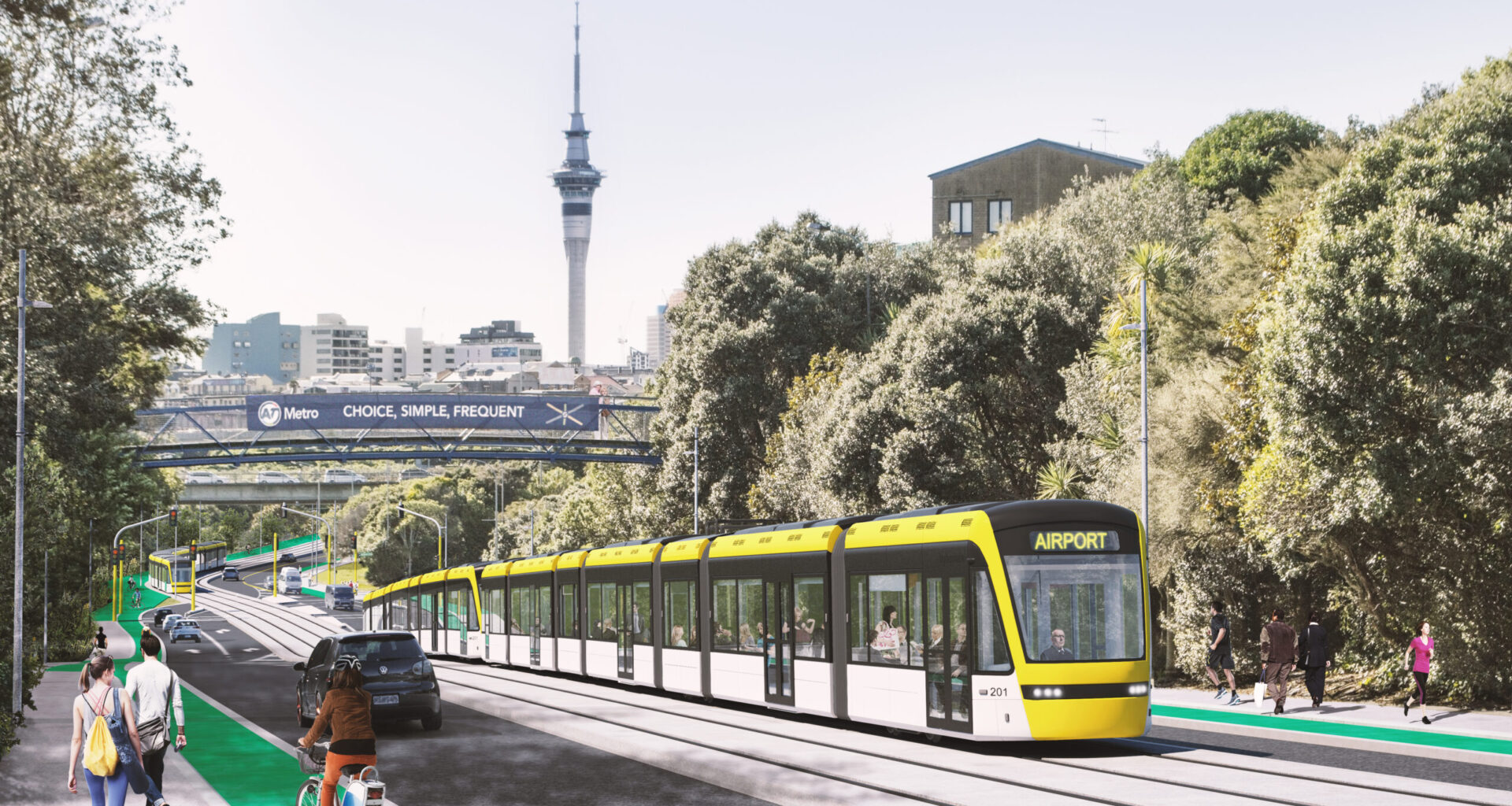
A render of Dominion Road light rail from Auckland Transport, 2017
Share this