
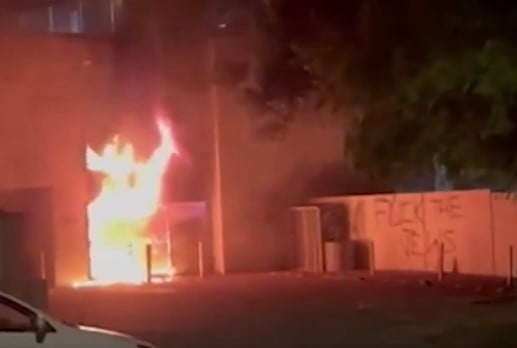
Jewish communities around the world sounded the alarm on Wednesday after a new report said the number of antisemitic incidents in Australia remained at “unprecedentedly high levels” during the past year.
A report published Tuesday by the Executive Council of Australian Jewry (ECAJ) said the country saw 1,654 incidents during the 12-month period from October 1, 2024, to September 30, 2025 — about five times the annual average recorded in the decade prior to the October 7, 2023, Hamas attack.
That was less, however, than the 2,062 incidents recorded a year earlier, in the year immediately following the attack, ECAJ noted, although the impact of the attacks on the community remained high.
Following the report, members of the J7 Large Communities’ Task Force Against Antisemitism said the spike reflects a global pattern threatening other Jewish communities around the world.
J7 is a partnership created by the Anti-Defamation League between Jewish organizations from the seven countries with the largest Jewish populations outside of Israel: Argentina, Australia, Canada, France, Germany, the United Kingdom and the United States.
Get The Times of Israel’s Daily Edition
by email and never miss our top stories
By signing up, you agree to the terms
“What is happening in Australia is not an exception; it should be a wake-up call to communities worldwide,” said ADL senior vice president for International Affairs Marina Rosenberg in a statement. “Across North America, Europe and Latin America, Jewish communities are reporting the same pattern of unprecedented harassment, threats and incitement. When synagogues can be firebombed in Melbourne, and Jews threatened and attacked in New York, London, Paris, Berlin, Buenos Aires and Toronto, this is a threat not only to Jewish safety but to democratic stability itself.”
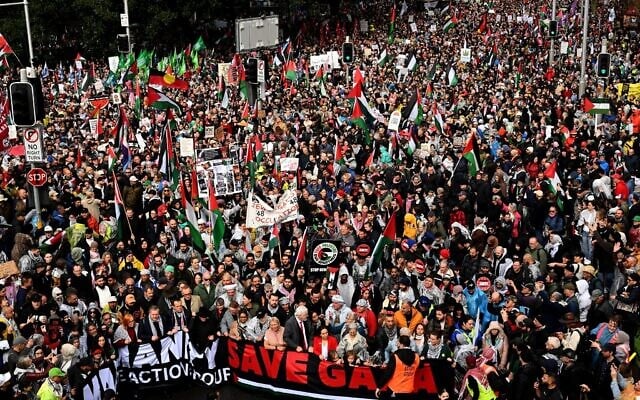
Demonstrators cross the Sydney Harbour Bridge during a rally calling for sanctions against Israel, on August 3, 2025. (Saeed KHAN / AFP)
J7 leaders convened on Wednesday in Sydney for strategic consultations and to develop coordinated responses to elevated threat levels.
A tidal wave of hate
Australia’s 120,000-strong Jewish community has been among the hardest hit in the world since the October 7 Hamas attack and the subsequent war set off a tidal wave of antisemitism across the globe.
After the community saw a record number of attacks in 2023-2024, an arson attack in December on Melbourne’s Adass Israel Synagogue was seen by many as a turning point, and Jews have been frustrated by what they say has been the government’s failure to rein in attacks and violent rhetoric.
Over the past year, Jews in Australia have seen synagogues, schools and homes firebombed, two nurses threatening to kill Jewish patients in their hospital, and the discovery of a trailer filled with explosives said to have been intended to cause a mass-casualty event at a Sydney synagogue.
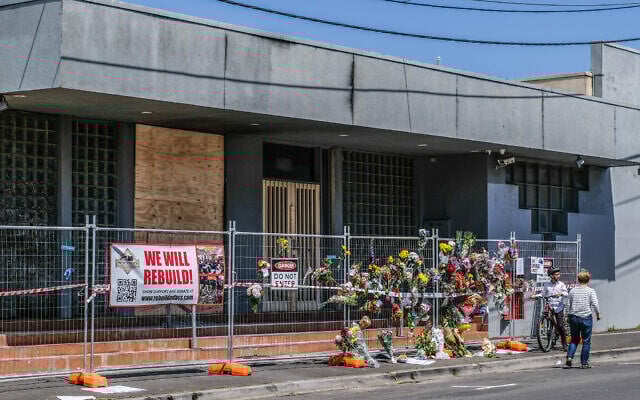
Flowers and messages of hope and support seen at the Adass Israel Synagogue in the Ripponlea suburb of Melbourne, December 8, 2024, after it was gutted in an arson attack early on December 6, 2024. (Reuters)
In August, Australian Prime Minister Anthony Albanese revealed that Iran was suspected of being behind a pair of 2024 antisemitic arson attacks, calling the actions “dangerous acts of aggression” designed to undermine his country’s social cohesion.
The country’s decision in August to recognize a Palestinian state at the United Nations General Assembly in September has aggravated a growing sense of alienation among the country’s Jewish community and sparked a sharp war of words between Albanese’s government and Israeli officials.
Over the past year, ECAJ tallied 621 cases of antisemitic verbal abuse, representing 38 percent of all incidents. There were more than 350 cases of graffiti, 33 cases of vandalism, and 24 reports of physical assault.
The number of physical assaults dropped by 63% from the previous year, but vandalism increased by 14%, the report showed. Incidents were only classified as antisemitic if they met the definition of racist violence developed by Australia’s Human Rights and Equal Opportunity Commission.
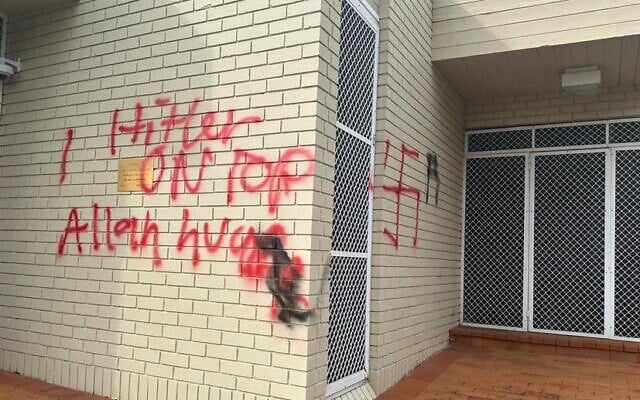
Antisemitic graffiti daubed on a Sydney synagogue, January 10, 2025 (Social media; used in accordance with Clause 27a of the Copyright Law)
In its report, ECAJ noted a marked increase in graffiti calling to kill Jews as a direct imperative, in contrast to previous messaging that it has seen as an expression of sentiment rather than a call to action.
It observed a dangerous convergence of ideological extremes, noting the “increasing ideological alignment” between neo-Nazis, the anti-Israel left, and Islamists in their “common hatred of Jews/Zionists.” These groups are “more active, more emboldened” to undermine any initiative that will counter their hatred, the report said.
Normalized and mainstreamed
Australians now feel that antisemitism has become mainstreamed throughout all aspects of national life, ECAJ said.
“We are now at a stage where anti-Jewish racism has left the fringes of society and become… normalised and allowed to fester and spread, gaining ground at universities, in arts and culture spaces, in the health sector, in the workplace and elsewhere,” the report said.
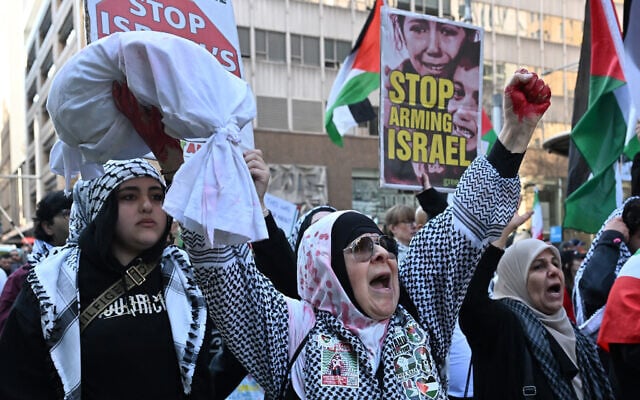
Demonstrators take part in an anti-Israel, pro-Palestinian rally in Sydney’s central business district on August 31, 2025. (Saeed KHAN / AFP)
“In such an environment, Jews have legitimate concerns for their physical safety and future in Australia,” it added.
Jeremy Leibler, president of the Zionist Federation of Australia, offered a similar prognosis following the report’s publication.
“The most worrying trend in this year’s report isn’t only the number of incidents — it’s how quickly they have become part of the background noise of Australian life,” Leibler told The Times of Israel. “When Jewish students expect hostility on campus, when synagogues quietly increase security, when parents think twice before sending their children on school excursions, something profound has shifted. Antisemitism thrives when people stop being shocked by it. The challenge now is not just to condemn these incidents but to restore the shared norms that once made this country feel safe.”
You appreciate our journalism

You clearly find our careful reporting valuable, in a time when facts are often distorted and news coverage often lacks context.
Your support is essential to continue our work. We want to continue delivering the professional journalism you value, even as the demands on our newsroom have grown dramatically since October 7.
So today, please consider joining our reader support group, The Times of Israel Community. For as little as $6 a month you’ll become our partners while enjoying The Times of Israel AD-FREE, as well as accessing exclusive content available only to Times of Israel Community members.
Thank you,
David Horovitz, Founding Editor of The Times of Israel