
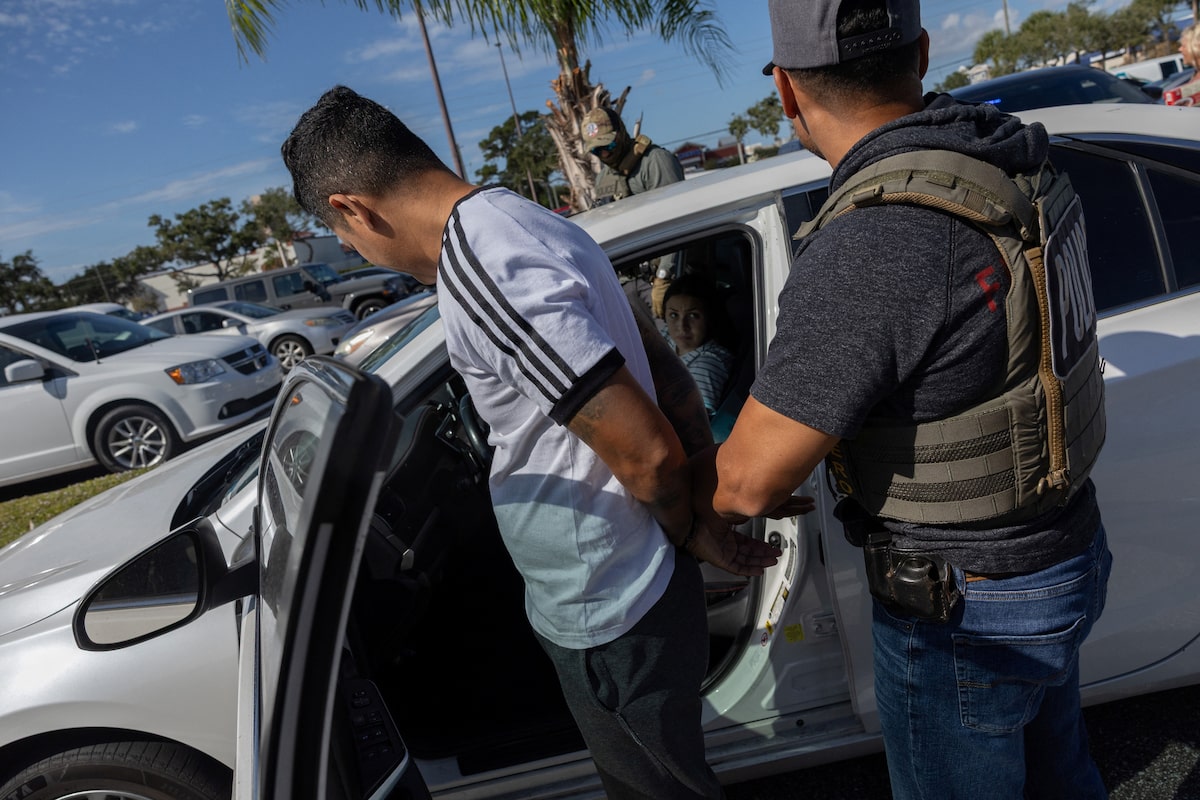
U.S. federal agents arrest a man in an immigration enforcement operation in Pinellas Park, Florida, on Nov. 7.Shannon Stapleton/Reuters
Foreign Affairs Minister Anita Anand wouldn’t say Wednesday whether Canada would block the export of Ontario-made armoured vehicles for use by U.S. Immigration and Customs Enforcement.
Human-rights advocates are expressing concern over a Canadian company equipping an American agency known for its aggressive enforcement tactics under the Trump administration’s mass deportation campaign.
U.S. government procurement records show Washington has ordered nearly $10-million in armoured vehicles from Brampton, Ont.-based defence contractor Roshel. They are earmarked for ICE, according to the Federal Procurement Data System, and the purchase was approved Nov. 28.
Canada reaches deal to join EU military procurement fund
Canada buying $200-million in weapons for Ukraine from U.S. stockpile
ICE agents have been spearheading a controversial effort by President Donald Trump to arrest and deport foreigners from the United States. Their disruptive tactics have been met with a backlash in many communities across the U.S.
Kelsey Gallagher, a senior researcher at Project Ploughshares, a Waterloo, Ont.-based arms control research organization, said there is sufficient evidence to support Canada blocking the export of armoured vehicles for use by ICE.
“Credible human-rights monitors have linked ICE to serious rights violations, including arbitrary and abusive detention and the irregular transfer or expulsion of migrants and foreign nationals based on their perceived ethnicity,” he said.
The contract is for Senator Emergency Response Tactical Vehicles. They provide armoured protection from rifles, grenade attacks or mines and feature bullet-resistant glass.
NDP MP Jenny Kwan said she was deeply troubled by this transaction, saying ICE in some ways is acting as “secret police” for the U.S. government.
“It’s profoundly concerning that a Canadian manufacturer is supplying specialized military grade vehicles built to withstand bullets and bomb blasts to an agency whose practices have long raised alarms amongst humanitarian organizations.”
Foreign Affairs Minister Anita Anand says she hasn’t received notifications regarding the armoured vehicles transaction.Sean Kilpatrick/The Canadian Press
Ms. Anand, who was speaking to reporters Wednesday on a conference call from a meeting of NATO foreign affairs ministers in Brussels, is responsible in Canada for monitoring and approving exports of military gear. She said she hasn’t received notifications regarding the transaction.
“The government is not involved in the transaction. We have not received any questions or permit requests regarding this transaction,” the minister said. “I will continue to reiterate that Canada and the United States have a strong bilateral relationship with an open line of communication in which, if necessary, I will raise the issues with Secretary Rubio.”
The minister added: “Secretary Rubio and I have an open line of communication, and we will continue to correspond and communicate about multiple issues.”
The Canadian government does not release public statistics on the export of military equipment or weapons to the United States and nor does it require export permits for the vast majority of defence gear sold to U.S. buyers.
Global Affairs does not publish the full value of annual military exports to the United States but Project Ploughshares estimates that it significantly exceeds $1-billion.
While Canada has traditionally only lightly regulated arms sales to the United States, the Foreign Affairs Minister has sufficient discretion under powers afforded to her in law to block any exports if she deems it necessary. In 2024, then-foreign affairs minister Mélanie Joly blocked U.S.-bound exports of ammunition. This ordnance, manufactured in Quebec, was being sold to the U.S. government for onward export to Israel.
“If a Canadian defence supplier sought to export a fleet of armoured vehicles to almost any other foreign agency with a similar documented pattern of abuse, the Canadian government would almost certainly intervene and deny that transfer, in line with Canada’s arms control obligations,” Mr. Gallagher said.
It remains to be seen whether the same standard will be applied in this case, he added.
The Department of Global Affairs should be conducting a human-rights risk assessment before approving transfers of armoured vehicles to the U.S. government, Mr. Gallagher said.
The Roshel transaction was first reported by the Independent in the U.K., which said the purchase covers 20 vehicles.
Roshel has manufactured more than 2,000 Senator armoured vehicles for Ukraine from its facilities in Ontario and employs more than 480 people in Mississauga and Brampton. It has previously sold its products to the U.S. government.
Roman Shimonov, president of Roshel, declined to comment directly on the contract. “We don’t sell to ICE. We sell to the U.S. government.”
He questioned the media focus on armoured vehicle sales. “Why don’t they report on companies that sell socks to the U.S. government?”