
Each station also has accessible toilets, parents’ rooms and adult changing place facilities. A Travellers Aid hub at Parkville will open soon and help passengers get between the station and nearby hospitals. Stations could do with more seating, though.
Good: Architecture and design 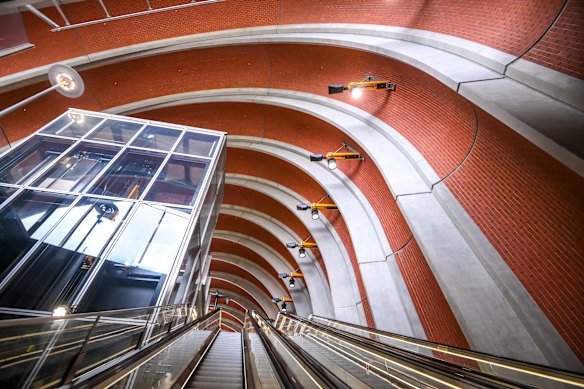
The Arden station entrance features massive concrete arches lined with more than 100,000 hand-laid bricks, reflecting North Melbourne’s rich industrial history.Credit: Justin McManus
It’s hard not to be impressed walking through the five new underground stations.
High ceilings and wide platforms create a sense of space and openness that is a world away from their grubby City Loop counterparts.
Arden station’s redbrick arches will surely become one of the city’s architectural landmarks.
The coupling of raw cement – most impressively in State Library station’s arched entrance – with Art Deco-inspired lighting and fixtures reflects the city above it. It feels undeniably Melbourne.
Signage is clear, and the connections between CBD interchange stations are intuitive to follow.
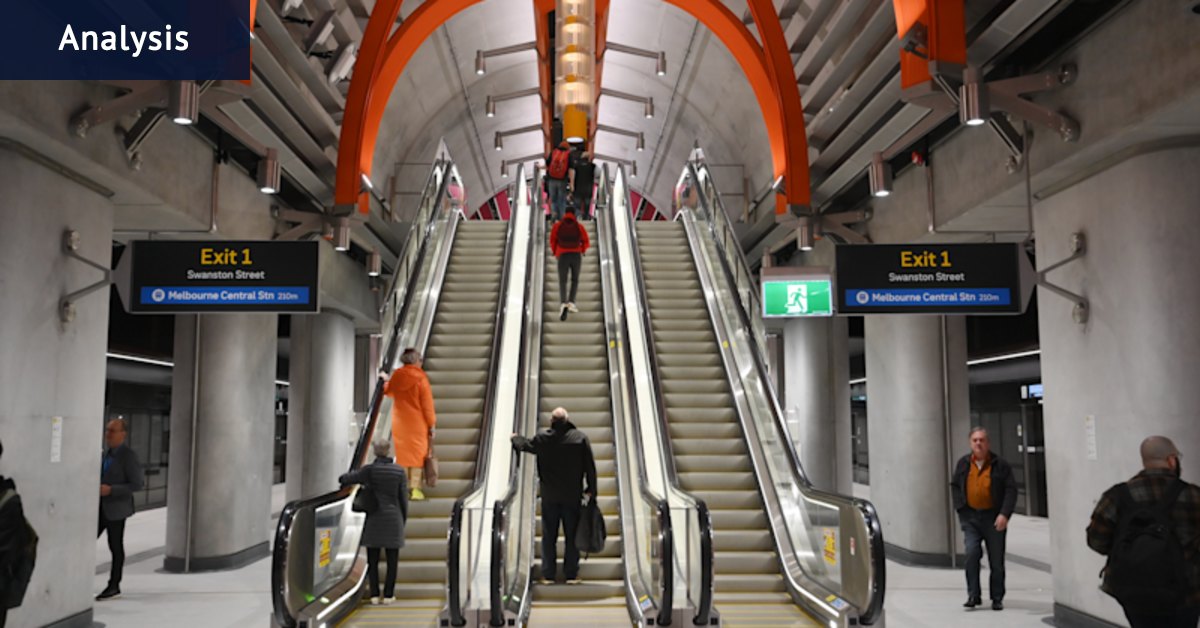
There are escalators galore – including a wall of five at the State Library entrance – to avoid the passenger congestion experienced at other CBD stations, and provide redundancy during breakdowns (looking at you, Southern Cross).
Bad: Deja vu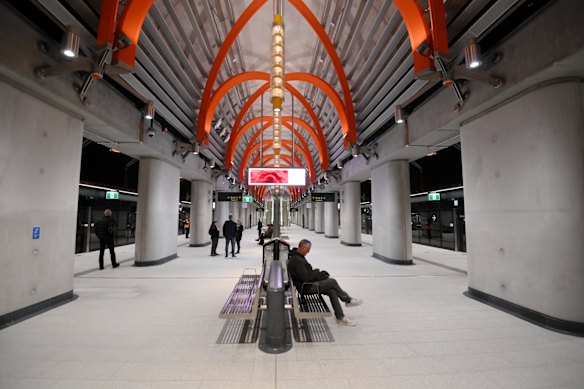
The quiet State Library station on Monday morning.Credit: Justin McManus
The platforms at Town Hall and State Library look nearly identical – especially on board an arriving train.
And because not every cement column on the platform is signed, it might not be obvious which station you are arriving at.
Making the two stations distinct was a missed opportunity to explore different design ideas while making life easier for commuters.
Good and bad: Anzac tram interchange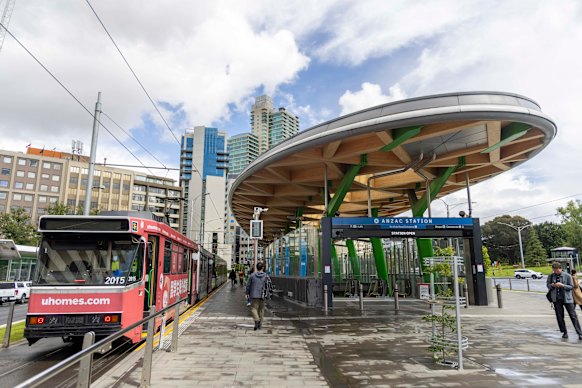
The canopy at Anzac isn’t up to the job. Credit: Wayne Taylor
Anzac station’s integrated tram stop works excellently. Transferring from St Kilda Road trams and directly down into the station takes just a couple of minutes. For many, getting on a train here will be quicker than taking a tram all the way up Swanston Street.
It doesn’t all work well, though. The 85-metre wooden canopy at Anzac is an attractive structure – but too small to protect passengers from the elements while transferring to/from a tram.
It also fails to stop rain falling onto Anzac’s concourse. Staff had to erect “wet floor” signs there during light rain on Monday.
Good: Platform screen doors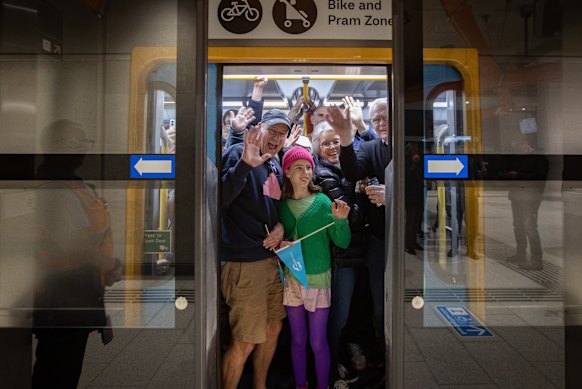
Platform screen doors improve safety and comfort. Credit: Simon Schluter
Platform screen doors at each of the five stations are a big step up for passenger comfort. There’s no loud whoosh of air as trains arrive or depart. They make platforms safer, quieter and easier to keep warm and cool.
One nifty feature: the displays showing passenger loads in each carriage on the next arriving train, so you can board at a door with the most room. Not all doors are in use right now, however, and this could be signed better. Metro is operating seven-carriage trains in the Metro Tunnel, but the platforms are long enough to accommodate 10-carriage trains in the future.
Doors not in use have signs that say “Board trains this way →” but The Age saw plenty of passengers expecting trains to arrive there, perhaps thinking the sign indicated the direction of travel.
Good: Artwork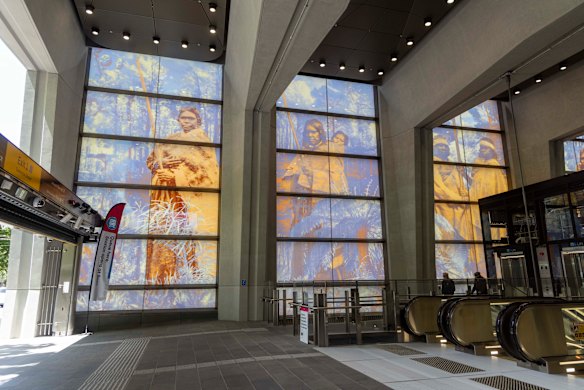
Danie Mellor’s work Forever at State Library station.Credit: Wayne Taylor
Future generations of Melburnians will be grateful for the public artworks included at the new stations.
Patricia Piccinini’s colourful ceramic tiles at Parkville seem to be a favourite among visitors.
Danie Mellor’s work Forever, consisting of photographic portraits of Wurundjeri Woi Wurrung women printed on huge glass panels along La Trobe Street, is a beautiful addition to the city.
Bad: Advertising onslaught 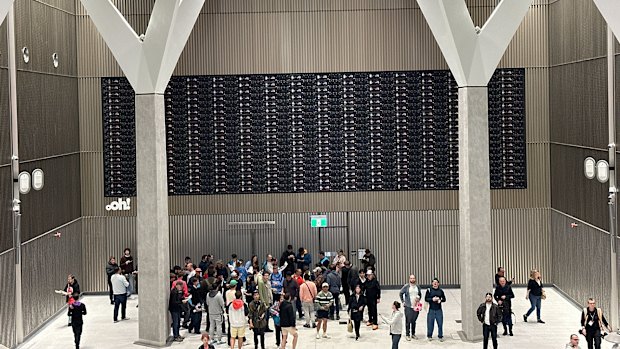
The unfinished digital advertising screen at Town Hall station.Credit: Gemma Grant
When taking the escalators from the new City Square down into Town Hall station, passengers come face-to-face with a large wall crying out for another mural or artwork.
Instead, an enormous LCD screen – we’re talking IMAX here – will assault commuters with “immersive 3D anamorphic display” advertising.
A three-screen digital wrap-around also detracts from the State Library station’s impressive entrance.
The stations were supposed to celebrate Melbourne’s history and people. Too many of them have fallen victim to the rapacious commercialisation of public life.
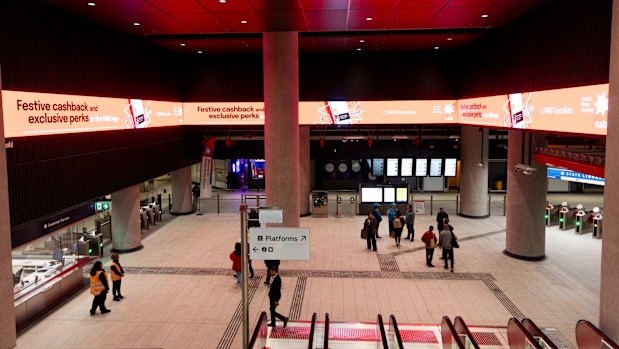
The wraparound advertising screens at State Library. Credit: Wayne Taylor
Bad: Fast food
The use of retail space is uninspired. There’s a McDonald’s at Town Hall, while Parkville has a Maccas and a KFC. The doctors at the Royal Melbourne and Peter Mac won’t love that patients have access to so much junk food on their doorstep.
The iconic Campbell Arcade is now accessible from Town Hall. It was home to an independent coffee shop, a record store and the Sticky Institute zine hub before it was emptied during construction. Let’s hope it rekindles that quirky and creative spirit when the shopfronts are leased out again.
Bad: CBD station myki glitch 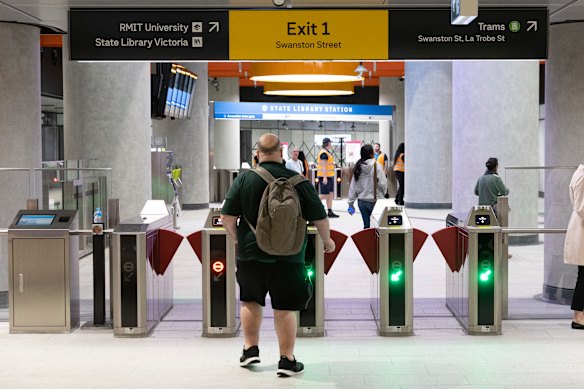
The underground concourse connecting State Library station to Melbourne Central. Credit: Jason South
Town Hall station connects to Flinders Street Station. State Library connects to Melbourne Central.
Passengers can transfer between them without going through myki gates – in effect, forming two CBD mega stations served by both the Metro Tunnel and City Loop.
But the myki ticket system treats them as separate stations.
Loading
Usually, if you enter a station, change your mind about travelling and exit the same station within 15 minutes, you are not be charged a fare.
But if you enter Town Hall, change your mind and then exit via the Melbourne Central gates, your myki will be charged.
Transport Victoria says it is working to change this, and also make it possible for anyone to use these underpasses without touching on.
Until then, one gate is left open at Town Hall and State Library.
Bad: Bicycle parking
The absence of secure or even undercover bicycle parking at Arden, Parkville or Anzac is a baffling oversight. There are bicycle hoops, all vulnerable to the elements and thieves.
Loading
Good bicycle parking can encourage commuters to combine a short bike ride with a train journey, massively enhancing the catchment of people who can access a station. The Dutch, of course, do this best: at Utrecht station, commuters can ride directly into its three-level, 12,500-bike underground parking facility.
That might be overkill for Melbourne. But the Metro Tunnel stations don’t even have the lockable Parkiteer bike cages, which are installed at many suburban stations.
Good and bad: Public space
The revamped City Square, above Town Hall station, is a welcome addition to a CBD that is starved of communal space. It’s a shame that other opportunities to create new public spaces were missed.
The project initially planned to permanently close Franklin Street (between City Baths and RMIT) to create a new pedestrian zone and public space, but that was scrapped.
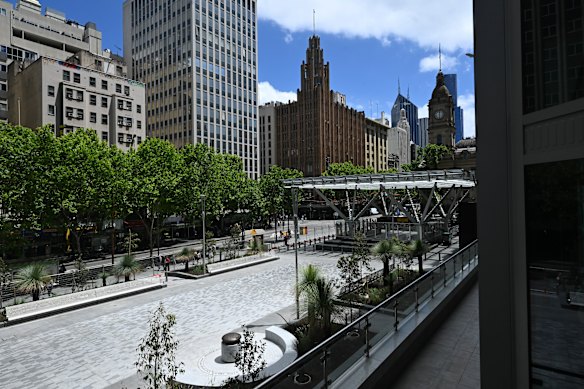
The redeveloped City Square. Credit: Joe Armao
The Swanston Street vehicle-free zone should have been extended north to A’Beckett Street, past State Library station.
Likewise, one or both sides of Flinders Street were closed for years during construction. People have gotten used to it. It could have stayed closed to make room for the tens of thousands of pedestrians set to pour out of Town Hall and Flinders every morning.
Instead, they’ll have to squeeze onto already overcrowded footpaths when it reverts to a traffic thoroughfare.
Bad: Soft launch timetable
Almost every Melburnian will be aware that the Metro Tunnel is now open. But how many will have read the fine print? It is only open between 10am to 3pm on weekdays, and until 7pm on weekends. Trains run only every 20 minutes. The full timetable starts on February 1.
It’s inevitable that some people will leave home thinking they can get a train to Parkville, only to find the tunnel is closed for the day. Visitors here for the Australian Open and other events this summer will be confused too.
Bad: The line with no name
In New York you can get on the “A” train to Harlem. Londoners ride the Jubilee and Suffragette lines.
Metro Tunnel will operate the newly connected Sunbury and Cranbourne/Pakenham lines.
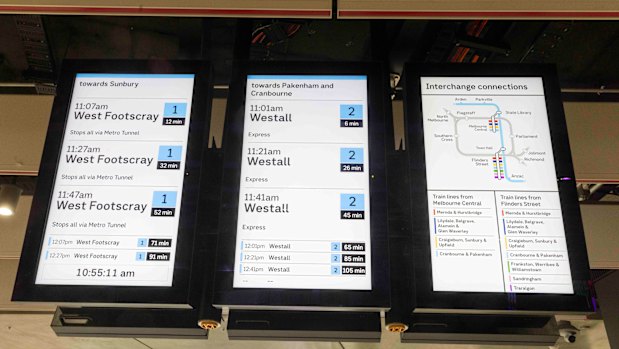
Passenger information displays at Anzac. Credit: Wayne Taylor
Not just a mouthful, it can be confusing, too.
Melbourne’s train lines are named after their final terminus (the Hurstbridge Line, the Glen Waverley Line). That’s fine if they only travel into the CBD and back again to their origin. It doesn’t work for the 100 kilometre end-to-end Metro Tunnel.
As it stands, Pakenham Line trains go to Sunbury, and Sunbury Line trains go to Cranbourne or East Pakenham.
If they applied the convention used on the London Underground, customers would be told they need a “Metro Line: Sunbury” train to travel towards Sunbury. Much easier to understand.
Good: Cross-city travel
People say the Yarra is the physical and psychological barrier that divides Melbourne. I’d argue the City Loop is just as significant. The Metro Tunnel bridges the divide, making it possible to travel directly from the outer north-west all the way to the outer south-east.
Over time, this will change how Melburnians conceive the city and their place in it.
People will be more willing and able to cross the city for work, study or leisure. Melbourne will be a smaller, more connected place.