
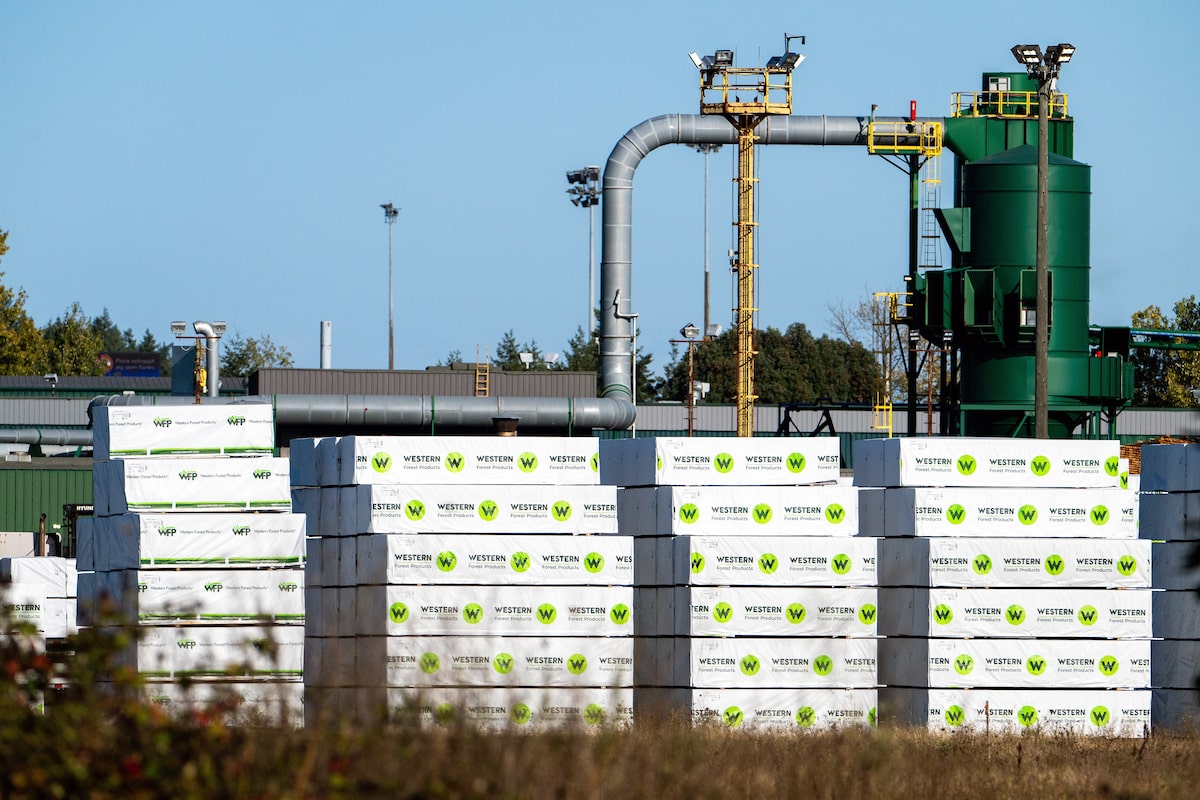
Stacks of lumber in the storage and sorting yard at the WFP Duke Point Sawmill in Nanaimo, B.C.James MacDonald/The Globe and Mail
The federal government has rejected an industry request for payouts to softwood producers in Canada on the hook for U.S. duties, fearing that direct intervention would further irritate the United States.
Canadian softwood producers have paid more than $10-billion since 2017 in accumulated U.S. duties, which are cash deposits held in trust by the United States that collect interest. The producers expect the U.S. to refund a portion of the duties if and when the two countries resolve their complex trade dispute over Canadian softwood shipments.
In the meantime, the industry has suggested that the Canadian government make payouts to reflect the present value of anticipated refunds, according to two forestry sources familiar with the matter.
The two sources said under this course of action, Ottawa would have received any future refunds in exchange for injecting much-needed liquidity into the struggling industry, which has long been targeted by U.S. trade regulators but has seen punitive import taxes rise under President Donald Trump.
However, Ottawa rejected the idea because of fears that such payouts would be viewed as subsidies and become a serious irritant during the wider U.S. trade war, according to a senior government official.
Trump may use USMCA withdrawal as a bargaining tactic, trade experts warn
The official said Ottawa has carefully crafted supports for Canada’s lumber industry to stay onside with international trade laws.
The Globe is not identifying the sources because they were not authorized to speak publicly on the matter.
Several contracts have already been signed in recent years, in which a Canadian producer in effect sold or designated a portion of “accounts receivable” to a private-sector third-party. That third-party then stands to receive refunds amounting to more than 30 cents for each dollar in duties currently held in escrow.
Canada’s lumber industry still prefers a negotiated solution to the trade battle dating back to the early 1980s, but given the impasse with the U.S., the proposed payouts were floated as a short-term measure for direct financial relief.
The Canadian sector has sounded the alarm that producers are facing enormous challenges during this period of high U.S. import taxes, warning of widespread effects on employees and the communities they work in.
Banks tell Natural Resources Minister loans for softwood industry are imminent, sources say
In August, Prime Minister Mark Carney unveiled plans to support Canada’s softwood industry. Ottawa’s $1.2-billion financial package included $700-million in loan guarantees and $500-million in grants and contributions in a bid to diversify markets and reduce dependence on the U.S.
Last week, the federal government announced an extra $500-million in loan guarantees to help Canadian producers of softwood lumber with their operations.
The U.S. Lumber Coalition described the increased support for the Canadian softwood sector as “yet another massive subsidy announcement to prop up Canada’s excessive and harmful lumber overcapacity and production.”
Canada has repeatedly rejected similar arguments from the U.S. Department of Commerce, which has alleged that Canadian producers are benefiting from subsidies while dumping the product below market value.
U.S. import taxes on softwood lumber currently add up to 45.16 per cent on most Canadian producers, including anti-dumping and countervailing duties of 35.16 per cent and tariffs of 10 per cent.
Federal Natural Resources Minister Tim Hodgson met with senior banking executives on Nov. 24 after the forestry sector complained that businesses have yet to receive the promised loans from the federal government, through the Business Development Bank of Canada.
Manufacturing meltdown: How Trump’s tariffs are squeezing Canadian factories
In October, BDC started welcoming applications from companies seeking help to weather the economic storm triggered by U.S. import taxes on lumber. Each ownership group is eligible for up to $20-million in loan-guarantee assistance through existing lenders.
Various forestry groups have expressed disappointment over the rollout of the Crown corporation’s financial supports, which they say has been too slow.
“Without swift and decisive action to resolve these trade issues and restore wood flow to manufacturing operations, thousands of forestry jobs are at risk,” industry leaders and B.C. union officials said in a joint statement in October.
Most forests in Canada are on Crown land, where buyers pay “stumpage fees” to provincial governments for the right to log. That is in contrast with the U.S., where most timber is on private property and companies pay market rates to harvest, American producers say.
Canadian producers paid US$5-billion in softwood duties during the previous round of the dispute from 2001 to 2006.
In the 2006 Canada-U.S. softwood trade deal, Canadian companies recouped 80 per cent of the duties that had been held by the U.S. government, while 9 per cent went to “meritorious initiatives” in the U.S., with the remaining 1 per cent allocated to promoting lumber in both countries.
The 2006 agreement expired in October, 2015, and the U.S. Commerce Department began imposing a new series of duties on shipments of Canadian softwood in 2017.
Conservative Leader Pierre Poilievre has repeatedly criticized the federal Liberal government for not negotiating a new softwood agreement with the U.S. “Affected families can no longer wait while bills pile up and mortgage payments are due,” Mr. Poilievre said in a letter last week to Mr. Carney.