
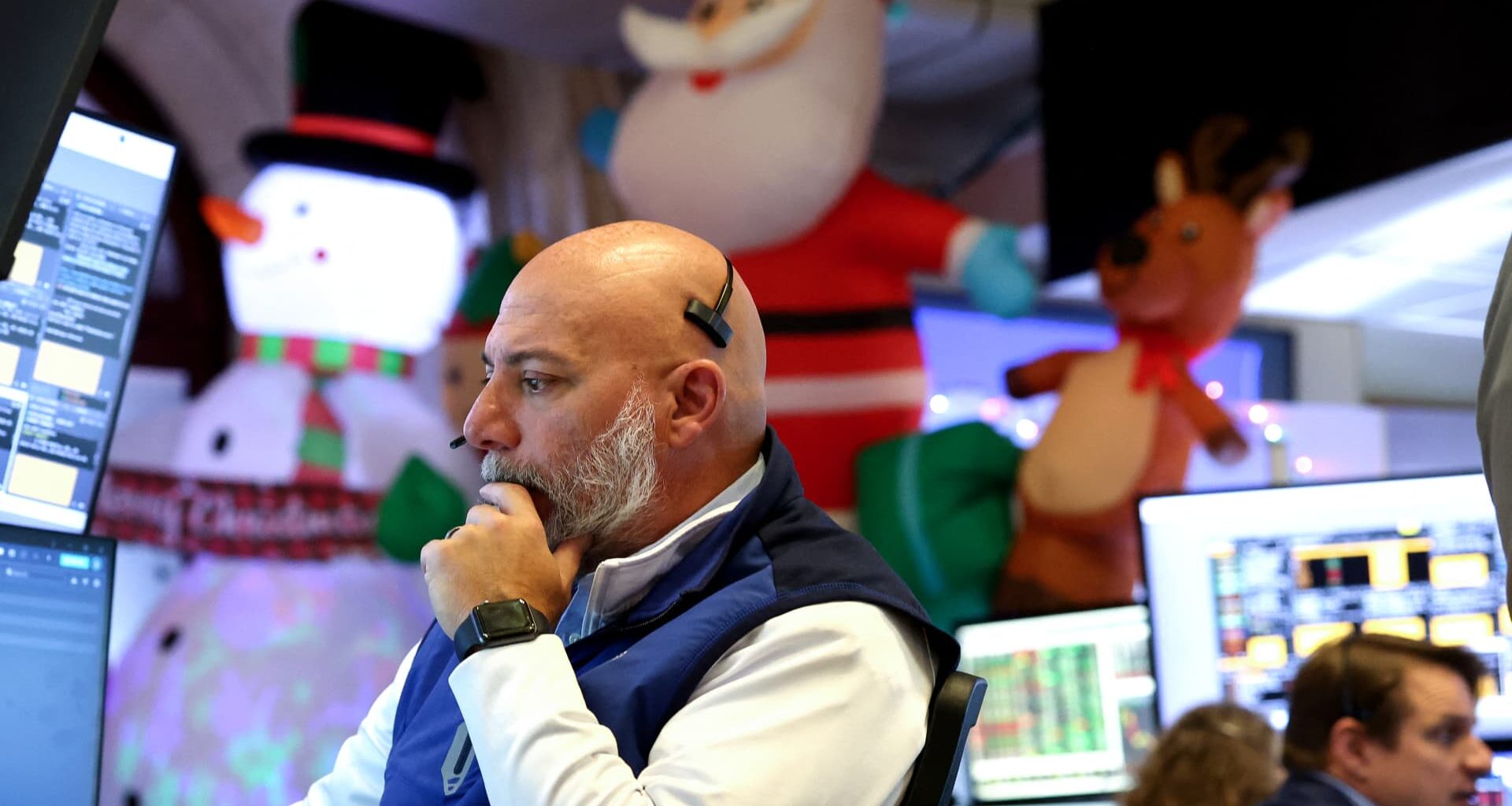
A trader works at his desk on the floor of the New York Stock Exchange (NYSE) after the opening bell in New York on December 3, 2025.
Timothy A. Clary | Afp | Getty Images
Stock futures are are little changed Thursday morning as investors grew more optimistic about a December interest rate cut.
Futures tied to the Dow Jones Industrial Average added 45 points, or 0.1%. S&P futures hovered above the flatline, while Nasdaq 100 futures fell less than 0.1%.
In after-hours trading, Salesforce stock gained more than 5% after the company offered a stronger-than-expected revenue forecast. Five Below rose about 2% after the discount retailer’s earnings flew past Wall Street’s estimates.
The latest jobs figures from ADP released earlier Wednesday helped lift the 30-stock Dow Industrial Average higher on the day, along with the other two major U.S. stock indexes. The Dow rose more than 400 points, or 0.9%. The S&P 500 and tech-heavy Nasdaq Composite ended 0.3% and 0.2% higher, respectively.
Investors took the ADP data — which reflected a surprising decline in private payrolls for the month of November — as a further signal that the Federal Reserve could be more inclined to cut its key interest rate at its upcoming Dec. 10 meeting. Markets are pricing in an 87% chance of a cut next Wednesday, which is significantly higher than rate cut bets just a couple weeks ago, according to the CME FedWatch tool.
Markets will be watching more jobs data Thursday when the Labor Department at 8:30 a.m. ET reports initial jobless claims numbers for the week ending Nov. 29. Economists surveyed by Dow Jones expect a slight uptick in filings to 220,000. Also, job placement firm Challenger, Gray & Christmas will release announced layoff figures for November.
Other significant releases this week come Friday when the Commerce Department releases delayed September data on spending, income and the consumer expenditures price index, the Fed’s primary inflation gauge. The University of Michigan also will release its consumer survey for December.
The artificial intelligence trade continued to wobble on Wednesday. The tech sector was the biggest laggard among S&P 500 sectors, dragged lower by losses in Microsoft, Nvidia and Broadcom.
Microsoft shares closed 2.5% lower after The Information reported that the company was lowering its software sales targets tied to artificial intelligence. Microsoft refuted the claims in the report, which led the stock to recover from its lows of the session.
“Rotation is often called the ‘lifeblood of a bull market,’ and this cycle has largely featured big-tech leadership followed by broader moves into other cyclical sectors. Recently, however, the rotation away from tech has shifted toward defensive areas, marking the first notable sign of risk aversion since the April rebound,” Adam Turnquist, chief technical strategist at LPL Financial, wrote in a note to clients. “While this could simply be a pullback from elevated levels, the shift warrants close attention.”
Investors are also keeping an eye for developments on Trump administration’s tariff policies and how the domestic labor market could be affected. Treasury Secretary Scott Bessent said Wednesday at The New York Times DealBook Summit that the administration will be able to recreate its tariff agenda, citing several sections of 1962 Trade Act, even if the current tariff structure fails to win in the pending case before the Supreme Court.