
 Ali Larijani (snn.ir, November 28, 2025)
 Iran’s ambassador to Lebanon (snn.ir, November 29, 2025)
 Ali-Akbar Velayati (Tasnim, November 26, 2025)
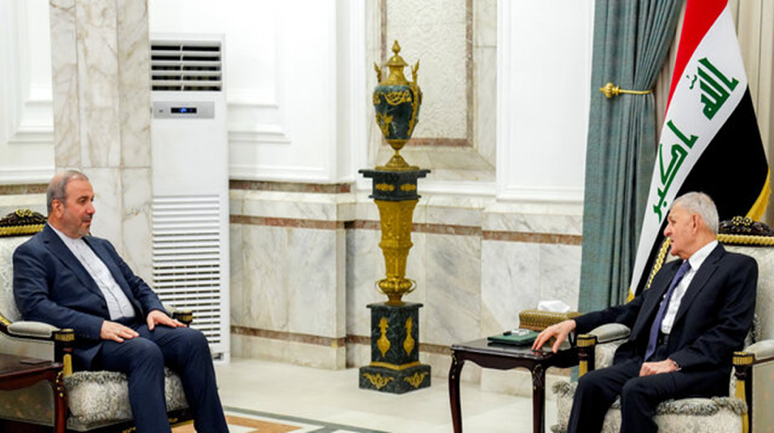 The Iranian ambassador to Baghdad meets with the Iraqi president (ISNA, December 2, 2025)
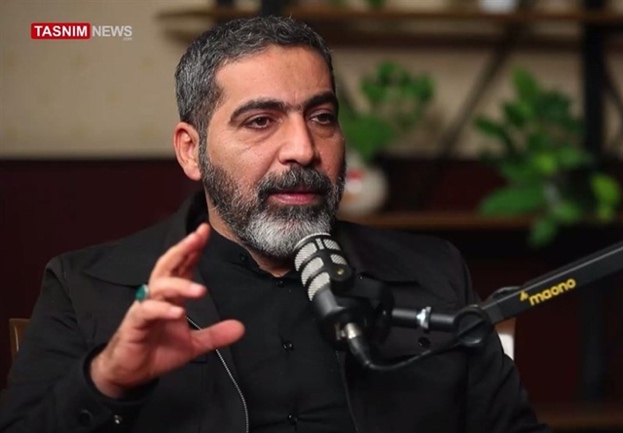 Firas al-Yasser (Tasnim, November 30, 2025)
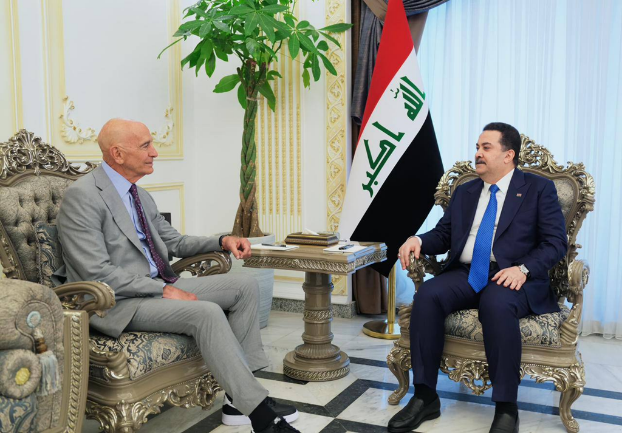 Al-Sudani and Barrack meeting (Telegram channel of the Iraqi Prime Minister’s Office, November 30, 2025)
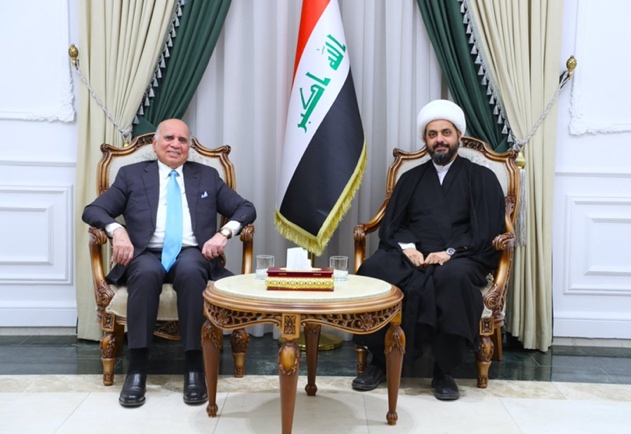 Al-Khazali’s meeting with Foreign Minister Hussein (Qais al-Khazali’s X account, December 1, 2025)Highlights[1]
In a public letter on the occasion of the “Day of Solidarity with the Palestinian People,” the Iranian President called for a solution to the Palestinian problem based on an end to the “occupation,” the return of the Palestinian refugees, and the realization of their right to self-determination.
Iran’s ambassador to Lebanon said that Hezbollah secretary-general Naim Qassem’s remarks that the organization would respond to the elimination of the organization’s chief of staff, Haytham Ali al-Tabatabai, indicated a change in Hezbollah’s strategy toward Israel.
Iran has reportedly transferred hundreds of millions of dollars to Hezbollah over the past year through a network of businesses in Dubai.
Political tension between Iran and Lebanon following the remarks of the senior advisor to the Supreme Leader of Iran, who claimed that Hezbollah’s existence is more vital to Lebanon than bread and water. However, the Iranian Foreign Ministry spokesperson reasserted that Tehran does not interfere in Lebanon’s internal affairs.
Iran and the Houthis condemned the IDF activity to arrest terror suspects in Beit Jinn in southern Syria. The Iranian Foreign Ministry praised the “resistance” of young Syrians in the face of “Israeli aggression.”
It is claimed that against the backdrop of the reorganization of the Houthi movement, competition has developed between two different approaches regarding the future of relations with Iran.
A senior official in a pro-Iranian Iraqi militia said they are working in cooperation with the Houthis to renew their military capabilities and threatened that they are preparing an updated list of targets that would “hurt the usurping entity [Israel]” if a new campaign broke out. The US special envoy to Syria and Lebanon reportedly warned the Iraqi Prime Minister that Israel would attack in Iraq if the militias helped Hezbollah in the event of an Israeli action against the organization.
The senior Shiite parties in Iraq reportedly decided to prevent the integration of militia-affiliated figures in the new government due to American pressure and in order to gain international recognition.
Iran and the Militias amid Developments in the Palestinian Arena
Iran
Iran’s Supreme Leader Ali Khamenei said in a televised speech that Israel’s attacks in the Gaza Strip, the West Bank, Lebanon, and Syria are all supported by the United States. He noted that without the US, “the Zionist regime” would not be capable of causing all the “disasters” it has caused. Khamenei also said that the element of “resistance,” which began in Iran, has expanded and grown, and today on the streets of Western countries, they are chanting slogans in favor of “resistance” in the Gaza Strip and in “Palestine” (Iranian Supreme Leader’s website, November 27, 2025).
Iranian Foreign Ministry spokesperson Esmail Baghaei strongly condemned “the ongoing crimes of the Zionist regime in the West Bank” and “the killing and torture of the residents.” Referring to the ongoing attacks by “Zionist soldiers and settlers” on the refugee camps in Nablus and Jenin, the killing of Palestinians, the arbitrary arrests of residents of the West Bank, and the demolition of the homes and fields of Palestinian farmers, Baghaei called on the international community to turn its attention to the “barbaric crimes taking place in this part of occupied Palestine” and to address the “grave violations” of the human rights of the Palestinians. He stressed the need to document each of these “crimes” as crimes against humanity and to prosecute the “Zionist criminals” (Iranian Foreign Ministry Telegram channel, November 28, 2025).
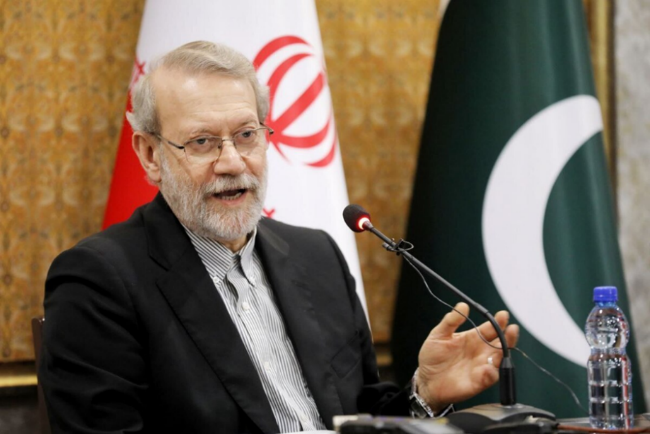
In an interview with the Pakistani network HUM News, the secretary of Iran’s Supreme National Security Council, Ali Larijani, said that what Iran is proposing to the Palestinian problem is a “democratic solution” and that the Palestinian people do not need a guardian and must decide for themselves in democratic elections which regime they want. He added that the management of the Gaza Strip must be carried out by the Palestinians themselves and that the border security forces should not interfere in the internal affairs of the Gaza Strip. Referring to the demand to eliminate Hamas, he said Hamas is part of the Palestinian people in the Gaza Strip (snn.ir, November 28, 2025).
Ali Larijani (snn.ir, November 28, 2025)
Iranian President Masoud Pezeshkian sent a letter to the countries of the world on the occasion of the International Day of Solidarity with the Palestinian People (November 29). In the letter, the President stressed the Islamic Republic’s firm support for the Palestinian people to realize their aspirations. He noted that November 29 commemorates eight decades of “occupation of Palestinian land” by “Israel’s oppressive regime,” the ongoing pain and suffering of the Palestinian people, and the continued injustice against the oppressed people. He also wrote that this day reminds us of the moral and legal duty of governments and peoples around the world to support and defend the rights of the Palestinian people, and that it clearly proves the inability of international organizations to deal with Israel, which he claims poses the greatest threat to peace and security in the world. The Iranian President wrote that Iran believes that the only solution to the Palestinian problem is an end to the occupation of the historic land of the Palestinian people, the return of the Palestinian refugees, and the realization of their right to self-determination, and that Iran’s plan is based on holding a referendum among the original inhabitants of “Palestine”: Muslims, Christians, and Jews, in accordance with democratic principles and international law, and on the basis of the realization of the right of self-determination and the right of return of all Palestinian refugees to their country (Mehr, November 30, 2025).
The Houthis
Houthi leader Abd al-Malik al-Houthi claimed in a speech marking Evacuation Day in Yemen, which commemorates the departure of the last British soldier from South Yemen, that the Western system sought “to enable the Zionist enemy to occupy Palestine as a prelude to implementing the vision of the Greater Land of Israel and turning it into their representative in the region.” According to him, the current phase of “Zionist aggression” is an extension of the Western expansionist approach. Al-Houthi added that “the Zionist regime has been exposed by its crimes against the Palestinian people and its aggression in Lebanon, Syria, and Yemen, which continue in disregard of ceasefire agreements.” He claimed that the “Zionist enemy” is attempting to use American cover to fully occupy the Gaza Strip, “uproot” Palestinians from their areas, and gain control over Lebanon and Syria. He noted that Houthi forces and the Yemeni people have led support for the steadfast stand of Gaza Strip residents and the confrontation with the “aggression,” emphasizing that they continue preparations in the military sphere and have no intention of halting the struggle (Al-Masirah, November 30, 2025.
The Houthi Foreign Ministry issued a statement condemning the “ongoing violation” of the ceasefire agreement in the Gaza Strip by the “enemy entity” by carrying out “genocide” against the Palestinian people in the Gaza Strip, as well as the “ongoing aggression” against the West Bank (Telegram channel of the Houthi Foreign Ministry, November 28, 2025).
Iran and the Lebanese Arena
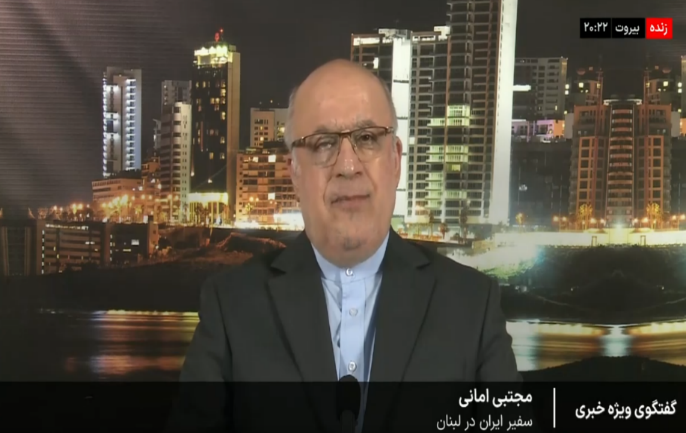
Iran’s ambassador to Lebanon, Mojtaba Amani, referred to the threat of Hezbollah secretary-general Naim Qassem that the organization has the right to respond to the assassination of its de facto chief of staff, Haytham al-Tabatabai, and that Hezbollah will determine the timing for doing so. The ambassador noted that Qasem’s remarks indicate a change in Hezbollah’s strategy toward the “Zionist regime.” According to Amani, Israel has the best and most advanced means, but on the other hand, while Lebanon and the countries that oppose Israel have a certain degree of military force, they rely mainly on willpower and determination. He emphasized that the “resistance” in Lebanon, especially Hezbollah, has demonstrated strategic patience to make it clear to all parties that Israel is untrustworthy and does not abide by any agreements. Amani added that Israel enjoys full immunity from prosecution for its actions, and that the lack of international enforcement in Lebanon and the Gaza Strip justifies the existence of armed “resistance.” Regarding calls to disarm Hezbollah, the ambassador said this demand has existed for years, but the reality on the ground in Lebanon – and especially the inability to formulate a national defense strategy – has caused Hezbollah to continue bearing the burden of defense (snn.ir, November 29, 2025).
Iran’s ambassador to Lebanon (snn.ir, November 29, 2025)
In the past year, Iran has reportedly transferred hundreds of millions of dollars to Hezbollah in Lebanon through a network of businesses in Dubai. According to the report, the Iranian funds are transferred to companies, businessmen, and couriers in Dubai, deposited with a merchant in Dubai, withdrawn immediately by a merchant in Lebanon, after which both sides delete the accounts (Wall Street Journal, November 27, 2025).[2]
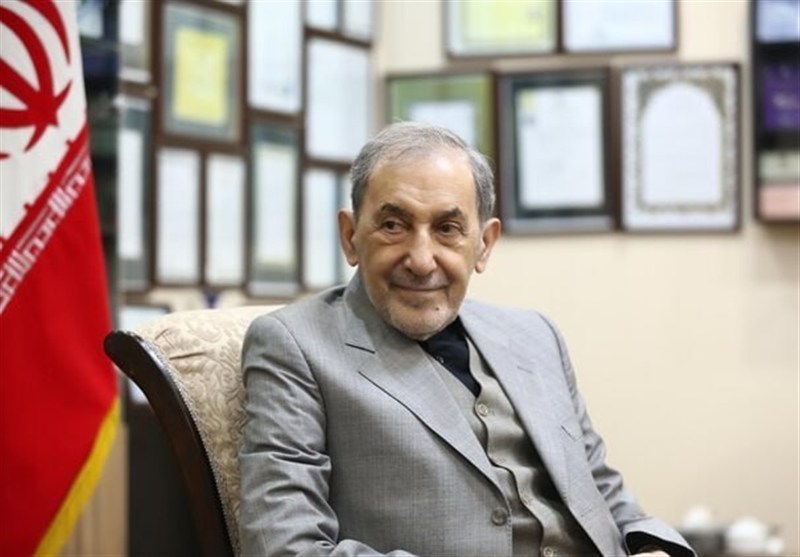
The Supreme Leader’s senior advisor on international affairs, Ali Akbar Velayati, condemned Israel’s “ongoing violations” of the ceasefire in Lebanon. Referring to the elimination of al-Tabatabai, Velayati claimed that it was carried out in violation of Lebanese sovereignty. He added that given Israel’s appetite for “killing and looting” in other territories, Hezbollah’s existence is currently vital to Lebanon “more than bread and water” (Tasnim, November 26, 2025). Lebanese Foreign Minister Youssef Rajji protested Velayati’s remarks, noting that he believed Iran was not interfering in Lebanon’s internal affairs until Khamenei’s advisor appeared “to enlighten us on what truly matters in Lebanon.” He stressed that what is more important to Lebanon than bread and water is its sovereignty, freedom, and independence in making its own decisions (Lebanese foreign minister’s X account, November 26, 2025).
Ali-Akbar Velayati (Tasnim, November 26, 2025)
Iranian Foreign Ministry spokesperson Esmail Baghaei reasserted at his weekly press conference that Iran does not interfere in Lebanon’s internal affairs. He noted that Iran’s support for the Lebanese “resistance” and its natural right to defend itself against “aggression” is within the framework of the principles accepted by all UN members, and that Iran fully understands Lebanon’s difficult situation, especially due to its proximity to Israel and its daily response to its attacks. He also said that the real intervention in Lebanon is carried out by parties that place demands on the various groups in the country and interfere in its internal affairs by threatening the use of force (Tasnim, December 1, 2025).
Iran and the Militias amid Events in Syria
Iran
Iran condemned the IDF operation in the Beit Jinn area in southern Syria, during which several armed militants were killed in an arrest raid targeting terror operatives planning attacks against Israel. The Iranian Foreign Ministry warned of the consequences of the “serious violations” of international law by the “Zionist regime,” the expansion of its “crimes” in the region, and the UN Security Council’s indifference to Israeli strikes on regional countries, including Syria and Lebanon, which harm global peace and stability. It further stated that the Syrian youths’ “resistance” against the “Zionist soldiers” is a “natural and legitimate response to Israeli aggression” (Iranian Foreign Ministry Telegram channel, November 28, 2025).
The Iranian media covered the incident in Beit Jinn extensively. An article in the hardline newspaper Vatan Emrooz noted that while the al-Shara regime is aligning itself with Israel and acting against the “resistance,” some young Syrians are choosing a different path associated with the “resistance,” concluding that if they do not oppose the “Zionist regime,” Syria too may become part of the areas occupied by Israel. According to the newspaper, this is the first time signs of anti-Israel resistance have appeared in regions that the Tel Aviv authorities claim are under Israeli influence. The incident, it argued, demonstrated to Israel that southern Syria is a rapidly changing environment that may produce local anti-Israel actors supportive of the “resistance”, actors who cannot be easily contained. The article added that even in a post-Assad era, Israel continues to face growing resistance that cannot be ignored, and that Syrian territory is no longer safe for the “occupying forces.” This means that even if a regime aligned with the United States and the “Zionist regime” is established in Syria, the country could, at any moment and by the will of the people, without any political intervention from the rulers in Damascus, enter a new phase of confrontation with the “Zionist enemy” (Vatan Emrooz, November 30, 2025.
The Houthis
The Houthi Foreign Ministry strongly condemned the “ongoing Zionist aggression” against Syria in response to the “incursion by the enemy entity” into the town of Beit Jinn and the accompanying attacks on residents and their property. The ministry stated that it views the “Zionist aggression” against Syria as a “flagrant violation” of the sovereignty, independence, and territorial integrity of the Syrian Arab Republic, contravening the UN Charter and all international norms, conventions, and laws. Finally, the ministry affirmed the Republic of Yemen’s unwavering support for the Palestinian and Syrian peoples and its solidarity with them in the face of the “brutal Zionist aggression” (Houthi Foreign Ministry Telegram channel, November 28, 2025).
Iran and the Iraqi Arena
Iran’s ambassador to Baghdad, Mohammad Kazem Al-e Sadeq, met with Iraqi President Abdul Latif Jamal Rashid. The two discussed strengthening ties between the two countries and further coordination on common issues. The Iranian ambassador stressed the need to expand cooperation between the countries in various fields (ISNA, December 2, 2025).
The Iranian ambassador to Baghdad meets with the Iraqi president (ISNA, December 2, 2025)
The Houthis in Yemen
Ties between the Houthis and members of the “axis of resistance”
“Knowledgeable sources in Yemen” claimed that there are differences of opinion among the Houthis regarding the movement’s continued ties with Iran. According to the report, the Houthi movement is in a stage of reorganization, in which there is competition between two conflicting approaches regarding the scope of the relationship with Iran and the level of independence that the Houthis should maintain in the next stage: the “independence stream,” comprising young field commanders and influential figures, who believe the movement has reached a status in which it can make its own military decisions without turning to Iran, which has lost its power; and the “full ties stream,” which includes the ideological and cultural leaders among the Houthis, who view Iran as a strategic guarantee for the Houthis’ continued existence and argue that any attempt to separate from it would place the Houthis in a regional and international confrontation they cannot sustain. A “Yemeni political source,” claimed to be knowledgeable about these discussions among the Houthis, emphasized that it is exaggerated to speak of a full rebellion within the Houthis, but it is accurate to say there is no single opinion regarding dealing with Iran (Aram News, November 26, 2025).
In his speech, Hezbollah secretary-general Naim Qassem referred to the organization’s de facto chief of staff, Haytham Ali al-Tabatabai, dwelling on his activities alongside the Houthis. Qassem noted that al-Tabatabai was in Yemen from 2015 to 2024 to assist the Houthis in training and preparation.[4] He said that the senior Hezbollah official “left a significant mark, and today the Yemeni people love him very much because they recognize this divinely inspired, courageous and resilient figure, who sought to support Palestine and worked for the liberation of the land and the freedom of humanity.” According to Qassem, Qassem Hussein Barjawi, who served as the director of al-Tabatabai’s office and was killed along with him and three other operatives in the Israeli attack on Beirut’s Dahiyeh, also stayed with al-Tabatabai in Yemen and assisted him (Al-Nur Radio, November 28, 2025). Following Qassem’s remarks, Hezam al-Asad, a member of the Houthis’ political bureau, stated that it is the right of the Republic of Yemen (Houthis) to bring in experts and develop any weapons or military technologies it desires without needing approval from anyone. According to him, the connection between the Houthis and the “axis of resistance” is principled and rooted in faith-based steadfastness, and if the US has the right to ally with the “infidel” West and regional regimes to protect the “Israeli occupation,” then the honorable people of the Islamic nation have the right to unite to confront the “American and Zionist hegemony” (Hezam al-Asad’s X account, December 1, 2025).
Firas al-Yasser, a member of the political council of the pro-Iranian Nujaba movement in Iraq, claimed that the Iraqi “resistance” is cooperating with the Houthis in Yemen for the purpose of “renewing weapons and military technologies,” as preparation for any future action. In an interview with the Iranian news agency Tasnim, al-Yasser said that the Houthis’ advanced development of missile technologies, precision operations, and GPS technologies opens space for broader cooperation from which the militia can benefit in developing its own capabilities (Tasnim, November 30, 2025).[5]
Firas al-Yasser (Tasnim, November 30, 2025)
Houthi preparations for fighting
Houthi leader Abd al-Malik al-Houthi claimed in a speech marking Yemen’s Evacuation Day that the “enemies” – Israel, the United States, and Britain – aspire to remove any obstacle in the region that delays the transformation of the Middle East, the meaning of which is the “submission” of all the region’s states. According to him, the “enemies” are preparing for a new round of “aggression,” and it is necessary to prepare for this in every possible way (al-Masirah, November 30, 2025). In a congratulatory letter sent by the Houthi minister of defense, Muhammad Nasser al-Atifi, and the chief of staff of the Houthi forces, Yusuf Hassan al-Madani, to the movement’s leader on the occasion of Evacuation Day, they stated that their forces “will fulfill the people’s just right to defend themselves and to make the aggressors’ land tremble.” The two stressed that “the forces will defeat any party that tries to overcome the sovereignty and destiny of our people. The forces of evil — among them America, Britain, and the criminal Zionist entity — must understand that the decisive moment is approaching, and their fate and punishment will be severe” (al-Masirah, November 29, 2025).
The Pro-Iranian Militias in Iraq
The US envoy to Iraq, Mark Savaya, stated that Iraq can play a greater role in the region if the problem of weapons outside state control is fully resolved. According to him, Iraq now has an opportunity to close this chapter and strengthen its image as a state built on the rule of law rather than the power of armed groups. Savaya added that the country is at a critical crossroads, and that what is now required is support for the state and commitment, along with cooperation that will make it possible to distance weapons from politics (Mark Savaya’s X account, November 27, 2025).
Subsequently, “high-ranking Iraqi sources” reported that in a meeting between Iraqi Prime Minister Muhammad Shia al-Sudani and the US special envoy for Syria and Lebanon, Tom Barrack, the senior American diplomat urged al-Sudani to control the militias in the country. According to the report, Barrack sought to convey a message to the Coordination Committee of the Pro-Iranian Parties, according to which the militias must be controlled and any economic or military activity that might support Hezbollah in Lebanon must be stopped. It was also claimed that against the background of the possibility of Israeli action against Hezbollah, Barrack stressed that Iraq, and especially the militias, should remain out of any escalation in the region (Al-Araby Al-Jadeed, December 1, 2025). In response, “political” sources in Iraq said that the meeting dealt mainly with the Syrian issue and that there was no basis for a report that Israel would attack in Iraq if any party intervened alongside Hezbollah in the event of a military operation in Lebanon (Al-Mayadeen, December 1, 2025).
Al-Sudani and Barrack meeting
(Telegram channel of the Iraqi Prime Minister’s Office, November 30, 2025)
In this context, Firas al-Yasser, a member of the political council of the pro-Iranian Nujaba movement in Iraq, claimed that the “Iraqi Islamic resistance” is in the process of updating its goals that will be “effective and painful for the usurping entity [Israel] and the American presence in the region” if a new campaign breaks out. He added that the security activity includes fortifying headquarters, using innovative technologies in the field of communications, and strengthening the defense of military centers. He also warned that the movement is not willing to accept the presence of American forces in Iraq and does not rule out the renewal of attacks on American bases at any moment (Tasnim, November 30, 2025).
American pressure on Iraq is increasing against the backdrop of talks to form a new government in Iraq following the achievements of the Shiite parties in the parliamentary elections. It was reported that due to the American position, the senior Shiite parties in Iraq decided to prevent any figure connected to the militias from being appointed a minister in the next government. In addition, “sources in the Coordination Committee of the Pro-Iranian Parties” stated that the decision stemmed from an aspiration to establish a government with international recognition, noting that the militias had accepted the decision and understood the importance of maintaining ties with the United States (The New Region, December 1, 2025).
Qais al-Khazali, secretary-general of the Asa’ib Ahl al-Haqq militia, met with Iraqi National Security Advisor Qassem al-A’raji and discussed developments in the political arena following the elections. The two reportedly stressed the importance of continuing to implement the security agreements regarding the withdrawal of foreign forces from the country, describing it as “a fundamental step to strengthen national sovereignty” (Qais al-Khazali’s X account, November 26, 2025). Al-Khazali also met with Iraqi Foreign Minister Fuad Hussein, noting that cooperation between the national forces would lead to stability in the country and enable it to better deal with challenges. They also stressed the need to expedite the formation of the government in accordance with the will of the people (Qais al-Khazali’s X account, December 1, 2025).
Al-Khazali’s meeting with Foreign Minister Hussein (Qais al-Khazali’s X account, December 1, 2025)
The Coordination Committee of the militias in Iraq denied involvement in a drone attack that hit storage tanks in the Khor Mor gas field in the Kurdish region of northern Iraq on November 26, 2025, causing the suspension of its activity. The committee claimed in its statement that “malicious parties who seek to shuffle the cards and cover up the conflict in the region” are behind the reports that the militias are responsible for the attack. According to the committee, attacking civilian sites is not on the agenda of the “resistance,” since its weapons are always aimed at the “occupation.” The committee also expressed its willingness to participate in the investigation of the ongoing attacks, especially those related to damage to national infrastructure and resources (Telegram channel of the Coordination Committee of the militias in Iraq, November 29, 2025).
[1] The weekly study includes the activities of Iran, the Shiite militias in Iraq, and the Houthis in Yemen.
[2] For further information, see the ITIC’s study from November 14, 2025, “Iran Assists Hezbollah’s Post-Ceasefire Reconstruction”
[3] For further information, see the ITIC’s study from August 18, 2025, “Iranian Backing for the Houthis during the Gaza Strip War: The Seizure of the Al-Sharwa as a Test Case”
[4] For further information on Houthi-Hezbollah relations, see the ITIC’s study from March 14, 2023, “The Houthi Movement and the War in Yemen: Development and Significance”
[5] For further information, see the ITIC’s study from August 5, 2024, “Cooperation between the Shi’ite militias in Iraq and the Houthis in Yemen”
Related Articles