
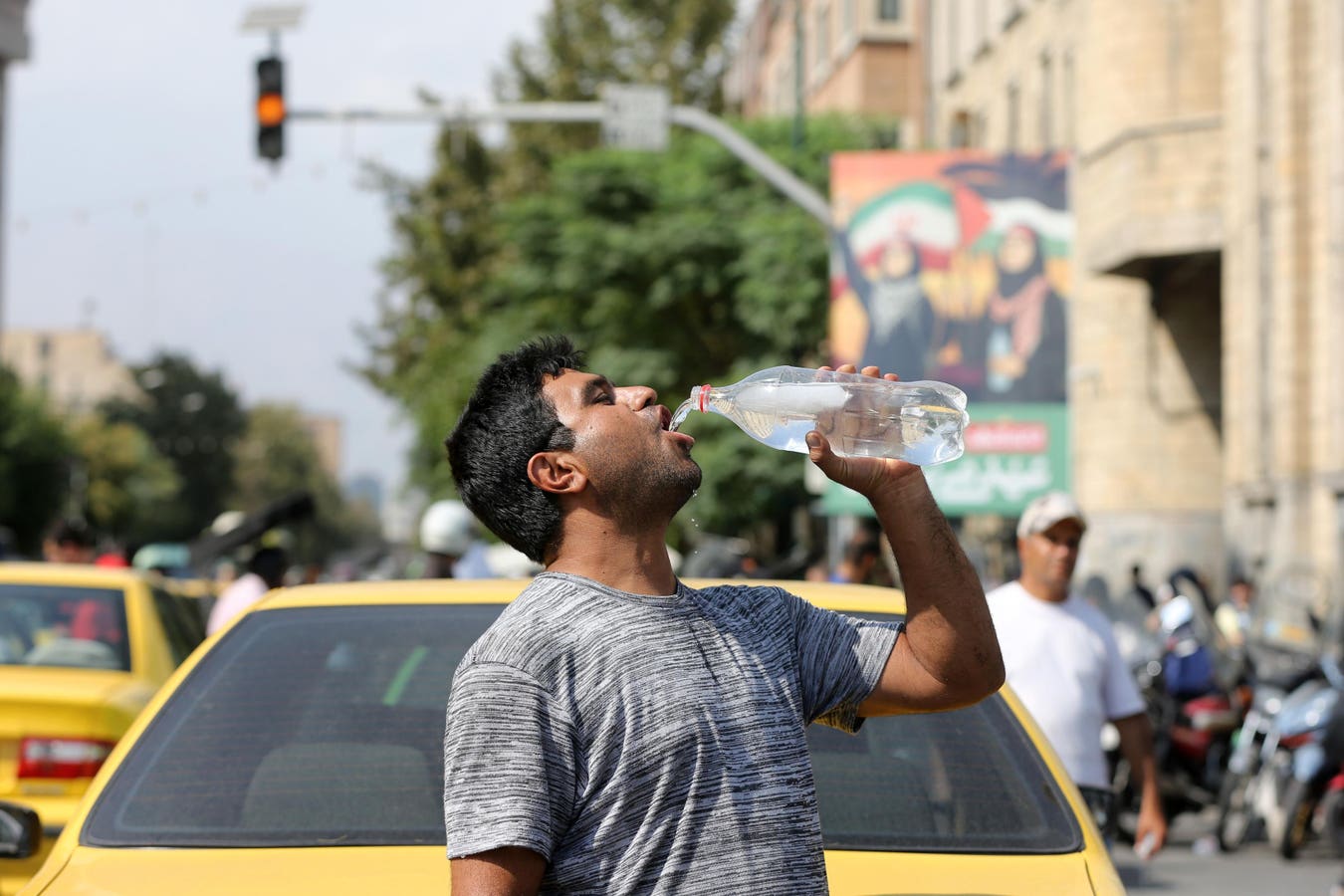
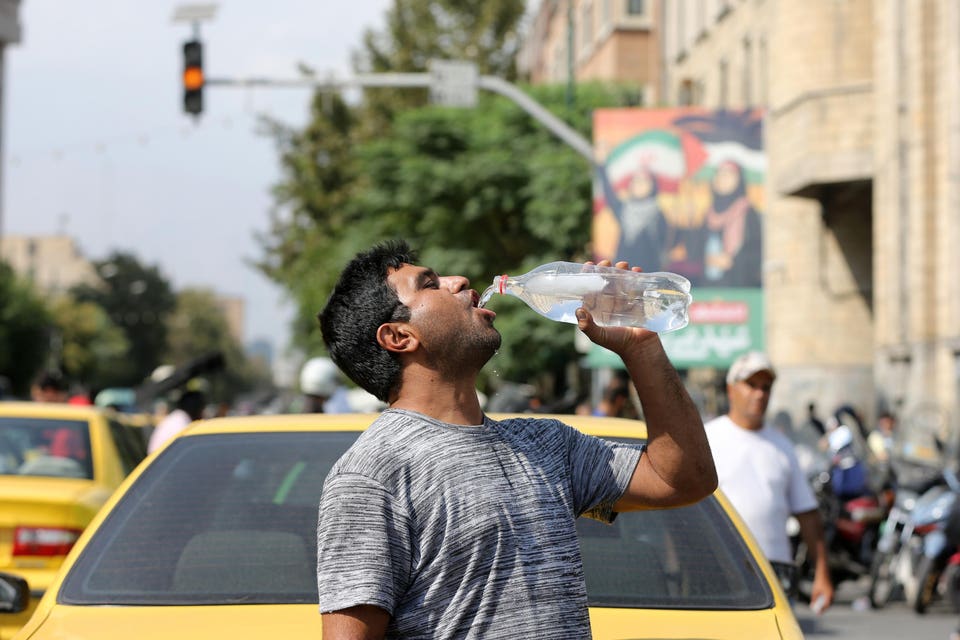
A man drinks water to cool off on a street in Tehran, Iran, Aug. 11, 2025. Iran’s President Masoud Pezeshkian warned in November that parts of the country, including the capital Tehran, are faced with a serious water crisis and evacuation would be necessary if the drought continues (Photo by Xinhua via Getty Images)
Xinhua News Agency via Getty Images
Tehran, a metropolis of over 15 million people, is now regularly mentioned as a city that is nearing its “Day Zero” – the moment when a city’s taps run dry. This is not unprecedented for a major city. All cities that have recently faced Day Zero, such as Cape Town (South Africa), Chennai (India), São Paulo (Brazil), Mexico City (Mexico), and Bogotá (Colombia), have a combination of climatic and decision-making drivers to blame. But each of them has some unique aspects that have stories to be told.
Iran is now in its sixth consecutive year of severe drought. Rainfall in the capital in the first two months of the current water year has been close to zero and extremely drier than normal. The main reservoirs supplying Tehran are at critically low levels, with some operating in the single digits of their storage capacity. Groundwater, the country’s long-term strategic reserve, has also been overdrawn for decades.
Officials have already reduced water pressure, imposed cuts, and openly discussed rationing, evacuation, and even moving the capital if the rain does not return. Here are six of the most frequent – and the answers that matter for Tehran to better understand what is going on in Iran, a country whose stories are often too politicized to reveal the ground truth.
1. Is this due to climate change or mismanagement?
Both played a major role, but the failure must not be climatized.
Iran is an arid and semi-arid country. Climate change is now making it hotter and drier, increasing evapotranspiration and the likelihood of extreme droughts. But even in a stable climate, the current situation at the national level would have been inevitable at some point under the country’s development model. For decades, successive governments expanded irrigated agriculture and urban growth as if water were limitless, often in the dry regions of the country, and treated warnings from scientists as politically inconvenient noise.
What we see today is no longer a water crisis but a “water bankruptcy” – a failure state for a system that withdrew more water than nature could repay for an extended period, depleting rivers, lakes and aquifers in the process. Extreme drought is now the harsh auditor uncovering this long-running bankruptcy, not its original cause. Invoking climate change as the main explanation is politically convenient because it dilutes accountability. But it is the combination of bad policies and a changing climate that has pushed Tehran and other parts of Iran to their edge.
2. Is Iran’s weather being manipulated?
There is no credible evidence that Iran is the victim of hostile weather manipulation.
In recent years, some Iranian officials and security agents have blamed “cloud theft,” foreign enemies, sophisticated weather warfare, and the High-frequency Active Auroral Research Program (HAARP) of the United States for abnormal rainfall patterns. These claims are scientifically unfounded and distract from real causes. Large-scale climate and weather systems are driven by planetary-scale processes. No state has a proven capability to selectively shut off rainfall over a country as large as Iran without affecting its neighboring countries and the rest of the region.
Conspiracy theories encourage people to look at the sky instead of decades of over-extraction, unsustainable development, and poor governance on the ground. Blaming enemies might be politically useful, but it does nothing to refill empty reservoirs.
3. Can evacuating or relocating Tehran help?
Temporary evacuation might work in an emergency, but it is not a solution.
If Tehran fully runs out of water, moving people – temporarily or permanently – can reduce the pressure on the system and delay Day Zero. Indeed, Iranian officials have been very good at using painkillers and band aids to hide the symptoms of chronic diseases. In periods of excessive air pollution or peak electricity demand, prolonging the weekends and shutting down schools and government offices have been effective in reducing the population of Tehran and alleviating the problem. If Tehran has only a few days or weeks of water left, any temporary reduction in water use can help officials buy time until there is some rain.
But relocation does not create new water; it simply moves demand from one stressed system to another. Iran’s water bankruptcy is national, not just urban, and about Tehran. Many other cities are already struggling, and many other population groups, especially farming and rural communities, have been living with water interruptions and shortages for years. Without structural reform, moving Tehran is like transferring a critically ill patient to another bed in the same collapsing hospital.
4. Will Tehran’s Day Zero lead to protests or the collapse of the Islamic Republic?
Water crises are powerful risk multipliers, but they are not automatic regime-change machines.
Iran has already seen how dry rivers and empty dams can bring people into the streets in places like Khuzestan and Isfahan. When taps run dry while fountains flow in wealthier neighborhoods, when farmers are told to stop pumping while politically connected projects continue, water scarcity becomes a symbol of something deeper: injustice, corruption, and broken promises. In that sense, Tehran’s Day Zero clearly increases anger, dissatisfaction, and mistrust. But these do not always translate into a sustained uprising or the collapse of regimes. On the contrary, the people who are struggling with meeting their basic water and sanitation needs might not have the bandwidth to fight for freedom and justice. If that was an automatic reaction of humans, protests and unrest should have been the common sight of all those cities and countries in the world that are doing worse than Tehran and Iran, which, unfortunately, are not few globally.
Environmental stress and water bankruptcy can weaken any government, but they do not write the script of what comes next. Celebrating drought and the misery of Iranians because of the possibility of Islamic Republic’s collapse is a dangerous delusion. Even if the political system changes overnight, the aquifers will still be depleted, the dams will still be low, and the climate will still be hotter and drier. Any future government will face the same basic equation: less water, more demand, and a shrinking margin for error. That is why serious adaptation and governance reform are not optional, regardless of who is in power.
5. Can cloud seeding save Tehran?
Cloud seeding is not a magic tap; at best, it is a marginal, unreliable tool.
Although there is no strong scientific consensus, some believe that cloud seeding can potentially enhance rainfall from suitable clouds by a modest percentage. But it certainly cannot make rain from nothing, guarantee where exactly the rain will fall, or compensate for a multi-year, national-scale water deficit.
The ambition of fertilizing clouds is not new in Iran. It dates back to the late 1940s, when Iran attempted to increase rainfall through a partnership with the Americans. Not surprisingly, it did not work. Since then, the dream has been pursued, especially in the desperate times of multi-year droughts.
Politically, cloud seeding sends a tempting message: “We are doing something.” Technically and economically, it can be a costly distraction. It also misleads those in charge who prefer an expensive magical engineering solution to politically costly policy solutions. When reservoirs are at historic lows and aquifers are depleted, the only realistic path is to reduce demand, increase efficiency, and restore damaged ecosystems through fundamental reforms to the way water is being managed, not to bet on the next flight of seeding planes.
6. What are the real solutions?
Avoiding collapse requires both emergency measures and long-term restructuring.
Tehran’s Day Zero risk is a symptom of a deeper national failure. In the short term, rain and reduced consumption are the only two things that can help. For the former, the Iranians must get luckier. For the latter, the Islamic Republic officials need the users to cooperate. Actions need to go beyond water rationing and alarmism. They need to earn the trust of the people through increased transparency, proper communication, and admitting to mistakes, rather than blaming the weather and enemies.
Over the long term, Iran must pivot from a resistance economy to a resilience economy, a mission that is hard to accomplish under international sanctions and as long as the country is unable to reach a resolution on its nuclear program to end its economic isolation.
Iran needs to reduce the pressure of its economy on its water and other natural resources through economic diversification and growth in the industrial and service sectors. Most importantly, Iran needs to radically decrease its agricultural water use, currently over 90 percent. Obviously, this is not trivial when the country is concerned about its food security under international pressure, and water is used to create employment opportunities for the poor.
The Iranian government must also end its “hydraulic mission” mindset of solving every problem with another dam or water transfer canal. Of course, the country must benefit from the best available technologies, such as reducing water leakage in the water distribution network, wastewater recycling and reuse, and even desalination where appropriate, environmentally and logically, after exhausting all other options. But technological interventions can only function when they are combined with proper measures that make development sustainable and peaceful.
Tehran’s looming Day Zero is not a natural disaster that struck without warning. It is a final reminder from a water system that has been overused, ignored, and abused for decades. Whether this moment becomes the beginning of Iran’s adaptation story – or the point of no return – depends less on the clouds above Tehran than on the decisions made in its corridors of power.