
After months of finagling, fine-tuning, haggling and political pressure, the government late last month finally came out with proposed legislation meant to find a way to put some ultra-Orthodox men in military uniform while giving others a pass.
If the proposal is enacted, boosters say over 30,000 Haredi men would enlist in either the army or civilian security services by 2030, an impressive-sounding achievement for a community that currently accounts for only a few thousand recruits a year.
Impressive, that is, so long as it’s not compared to the total eligible cohort of draftees, which is thought to contain more than twice that number.
And that’s before one gets into the carveouts and lower target percentages that put the actual number of army recruits by 2030 at around 21,000. That’s technically tens of thousands, but not much to write home about.
The numbers are just one aspect of a bill that critics is say is chock-full of loopholes and feints, imposing ineffective sanctions that do little to encourage enlistment and enshrining policies that actively discourage societal integration, allowing politicians to look like they are addressing the issue but essentially restoring the situation to where it was before the court deemed blanket exemptions illegal.
Get The Times of Israel’s Daily Edition
by email and never miss our top stories
By signing up, you agree to the terms
Presented to lawmakers on November 27, Knesset Foreign Affairs and Defense Committee chairman Boaz Bismuth’s latest revision of the controversial legislation lists its goal as “regulat[ing] the status of full-time yeshiva students while recognizing the importance of Torah study.”
The bill is a top demand by Prime Minister Benjamin Netanyahu’s erstwhile ultra-Orthodox government partners, who are seeking a law that allows Haredi men to opt out of mandatory military service in favor of Torah study, protecting longstanding exemptions that courts and most other Israelis have sought to end.
Some 80,000 ultra-Orthodox men aged between 18 and 24 are currently believed to be eligible for military service but have not enlisted. The Israel Defense Forces has said it urgently needs 12,000 recruits due to the strain on its standing force and reservists against the backdrop of the war in Gaza and other military threats.
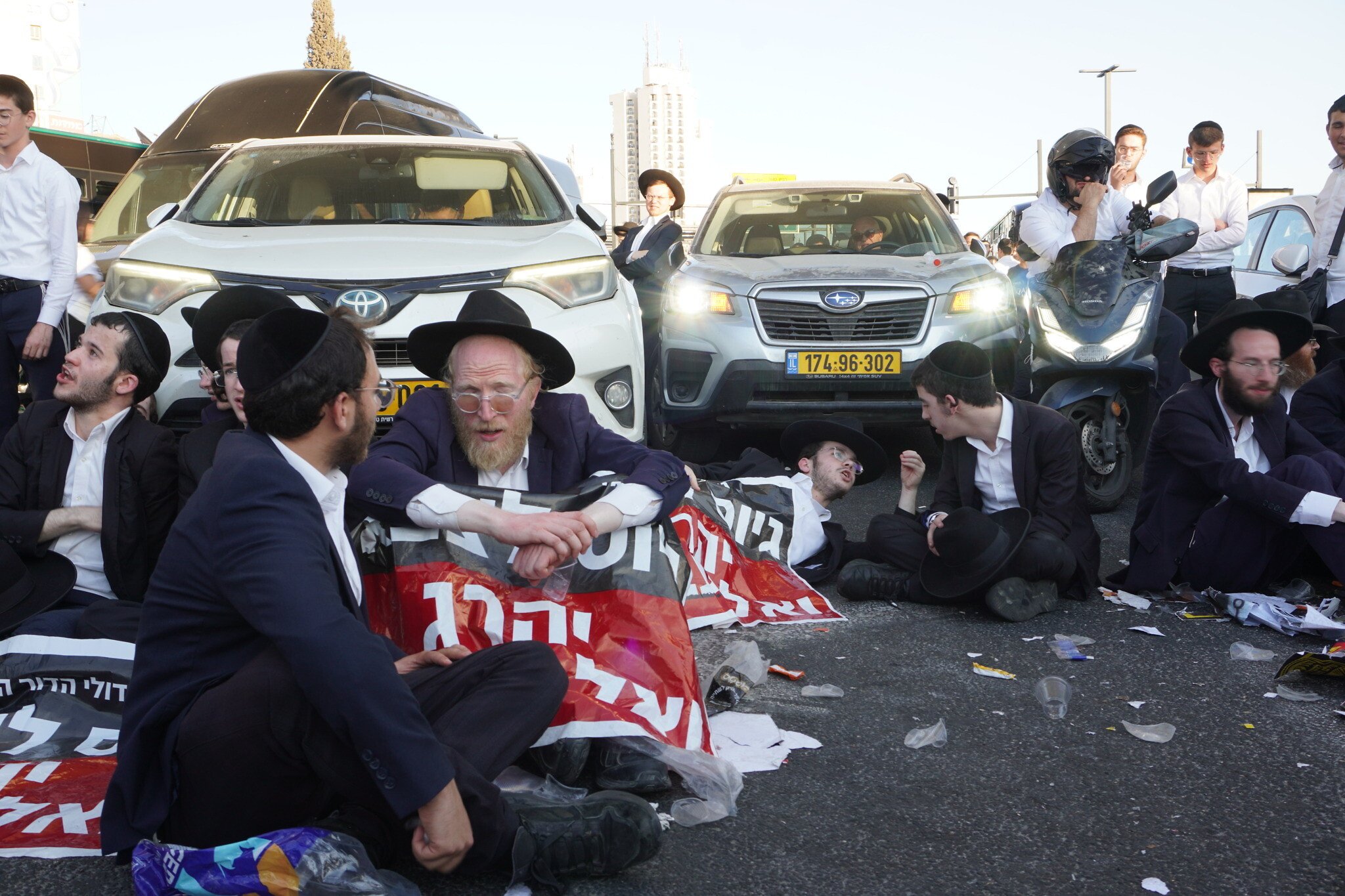
Haredi protesters demonstrate against efforts to draft yeshiva students into the IDF at the entrance to Jerusalem on July 23, 2025. (Charlie Summers/Times of Israel)
In June 2024, the High Court issued a ruling ordering the government to start conscripting Haredi men. Since then, yeshivas harboring draft dodgers have seen their budgets slashed, draft refusers have lost access to daycare subsidies for their children and other benefits, and the IDF has begun arresting small numbers of evaders, including some attempting to leave the country.
However, if passed into law, Bismuth’s bill would effectively reset the status of yeshiva students who ignored call-up orders over the past year, while yeshivas would immediately receive half of their pre-ruling funding, easing economic and legal pressure on the community.
“The Haredim will immediately regain financial support, daycare discounts, and National Insurance benefits [as well] as support for yeshivas [and the cancellation] of all enforcement procedures against draft dodgers under the current law,” said Stav Livne Lahav, the head of the policy and legislation department at the Movement for Quality Government, a government watchdog that has petitioned the court to conscript Haredim.
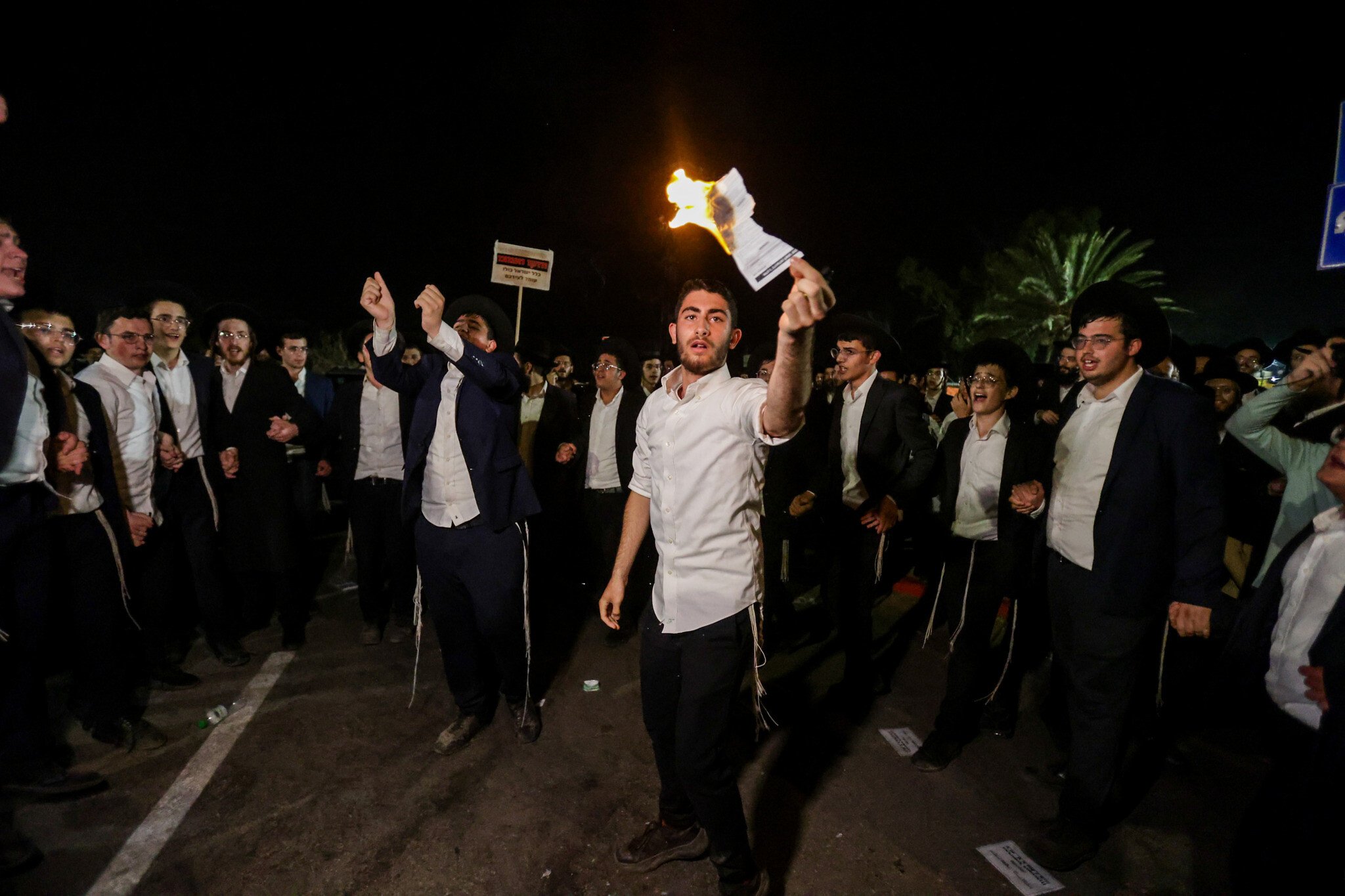
Ultra-Orthodox demonstrators burn enlistment orders at a demonstration outside the Beit Lid military prison, August 14, 2025. (Tal Gal/Flash90)
The proposed legislation stipulates that full-time yeshiva students who do not engage in any other vocation can be granted yearly deferments from enlistment, but removed various provisions from a previous draft that were intended to ensure that those registered for yeshiva study are actually doing so.
Those who receive deferments would be subject to sanctions related to travel, which critics say are largely irrelevant and would be lifted by age 26. Harsher sanctions affecting various subsidies would only kick in if enlistment levels fall short of targets, a provision that may rest on shaky legal ground, an expert said.
And by restricting deferments to those in yeshiva full time, the legislation keeps Haredi men from entering the workforce, running counter to efforts to encourage Haredi men to earn paychecks rather than relying on state handouts.
“There is a fundamental concern that this [latest] draft may appear as a mechanism containing effective sanctions but in practice weakens the existing incentive system [for Haredim to serve] while harming the ability to provide a response to the IDF’s acute manpower needs,” the Finance Ministry’s budget department argued in a position paper this week, warning that the Bismuth bill is unlikely to allow for the reimposition of meaningful economic sanctions against draft-dodgers.

Defense and Foreign Affairs Committee head Boaz Bismuth speaks in the Knesset plenum on August 13, 2025. (Dani Shem Tov/Knesset spokesperson)
The bill was formulated after Haredi parties balked at an earlier version backed by former Knesset Foreign Affairs and Defense Committee head Yuli Edelstein that reportedly contained more sanctions against draft dodgers and other provisions rejected by the two ultra-Orthodox parties, United Torah Judaism and Shas, which both left the government in protest.
Critics say Bismuth was brought in to replace Edelstein to meet the Haredi demands, though the lawmaker says he has only sought a fair compromise.
While senior Haredi political figures have criticized Bismuth’s bill for including any sanctions at all, several have expressed grudging support.
“This law is basically just a political maneuver that allows political gain and coalition maintenance,” charged Idit Shafran Gittleman, a senior researcher at the Tel Aviv-based Institute for National Security Studies.
Counting on recruits
Striking out part of a clause from a previous version that stated that the government would recruit conscripts from among post-high school yeshiva students, the updated bill stipulates that the government will recruit from among a larger pool that includes anybody who attended a Haredi educational institution for at least two years between the ages of 14 and 18.

Soldiers from the Hasmonean Brigade take part in a ceremony at the Western Wall in Jerusalem’s Old City on August 6, 2025. (Chaim Goldberg/Flash90)
What constitutes a Haredi educational institution is vaguely defined, and the switch means that some of those counted toward the total may be recruits who have left the ultra-Orthodox community and would have enlisted anyway.
The numbers presented by the coalition “sound great, but the truth is that already today about 3,000 graduates of the Haredi education system enlist each year, except that 70% of them are not actually Haredi; they are formerly Haredi,” said MK Moshe Tur-Paz, who represents the opposition Yesh Atid party on the Foreign Affairs and Defense Committee.
According to the IDF, only 2,940 ultra-Orthodox men were drafted to the military in 2024.
The bill stipulates that 8,160 conscripts be drafted by June 2027, which it says constitutes the first year of recruitment. The number drops to 6,840 the next year, before rising to 7,920 and 8,500 the next two years.

MK Moshe Tur-Paz arrives for a closed meeting of the Knesset Foreign Affairs and Defense Committee, October 9, 2023. (Oren Ben Hakoon/Flash90)
By year five, in 2031, the number will be set as at least 50% of the eligible cohort of recruits. After that the defense minister will be empowered, with the Foreign Affairs and Defense Committee’s approval, to set an annual minimum threshold no lower than that of the fifth year.
The numbers include both military recruits and those serving in non-military security services, such as the Shin Bet or Mossad, capped at 10 percent of the total. In addition, the community will only be expected to meet a percentage of the target, which will rise from 75% to 90% over the first four years.
At the end of the day, the government’s plan will end up recruiting far fewer Haredim than the IDF says it can absorb, said Shafran Gittleman. And it does not mandate how many recruits must serve in the combat or combat support roles the IDF has said it needs to fill.
“There’s no attempt to claim that this law actually meets the army’s needs. It doesn’t meet the army’s needs; it doesn’t align with them at all,” she said, noting that the IDF has said that starting next year there will be no limit to the number of ultra-Orthodox servicemen it has the capacity to enlist.
The yeshiva trap
Meanwhile, those who study in yeshiva full time will receive deferments, though they’ll still be punished by being banned from getting a driver’s license or traveling abroad until age 23. They will also be ineligible for academic scholarships or tax credits until age 26.
Sanctions will ramp up if enlistment targets are not met, in a bid to encourage more yeshiva students to put down books and pick up guns.
These sanctions include ineligibility for housing assistance, national insurance discounts, daycare subsidies and transit discounts, also imposed until age 26.
In its position paper, the Finance Ministry took issue with the approach, saying it creates a situation “in which in practice no individual is obligated to enlist.”
The decision to condition the additional sanctions on the government failing to recruit enough soldiers also creates potential legal issues, asserted Uri Keidar, the chair of the Israel Hofsheet religious freedom advocacy group.
It is “problematic to retroactively punish people who are acting in accordance with the law due to the behavior of others,” said Keidar, who promised to immediately petition the court against Bismuth’s bill should it pass in the Knesset.
Sanctions will be reviewable by an exceptions committee, which will include a representative of the Vaad HaYeshivot, an organization that has actively advised yeshiva students to ignore enlistment orders.
“Not only are we not attempting [to implement] civil and economic sanctions, we’re not even trying to increase enforcement as the court demanded,” said Livne Lahav.
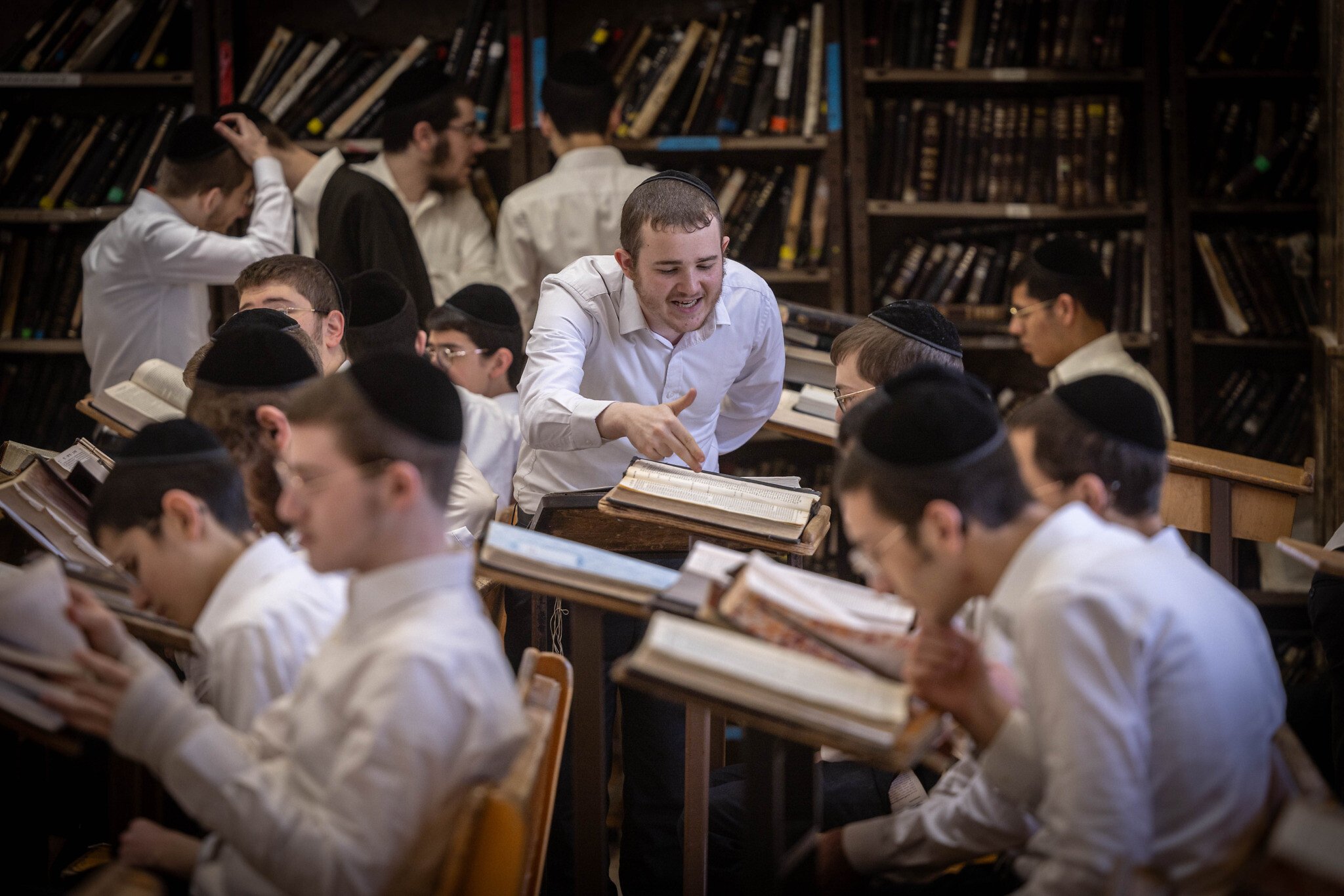
Illustrative: Ultra-Orthodox students seen at the Ponevezh Yeshiva in Bnei Brak, February 27, 2024. (Chaim Goldberg/ Flash90)
She argued that sanctions like banning drivers licenses actually fall in line with rules yeshiva students are already subjected to by their institutions.
These are “things yeshivas already require from their students,” she said. “The enlistment law’s sanctions align with what rabbis want.”
The bill explicitly states that someone receiving an exemption must “not engage in any occupation other than his studies.”
This, combined with the fact that all sanctions end at age 26, effective trap the Haredim in yeshiva and prevents their integration into the workforce, argued Shlomit Ravitsky Tur-Paz, the director of the Israel Democracy Institute’s Center for Shared Society.
“All these things basically keep you in the yeshiva, not out of it,” said Ravitsky Tur-Paz, who is married to the Yesh Atid lawmaker.
“The big question we’re asking is: when a Haredi young man plans his life, looks ahead to his future, what picture does he see,” she asked. “Does the picture the law paints of his future as a potential conscript make him more likely to enlist, or not? And in this bill, we don’t see any motivation that would make him change.”
Not working
At the same time, the bill does little to meaningfully strengthen efforts to ensure that yeshiva students are actually learning full-time, and actually “makes things worse,” said MK Tur-Paz.
While many ultra-Orthodox young men are widely believed to register for yeshiva without actually studying full-time in order to evade service, Bismuth’s bill removes a provision included in an earlier draft by his predecessor, Yuli Edelstein, requiring yeshiva students to log in and out using biometric sensors.
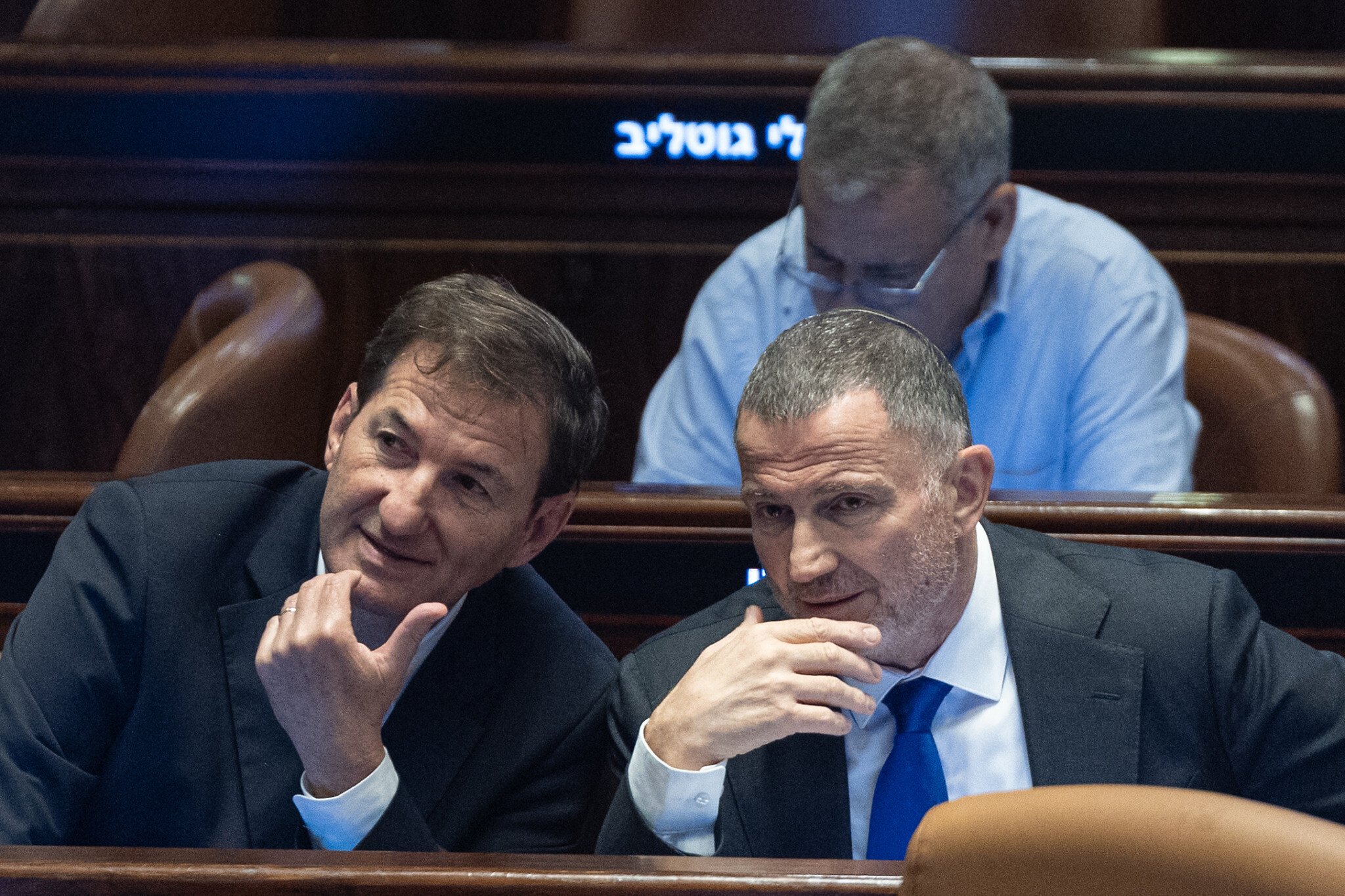
Likud MK Boaz Bismuth (left) speaks to fellow party MK Yuli Edelstein in the Knesset on July 23, 2025. (Yonatan Sindel/Flash90)
At least 22 percent of ultra-Orthodox yeshiva students under the age of 26 are employed under the table, a 2024 study by the Israel Democracy Institute found, appearing to undercut the community’s argument that its members do not enlist in the army due to their total immersion in Torah study.
Researcher Gabriel Gordon, the study’s author, told The Times of Israel that yeshiva students are more likely to seek work the older they get.
“What the research shows is that the more years a yeshiva student spends in yeshiva, the more deeply involved he is in the labor market. So it’s hard to understand how he is combining significant participation in the labor market with full-capacity study in the yeshiva,” Gordon said.
However, Bismuth’s bill removes a clause from a previous draft stating that yeshiva students may undergo occupational training and, if married, work once they reach the age of 22.
“The yeshiva boys will remain trapped in the yeshiva” and “condemned to poverty,” said Ravitsky Tur-Paz. “The sanctions are weak at the young ages, and the strong ones would apply for a very short time. Meaning the economic hardship that ideally these sanctions were meant to create — hardship that would make the Haredi youth say: ‘It’s better to enlist than remain a lawbreaker for life and suffer administrative financial sanctions’ — all of that disappears.”