
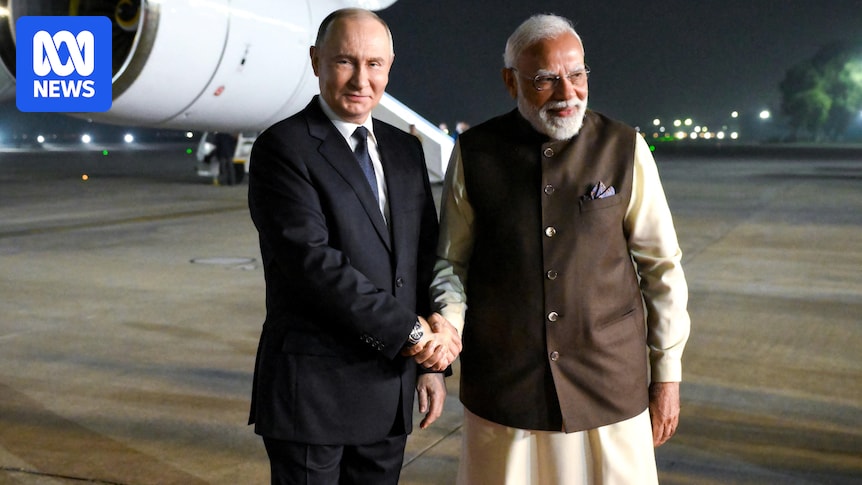
Vladimir Putin is in the mood to make deals with India.
He wants new deals on Russian oil, missiles, jets but he also wants broader business links that go beyond energy and defence equipment.
With an increasing number of international sanctions targeting Russia for its war in Ukraine, and Donald Trump’s tariff policy hitting Indian exports, there are incentives for both countries to expand economic ties.
Here’s what we know about the Russian president’s first state visit to India in nearly four years to visit Narendra Modi.
What does Russia want from India?
The two-day visit is expected to focus heavily on trade with reports that several deals are likely to be announced.
Russia wants to import more Indian goods to balance bilateral trade that is currently heavily skewed toward Russian oil.
In an interview with India Today, Putin said he was “very happy” to be meeting “my friend” Narendra Modi.
“The range of our cooperation with India is huge,” he said in remarks translated by the broadcaster, citing ship and aircraft manufacturing, nuclear energy and space exploration.
The Deputy Kremlin Chief of Staff Maxim Oreshkin said the delegation had “come for Indian goods and services. We want to significantly increase their purchases.”
“This is not a momentary story, but a strategic choice in developing relations” between the two countries, he added.
The world’s fastest-growing economy is rich in opportunity for Russia.
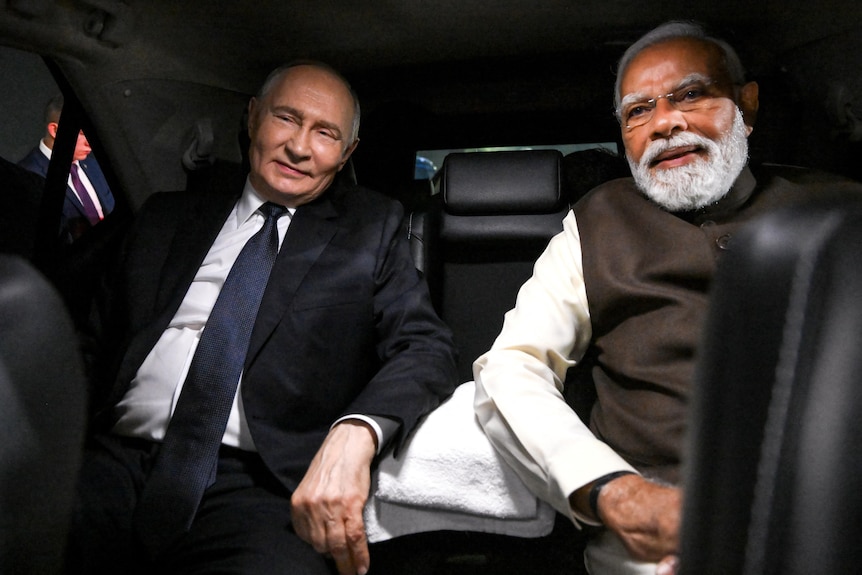
Vladimir Putin and Narendra Modi left the Palam Air Base in New Delhi in the same car.
(Sputnik/Grigory Sysoev/Pool via Reuters)
India and Russia aim to raise two-way trade to $US100 billion ($151 billion) by 2030.
Their commerce rose more than five-fold from about $US13 billion in 2021 to near $US69 billion in 2024–25, almost entirely driven by Indian imports of Russian oil.
New Delhi was happy for India to buy more cheap Russian oil, but Donald Trump wasn’t.
He slapped an additional 25 per cent tariff on Indian goods for the move, taking the total US levy to 50 per cent.
What does India want from Russia?
As a result of the US president’s tariff war, India wants new export destinations for its goods.
India’s Trade Minister, Piyush Goyal, said New Delhi wants to diversify its exports to Russia.
Increasing the sales of cars, electronic goods, data-processing equipment, machinery, industrial components and foods are all in New Delhi’s sights.
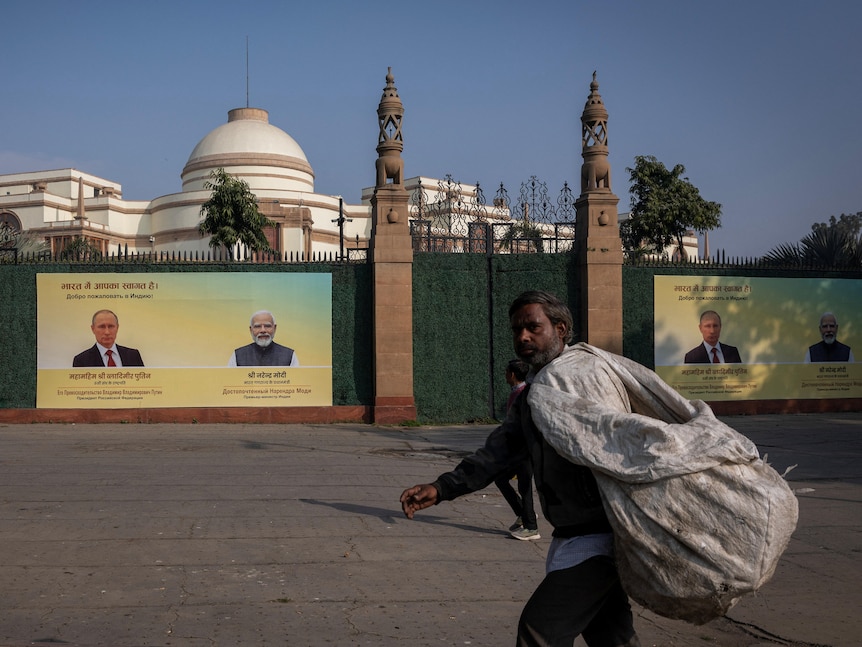
Posters of Vladimir Putin and Narendra Modi have been put up across New Delhi for the state visit. (Reuters: Adnan Abidi)
“Russia has a huge demand for a wide range of industrial goods, consumer products, presenting multiple untapped opportunities for Indian businesses,” Mr Goyal told the conference.
“We need to bring more diversity in our trade basket. We need to make it more balanced between Russia and India. We need to add more variety,” he said.
That variety could include exporting more shrimp, with India the world’s largest exporter of the fish.
India did provide the US with 20 per cent of its shrimp, but now needs a new market because of US tariffs.
How will the war in Ukraine impact the visit?
Donald Trump’s tariffs are designed to slow Russian oil sales, a key money-maker that’s helping fund its war in Ukraine.
India’s reliance on Russian oil has become a key issue between Washington and New Delhi.
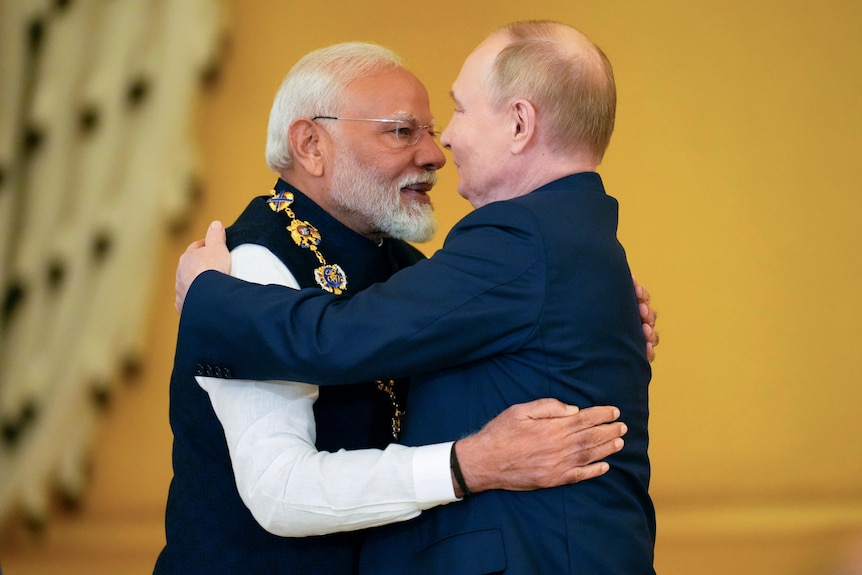
The pair’s relationship has frustrated mutliple US administrations. (AP: Alexander Zemlianichenko)
Aleksei Zakharov, fellow at the Observer Research Foundation, told ABC’s The World that Russian oil made up about 35 per cent of India’s oil imports in the past three and a half years.
However, he said the most recent sanctions that targeted Russian oil companies has seen a drop in Indian oil imports.
“I don’t think that’s the end of the story,” Mr Zakharov said.
“There are still some loopholes in the sanctions mechanisms and there are attempts to recalibrate supply chains. Russia offers to import oil from non-sanctioned entities and some of the Indian companies, primarily public ones, who are looking for ways to go ahead with imports.”
By forcing India to pick a side, Trump has missed the memo
Kremlin spokesperson Dimitri Peskov told Russian state media outlet, Sputnik India, that the drop in Indian oil imports would be “temporary” because Moscow was working on subverting Western sanctions.
Narendra Modi and Vladimir Putin were scheduled to share dinner on Thursday night.
It was there that Mr Zakharov expected the war to be raised “informally”.
“Prime Minister Narendra Modi has always tried to deliver his message that it is not the year of war and it’s the time to stop hostilities … I think he will try to privately deliver his message again.”
He also expected the Indian leader to try and get a sense of Russia’s appetite for peace, following recent talks on a US-led proposal.
What else is expected to be discussed?
Space collaboration, and a possible deal to address specific labour market shortages in Russia using Indian workers could also be discussed.
India has also imported weapons from Russia to use in its own defence program but that trade has slowly declined in the past decade.
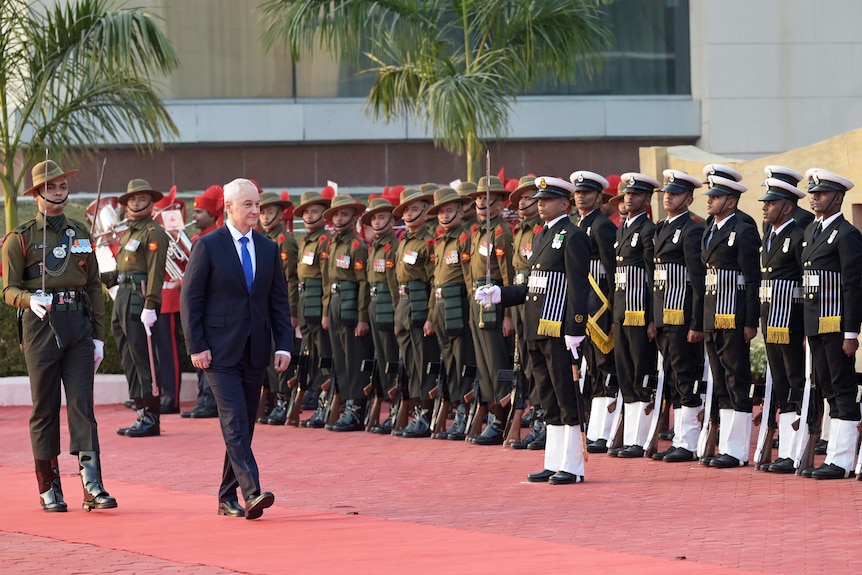
Russia’s Defence Minister Andrei Belousov was one senior government official in New Delhi for the talks.
(AP Photo)
Sanctions on Russia’s military and industrial businesses have further slowed investment into India.
“Russia’s share of the Indian arms market has significantly reduced as India has been prioritising deals with other partners,” Mr Zakharov said.
“India has been trying to find the best deals for its own interests but at the same time we can see that Russia is still there.
“Russia will remain a key defence partner because many military platforms that had been supplied since the end of the Cold War will be there, within the Indian armed forces, for maybe one or two decades longer.”
ABC/wires