
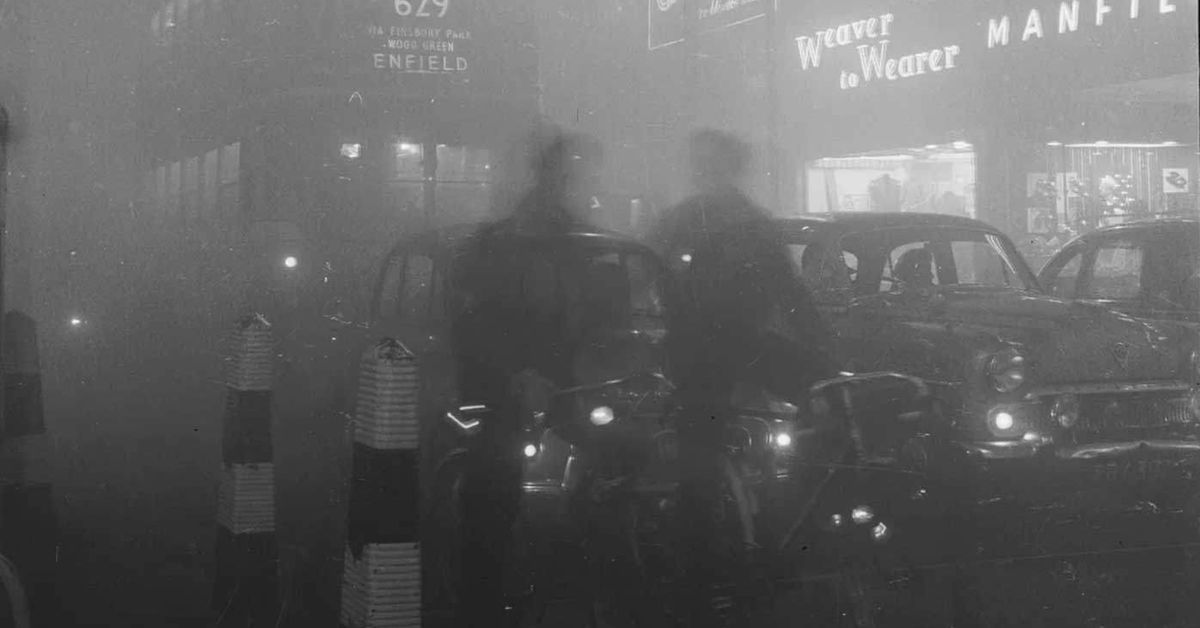
Visibility in London was reduced to near-zero on December 5, 1952, as a heavy smog settled over the city.
The British capital was well-known for its smog events, known as “pea soupers”.
But the so-called Great Smog was something else altogether.
 The smog made it near impossible to move around the city. (Getty)
As temperatures dropped, Londoners upped their heating, which at the time was largely low-grade coal fires.
London was also powered by coal-fired power stations in the city itself.
When an anti-cyclone settled over the city, the sheer volume of pollutants did not disperse in the atmosphere or blow away.
Instead a smog reduced visibility to just a few metres, effectively shutting the city down.
And the moist air transformed the sulphur dioxide in the coal fumes into sulfuric acid.
Buses were halted and there was a surge in car accidents.
As the smog seeped inside buildings, movies and concerts had to be cancelled, as well as outdoor sports events.
 London’s link-men light a fog flame to show the location of Whitehall in the Great Smog. (Keystone)
Even walking outside in the middle of the day was risky, with pedestrians needing to feel for a kerb with their feet.
An estimated 4000 people died in the smog, which lasted for five days.
But subsequent revisions estimated the total number of deaths as a result of the smog was 12,000.
In either case, death rates were higher than at any time since the Spanish Flu epidemic, including World War II.
 The Great Smog caused an estimated 12,000 deaths. (AP)
Most of those deaths came from lung infections and other breathing issues. Most of the dead were elderly or very young.
It was later determined that infants or unborn children who were in the Great Smog had lower intelligence than others who didn’t.
The British Government was reticent about blaming pollution for the Great Smog, but eventually measures were taken to prevent it happening again.
Coal fires were steadily replaced by gas, and power stations were moved out of the city.