

Listen to this article
Estimated 4 minutes
The audio version of this article is generated by text-to-speech, a technology based on artificial intelligence.
Changes are coming to residential recycling in Toronto starting in the new year, two councillors announced on Thursday.
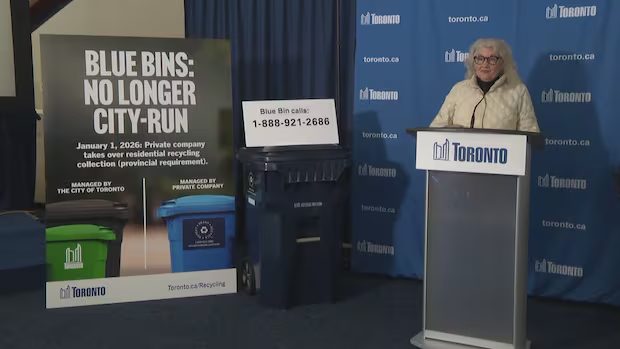
Blue bins will still be picked up in Toronto, but city workers won’t be doing the job as of Jan. 1, 2026, Coun. Mike Colle and Coun. Paula Fletcher told reporters at a news conference at city hall.
Circular Materials, a private company, will take over collection of recyclables for single-family homes, most multi-residential buildings, schools, long-term care facilities and retirement homes. Changes to recycling collection will not apply to commercial buildings, city facilities, divisions or agencies, charities, institutions or religious organizations.
Colle said the transition is required under a provincial regulation that is shifting responsibility for recycling from the city to producers of blue box materials.
“Starting on January 1st, residential recycling in Toronto will change and will no longer be collected by the City of Toronto. No longer will the city be involved in the blue bin program. It’s now a provincial responsibility, a provincial takeover of recycling,” Colle said.
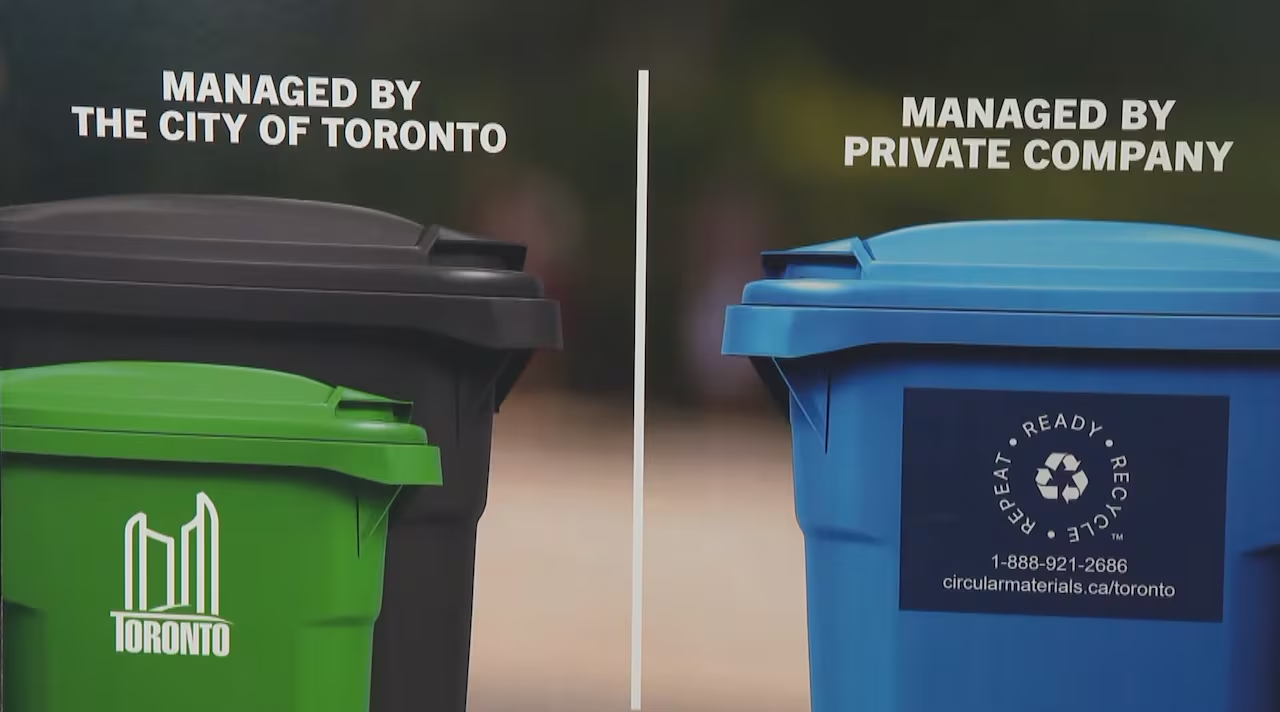
In Toronto, residents will still use the same bin on the same recycling days, as dictated by their regular collection schedule issued by the city in early December. The materials to be recycled will be the same with a few additions.
Grey bins for solid waste and green bins for organic waste will continue to be picked up by the city.
GLF Environmental Inc., an environmental services company, has been contracted by Circular Materials to do recycling pickup.
What is changing?
Matt Keliher, general manager of the city’s solid waste management services, said Circular Materials will take over not only collection but also management of recycling.
“The city has worked diligently to ensure that we have a seamless transition for residents with the new service provider,” Keliher said.
WATCH | City no longer responsible for blue bin program in January: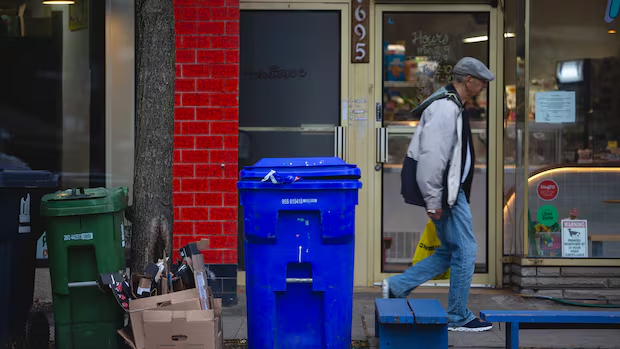
What you need to know about changes coming to Toronto’s recycling program
Big changes are coming to Toronto’s residential recycling program in the new year. Here’s what you need to know.
Keliher said the city expects to save about $10 million a year with the shift in responsibility and no city workers will lose their jobs.
City’s 311 line received thousands of calls about blue bins
Fletcher, who chairs city council’s infrastructure and environment committee, said the city received about 24,000 calls to its 311 line about the blue bin program in 2024.
“I’m a tiny bit worried that this new company will not understand what level of service Torontonians have come to expect,” she said.
Stickers with contact information for Circular Materials have been affixed to the bins and the city will send out communications to residents to help create a smooth transition, Fletcher added.
If residents have a question, such as to report a missed pickup or broken bin, or to ask for a replacement, they are told not to call 311, but to call Circular Materials at 1-888-921-2686 or circularmaterials.ca/toronto.
 The city says it will send out communications to residents to help create a smooth transition in January. (Mark Bochsler/CBC)
Allen Langdon, CEO of Circular Materials, said in an email on Thursday that, beginning in the new year, GFL Environmental Inc. will collect new material such as black plastics, hot and cold beverage containers, deodorant and toothpaste tubes, ice cream tubs and frozen juice containers.
Langdon said the city is continuing to apply stickers to blue bins and those without stickers will still be picked up starting Jan. 1.
If a blue bin did not receive a sticker, residents should call 1-877-667-2626 starting Jan. 1.
A complete list of materials is available on its website at circularmaterials.ca/recycleontario.
Program started in 1988 with papers, glass, bottles, cans
Colle said the city introduced its blue box recycling program in 1988, one of the first in North America, and it collected only newspapers, glass, bottles and tin cans.
The city had a goal of diverting 15 per cent of waste from residential homes away from the landfill. No plastics or cardboard boxes were collected.
Today, the city estimates it diverts 52 per cent of waste from residential homes away from the landfill. Colle said the city hopes that continues to be the case with the new service provider.