

If you think food prices in Canada are already high, brace yourself — costs are expected to climb once again in the new year.
On Thursday, Dalhousie Agri-food Analytics Lab released Canada’s Food Price Report (CFPR) 2026, which outlines how much more Canadians can expect to spend. According to the forecast, overall food prices will go up by four to six per cent. An average family of four is expected to spend $17,571.79 on food in 2026 — an increase of up to $994.63 from last year.
“The average Canadian family of four should expect to pay nearly $1,000 more for groceries next year if they follow an average diet,” reads the report.
Despite the inflation rate remaining relatively steady in 2025, food was still 27 per cent more expensive this year compared to five years ago. Not surprisingly, 85 per cent of Canadians said their food expenses have increased in the past 12 months, and that’s not likely to change next year.
“Prices are only one piece of Canada’s complex food industry story,” said Dr. Evan Fraser, director of the Arrell Food Institute at the University of Guelph. “Prices increase year over year, but reports like this one help us understand that our food sits in the middle of shifting disputes, behaviours, and policies.”
How much can you expect to spend?
Stefan Malloch/Shutterstock
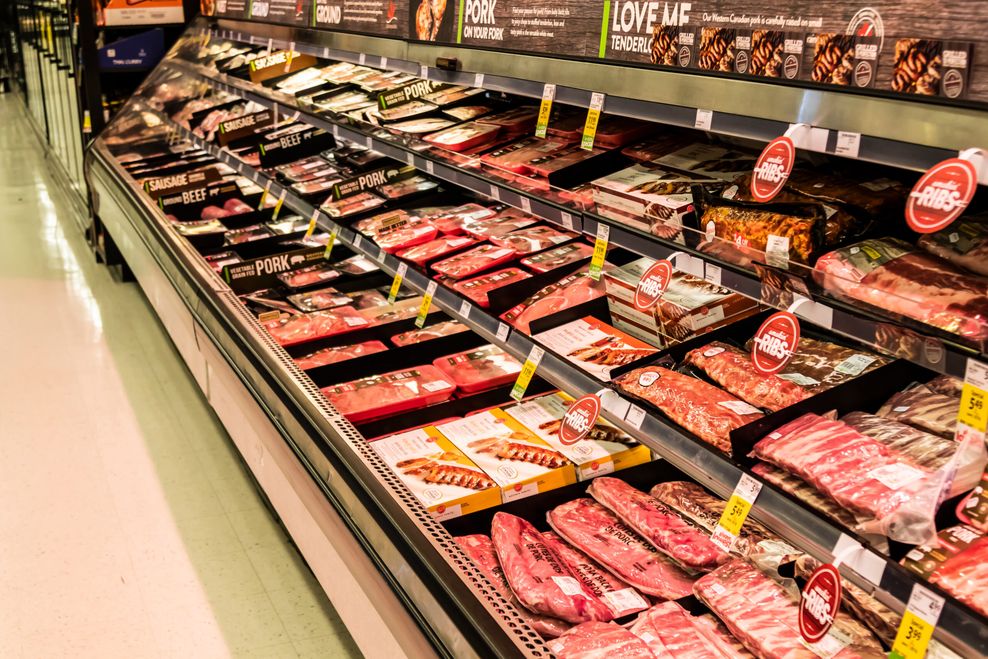
If you were considering a diet low in meat, 2026 just might be the time for that because meat prices are expected to go up significantly by around five to seven percent, the biggest anticipated change among all grocery categories.
Dining at restaurants is also going to be much more expensive — a projected four to six per cent increase. Vegetable prices will likely go up by three to five per cent, while baked goods, dairy, and eggs will go up by two to four per cent.
Fruit will see a modest increase of one to three per cent, while seafood will see the lowest increase of one to two per cent.

Canada’s Food Price Report 2025
Beef continued to be expensive in 2025, and prices likely won’t normalize before 2027. Compared to five years ago, Canadians are paying an average of 23 per cent more for beef.
In all, 86 per cent reported eating less meat due to prices. To cut costs, more Canadians are substituting beef with chicken. However, the price of chicken could also increase in 2026 due to underproduction.
“Very rarely have we seen all three main components of the meat trifecta — beef, chicken, and pork — become more expensive at the same time in a single year,” states the report.
Although the Buy Canadian movement may have had some shoppers choosing local goods, for younger Canadians, price still wins out — 58 per cent of Gen Z said price matters more than a product’s country of origin.
In 2026, while a family of four can expect to spend $17,571.79 on food, a household of two people (a man aged 51 to 70 and a woman aged 51 to 70) can expect to spend $8,319.24 in 2026.

Canada’s Food Price Report 2025
Where you live can also determine how much you spend on food in 2026.
Food price increases are expected to fall below the national average in British Columbia and Manitoba. In comparison, food prices are expected to increase to “above national average” in Alberta, New Brunswick, Nova Scotia, Ontario, and Quebec.

Canada’s Food Price Report 2025
What’s behind the rising costs?
A variety of global factors will contribute to an even higher grocery bill.
The ongoing trade dispute between Canada and the U.S. will continue to affect food prices in 2026. Immigration is also a huge factor. Canada’s agricultural industry depends on seasonal workers, and a major labour shortage in this sector could see costs get passed down to consumers.
Severe and unpredictable weather could also disrupt agricultural production, resulting in “supply challenges.” Other factors that could result in higher prices include a mandate for front-of-pack labelling and the Health Canada mandate that dairy milk must be fortified with almost twice the current amount of Vitamin D.
But it’s not all bad news.
PhotographerIncognito/Shutterstock
Inflation is expected to drop even further in 2026 to around two per cent. Also, a rollback on tariffs on over 200 agricultural and food products is “a promising pivot” that could help ease prices.
In addition, the One Canadian Economy Act (passed in July 2025) is expected to ease trade restrictions between provinces and territories and stimulate productivity and mobility between regions. Canadians could start to feel the impact of that in 2026.
Over 70 per cent of the national market share is controlled by the top four grocery chains. Major supermarket chains have signed the Grocery Code of Conduct, which goes into effect in January 2026. The rules ensure fairness and more transparency, but the report states that “it remains to be seen if it will be effectively enforced.”
According to the report, if 2025 was difficult for Canadian households, next year is “unlikely to be any easier.” And food insecurity is a very real issue in Canada, with 2.2 million people visiting food banks in 2025.
Fraser stated, “It remains critical that we continue to collaborate across Canada to track new trends, because affordable access to food is a matter of security.”