
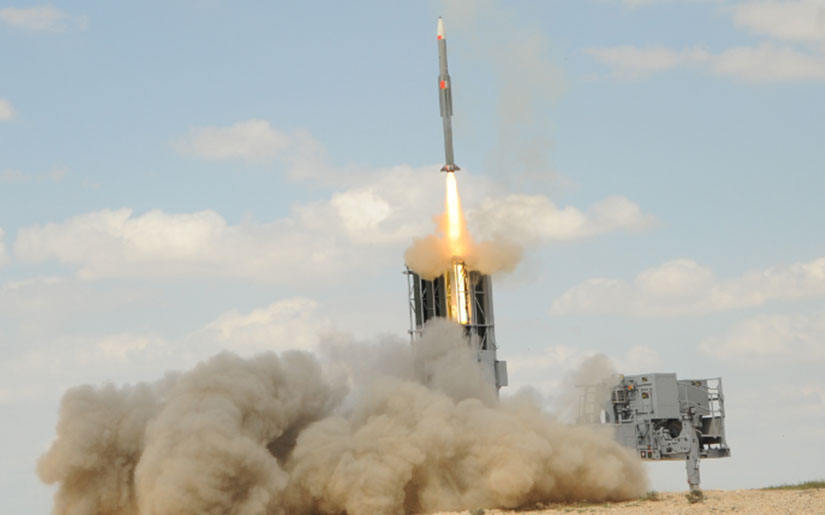
 Thailand’s air force has selected the Barak MX air defence system to protect its air bases with medium-range missiles. (IAI)
Thailand’s Air Force Logistics Department announced on 20 November that it had selected Israeli company IAI to supply Barak MX air defence systems to the Royal Thai Air Force (RTAF) to help protect its air bases.
The value of the contract awarded to IAI for this Military Base Defence Development Project was worth THB3.44 billion (US$108 million). The RTAF Logistics Department said the first phase of the project would see the procurement of one Barak MX launcher battery.
The battery will be operated by the Antiaircraft Regiment of the Security Force Command. The Barak MX is able to intercept aircraft, drones, cruise missiles and even ballistic missiles when using the extended-range effector.
Regarding this procurement, the RTAF stated, “The air force must be prepared for future threats by procuring modern weapon systems to enhance air defence, which currently faces limitations in dealing with emerging threats effectively.”
This integrated air defence system was mentioned in an RTAF White Paper published on 29 February 2024. That document prioritised a medium-range air defence system possessing a minimum 56km range from FY2025-28. It was to be followed by phase two from 2033 for more medium or even long-range missiles.
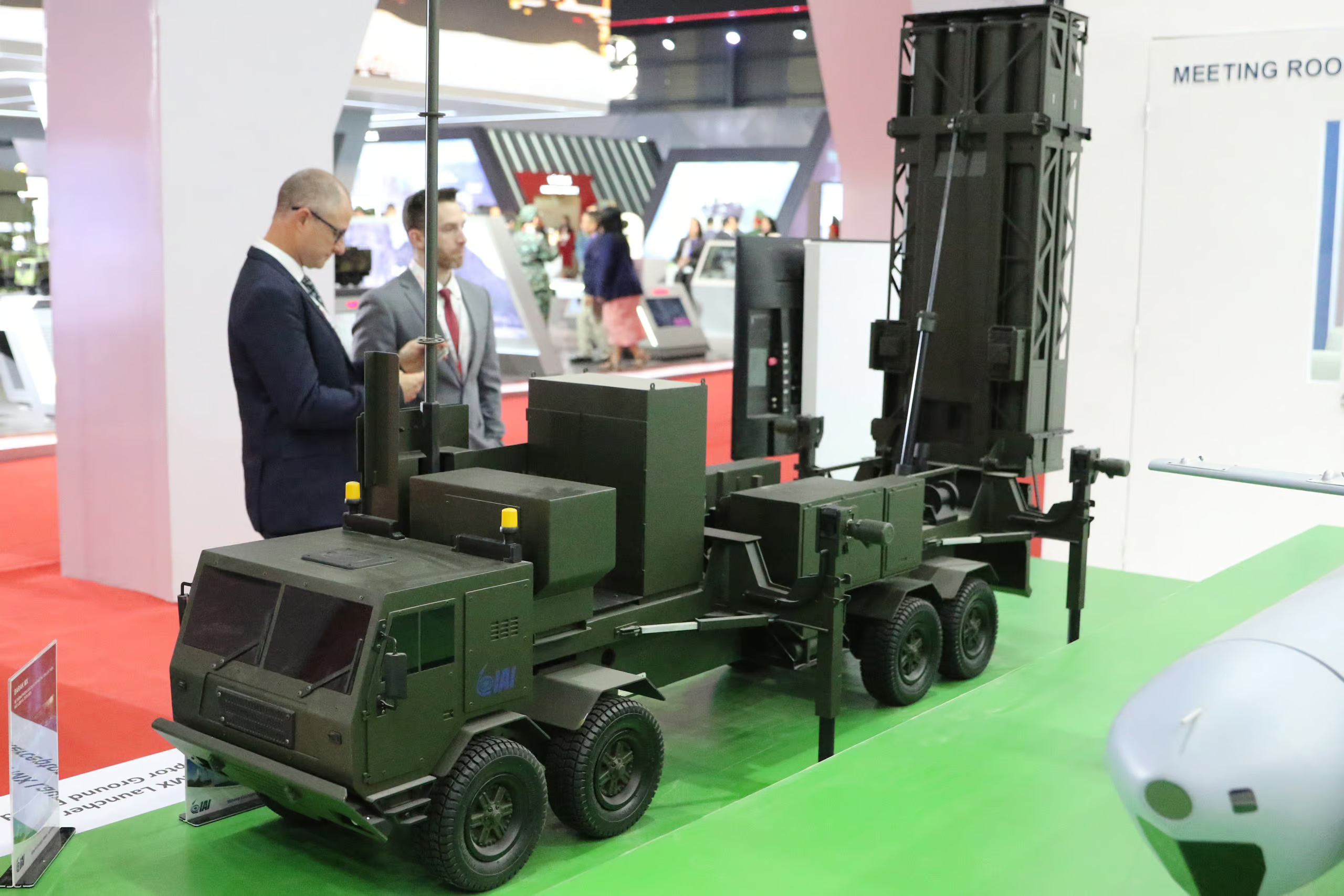 This scale model exhibited by IAI represents a mobile launcher vehicle for a Barak MX air defence system. (Gordon Arthur)
The fact that a contract has been so quickly signed likely stems from Thailand’s brief border war with Cambodia in July this year.
At that time, Cambodia deployed various surface-to-surface weapons that could strike over the border into Thai territory. Examples included Soviet-era BM-21, Czech-built RM-70 and Chinese Type 90B rocket launchers. Cambodia’s longest-range system is PHL-03s that have a range approaching 150km, with these arriving from China in mid-2022.
The RTAF deployed various aircraft in the brief border clash with Cambodia, and it made use of the Wing 21 air base in Ubon Ratchathani, and the Wing 1 base in Korat.
IAI introduced the modular Barak MX system back in 2018. It can incorporate four types of missile: the 15km-range Barak SR, the 35km-range Barak MR, the 70km-range Barak LR and the 150km-range Barak ER.
Israel used the Barak MX operationally from land and sea platforms to defend against Iranian missiles during Operation Rising Lion in June this year.
The aforementioned RTAF White Paper also listed other air defence requirements for the RTAF. From FY2028-2032, a short-range air defence system boasting cannon, missile and laser effectors is required. Credence is given to counter-drone systems too, and a nine-year project to procure these commenced in 2025. The RTAF also requires a wider command-and-control capability that includes an integrated ground operations centre.
 Thailand and Israel have cooperated closely on a number of occasions, including the M758 ATMG based on the ATMOS from Elbit Systems. (Gordon Arthur)
Thailand is a keen buyer of equipment from both China and Israel. The Thai military previously acquired KS-1C and FK-3 air defence systems from China, so it is unclear why it has now turned to IAI.
Current areas of Israeli-Thai cooperation include the D11A multiple rocket launcher (a localised version of Elbit Systems’ PULS), the M758 Autonomous Truck-Mounted Gun (based on the ATMOS), and the M361 Autonomous Truck-Mounted Mortar that features the Elbit Systems Spear 120mm mortar.
The Barak MX could potentially arm warships of the Royal Thai Navy in future too, especially with a new frigate procurement programme now on the cards.
by Gordon Arthur