
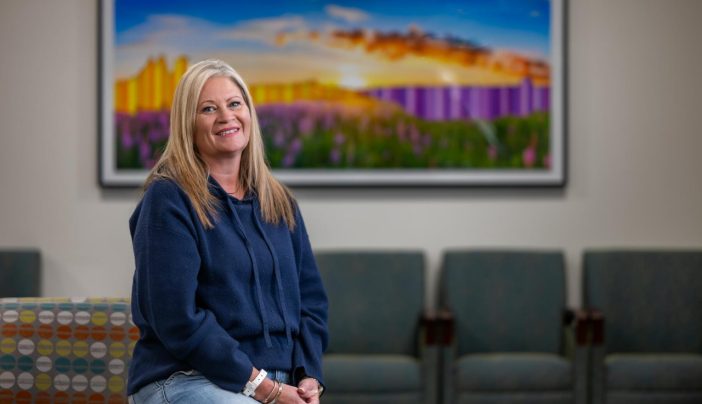
Casey Brown was diagnosed with a benign skull base tumor called an acoustic neuroma in September 2022.
Her diagnosis came after she started losing hearing in her right ear. Her ENT gave her steroid injections for three weeks, and she had an MRI that revealed the tumor. She was 47.
Choosing MD Anderson for acoustic neuroma treatment
Acoustic neuromas are not cancerous, but because they are located on the nerve that controls hearing and balance, the symptoms can disrupt your quality of life. Casey wanted to go to the best place for treatment.
She lives near Houston and knew of MD Anderson’s reputation. She had a friend who was being treated at MD Anderson, and her husband’s friend was a nurse practitioner at MD Anderson. He recommended that Casey see Marc-Elie Nader, M.D., a head and neck surgeon and neurotologist who specializes in treating benign and malignant tumors of the ear, temporal bone and skull base.
“I decided to come to MD Anderson because you guys are the best,” says Casey. “After my diagnosis, I visited doctors at other local hospitals. They were OK, but I just felt at home at MD Anderson.”
Casey’s first appointment was on Sept. 29, 2022. Nader discussed her options for treatment.
“Dr. Nader was incredible. He explained everything so well; it took all the fear out of my diagnosis,” she says.
Instead of surgery, she decided on active surveillance. This meant her doctors would regularly monitor the tumor for growth and progression.
Surgery and cochlear implant help restore hearing
Casey’s hearing loss got worse over the next several months. She met with Nader and neurosurgeon Shaan Raza, M.D., who specializes in treating skull base tumors.
They told her about a new surgical approach MD Anderson was offering to some acoustic neuroma patients. In a single procedure, surgeons remove the tumor and simultaneously place a cochlear implant to help rehabilitate hearing. The Food and Drug Administration (FDA) approved cochlear implants to be used for single-sided hearing loss in 2019.
“My doctors told me that my hearing was not going to get any better. And after learning that this surgery was an option with the cochlear implant, it felt like the right time to get the tumor removed,” says Casey.
She saw MD Anderson’s vestibular therapists to get an analysis of her balance, posture and vision before surgery. She wasn’t nervous about the surgery because her surgeons and their teams explained the procedure to her so well beforehand.
“They made it seem like it was just a routine surgery for them,” she says. “And I was overjoyed at the opportunity to have even some hearing restored in my right ear.”
On Oct. 25, 2023, Casey underwent surgery to remove the acoustic neuroma and place the cochlear implant.
“I woke up from surgery with no issues,” recalls Casey, who says she was texting people and answering emails shortly after waking up. “I did have a little bit of dizziness, but my care team gave me medication for it.”
Casey stayed in the hospital for three days to recover. She began physical therapy, vestibular therapy and occupational therapy, which included walking laps around the hospital floor.
“Dr. Nader and Dr. Raza came to check on me to make sure I wasn’t having any issues,” she says. “And the nursing staff was incredible. They made sure I could shower before I left and that I was comfortable.”
At home, Casey continued to follow the advice of her care team to help her regain her balance during recovery, including going on walks with her kids and husband. About a month after her surgery, her cochlear implant was activated.
“When I first heard the beeps, I cried tears of joy,” says Casey. “It was incredible. I felt so blessed.”
Grateful for MD Anderson
It’s been almost two years since Casey’s surgery, and she is still doing her part to make sure she maintains her hearing.
“I’ll have my iPad on my desk at work, listening to it from my right ear where the implant is,” says Casey. “I also visited MD Anderson’s vestibular therapists after surgery to assess where I was compared to before the surgery. That helped me see what I still needed to work on.”
Her advice for other people with acoustic neuroma who are considering getting a cochlear implant: do the work.
“I love my cochlear implant, and I’m so glad I got the surgery. But it’s not some magical thing you turn on where everything goes back to normal,” she says. “You have to put in the work to make it work for you. That includes doing any exercises your care team tells you to do for however long you need to do them.”
Casey is glad she was able to have the surgery and is grateful she chose to do it at MD Anderson.
“Everybody at MD Anderson – from the people who check you in to the valet to the doctors – is just phenomenal,” she says. “Whenever you pass a staff member in the hallway, they always have a smile on their face. MD Anderson is just different from other hospitals.”
She is especially thankful for everybody in the Head and Neck Center.
“They’re all so kind. I’d never know if Dr. Nader had to have a difficult conversation with another patient before he saw me because he always walked into my room with a smile on his face,” she says.
Casey gets follow-up scans once a year now. Recently, Nader asked her how she was doing with the cochlear implant and if she’d recommend it to others.
“The difference in my hearing from before I got the cochlear implant to now is night and day,” she says. “I’d absolutely recommend the cochlear implant to others – 1,000%.”
Request an appointment at MD Anderson online or call 1-877-632-6789.