
By Steve Rosenberg
First, about the welcome Vladimir Putin received.
The Russians loved it.
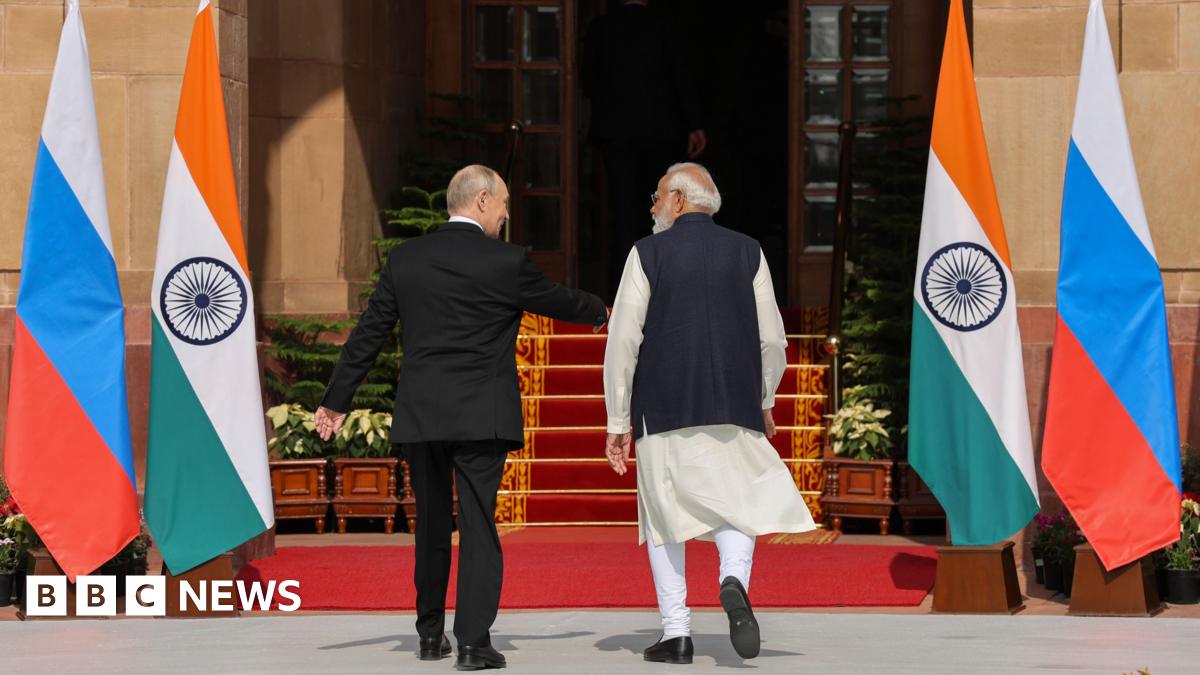
“A cavalcade, volleys of cannons and a marble throne room,” wrote the ultra pro-Kremlin news site Komsomolskaya Pravda on Friday. “How Vladimir Putin was greeted in an Indian palace with 340 rooms.”
So much for Western efforts to turn President Putin into a pariah for his full-scale invasion of Ukraine.
When it comes to deals done, there are fewer of those than rooms in the palace.
But still enough for Russia and India to be able to trumpet their “special and privileged strategic partnership” and for President Putin to hail efforts to expand cooperation.
Agreements like the Russia-India economic cooperation programme.
An agreement involving critical minerals and supply chains.
Pharmaceuticals, too. A Russian-Indian pharmaceutical factory will be built in Russia’s Kaluga region.
But what about the most talked about – and sensitive – issues?
First, oil.
India has been buying large volumes of Russian oil. These purchases have been a major support for Russia’s sanctioned economy.
Much to the annoyance of America. It accuses India of helping to finance the Kremlin’s war chest. So, through heavy tariffs on Indian goods, the Trump administration has been exerting pressure on Delhi to stop purchasing Russian energy.
On Friday, Putin emphasised that Moscow is ready to ensure uninterrupted oil supplies to India.
But no details have been announced. It feels like the ball is in India’s court to decide what comes next.
Then there’s the question of Russian weapons and defence systems.
Ahead of Putin’s visit, there was much speculation: Is India about to purchase state-of-the-art Russian fighter jets and air defence systems?
No defence deal was announced.
That may be a sign of the balancing act India has to perform – between its relationship with Moscow and ties with Washington.
On Friday, all eyes were on the pomp and ceremony (and palaces) and deals done and announced.
But I’d love to know what was discussed last night in what the Russians are calling the “informal dinner” between President Putin and Prime Minister Modi.
According to Putin’s foreign policy aide Yuri Ushakov, that was “one of the key points of the visit”.
Ushakov told the Russian government paper Rossiyskaya Gazeta that “during such confidential face-to-face contacts, the most urgent, most sensitive and most important issues of both bilateral relations and the international situation are discussed”.
“Politics is made at these kind of meetings.”