
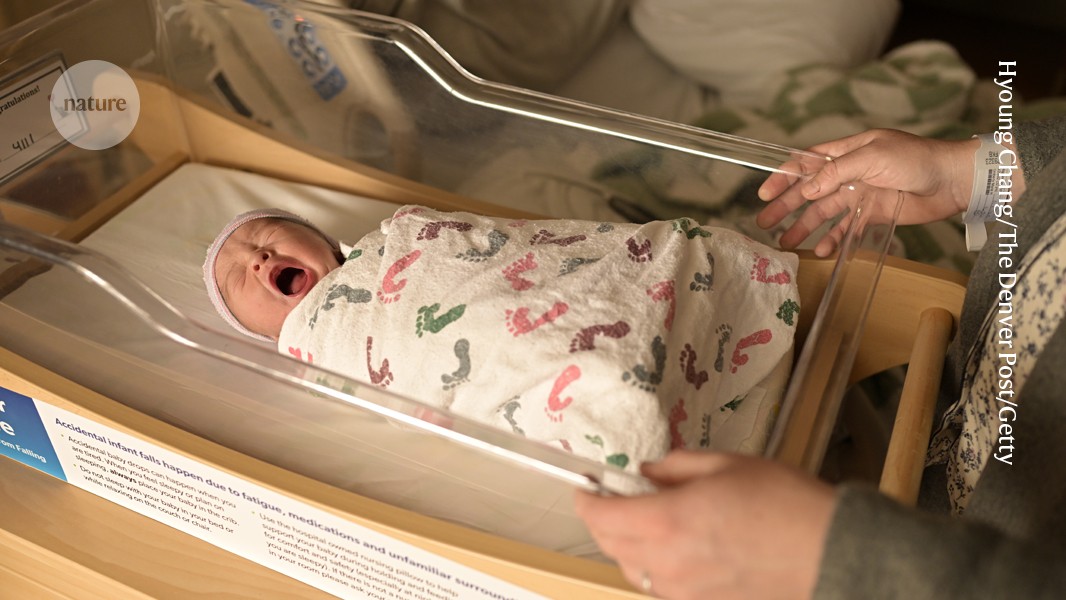
Current US guidelines call for universal hepatitis B vaccination of newborn babies.Credit: Hyoung Chang/The Denver Post/Getty
Members of a top US vaccine advisory panel voted today to roll back a decades-old recommendation that all newborns receive a hepatitis B vaccine shortly after birth — a measure that has been associated with a sharp decline in mother-to-child transmission of the hepatitis B virus, which causes liver disease.
Newborn vaccination is still recommended for babies born to mothers who have tested positive for the virus, or whose mothers’ infection status is unknown. But for babies born to mothers who have tested negative for the hepatitis B virus, the US Advisory Committee on Immunization Practices (ACIP) now recommends that decisions be made individually – and suggests that babies who do not receive a ‘birth dose’ of the vaccine be vaccinated no earlier than the age of two months.
Recommendations made by the ACIP must be approved by the director of the US Centers for Disease Control and Prevention (CDC) before they become official policy of the agency.
The vote came after more than a day of discussion that was at times confused and contentious. Several members of the panel have previously expressed broad criticism of vaccines, and continued to do so at this week’s meeting.
Aluminium is crucial to vaccines — and safe. Why are US advisers debating it?
“What we are doing here is trying to undo some really, really bad decision processes we had in the past,” said ACIP member Retsef Levi, a professor of operations management at the Massachusetts Institute of Technology in Cambridge, who pointed to what he considers to be gaps in the data about the vaccine’s safety.
But other ACIP members expressed concern that the new recommendations were not grounded in data, and could cause harm. “To make the change that is proposed, we will see more children and adolescents and adults infected with hepatitis B,” said Cody Meissner, an ACIP member and a paediatrics researcher at the Geisel School of Medicine at Dartmouth in Lebanon, New Hampshire. He repeatedly argued that studies have shown the hepatitis B vaccine to be safe.
Several public commenters at the meeting also pointed to data indicating that the vaccine is safe. And Rochelle Walensky, who directed the CDC from 2021 to 2023 and is now a professor of medicine at Harvard Medical School in Boston, Massachusetts, noted at a media briefing Thursday that US vaccine-safety monitoring system can detect “very, very rare” safety events. “Over 35 years, with a huge amount of experience and millions of doses given, we have not detected those events”, she said.

Childhood vaccines up for review in the US: what’s at stake
Chronic infection with the hepatitis B virus can cause liver cancer and even death. Since 1991, US public-health officials have recommended vaccinating all healthy babies at birth, a policy that helped to drive down infections in people younger than 19 by 99%. But, in September, members of the ACIP, which provides advice to the CDC, started discussing the possibility of delaying the first vaccine dose.
At the meeting today, ACIP members also passed a recommendation that parents discuss with their healthcare providers whether children should be tested to see if they have already achieved “protective” levels of antibodies against the hepatitis B virus when considering whether to give additional doses of the vaccine. Meissner, who voted against the measure, said the recommendation did not have scientific backing and could be interpreted to suggest that a child does not need the full course of three doses of hepatitis B vaccines. “We have no basis for saying that,” he said.
Here, Nature examines some of the questions that have been raised about the hepatitis B birth dose.
What is the rationale for revisiting this vaccine recommendation?
The ACIP routinely revisits its recommendations in light of new evidence. This re-evaluation was prompted by concerns about public dissatisfaction with US vaccination policy, according to ACIP member Vicky Pebsworth, a nurse and health-policy analyst at the National Vaccine Information Center in Sterling, Virginia. During the meeting on Thursday, Pebsworth cited two surveys, including one in which 16% of parents reported skipping or delaying childhood vaccines in part because of concerns about side effects and safety. “This level of dissatisfaction is of societal significance and poses challenges for vaccination policy making,” she said.
The same survey also found that 90% of parents said it is important for children to receive the vaccine for measles, mumps and rubella, and 88% said the same for the polio vaccine.
Pebsworth also noted that the US policy is “misaligned relative to existing recommendations in most other developed countries” where universal birth-dose vaccination is not the standard practice. Walensky responded at the briefing that “the United States has access issues and insurance issues that don’t mirror access and insurance issues of other countries”.
Hepatitis B is a sexually transmitted disease, so why should newborns be vaccinated?
It’s true that hepatitis B spreads through contact with infected body fluids such as blood, semen and vaginal fluids. In countries where the virus is less prevalent, such as the United States, most infections are acquired during adulthood, according to the World Health Organization. But even in the United States, more than 600 mothers transmit the virus to their babies annually, according to a study1 published on 3 December by Walensky and others.
“People are talking about hepatitis B as if we’re back in the 1970s, when we were very concerned about sexual transmission,” says John Ward, a medical epidemiologist specializing in hepatitis at the Task Force for Global Health, a non-profit programme in Decatur, Georgia. At the time, “the studies had not yet been done showing how frequently the virus spread from mother to child”.
Why not vaccinate only babies whose parents test positive for hepatitis B?
If screening worked perfectly well, targeting only these babies might be enough. But “there will be a number of infants who sneak through the cracks, who are missed by gaps in prenatal detection”, says Angela Ulrich, an infectious-disease epidemiologist at the Center for Infectious Disease Research and Policy (CIDRAP) at the University of Minnesota in Minneapolis.

Will RFK Jr’s vaccine agenda make America contagious again?