
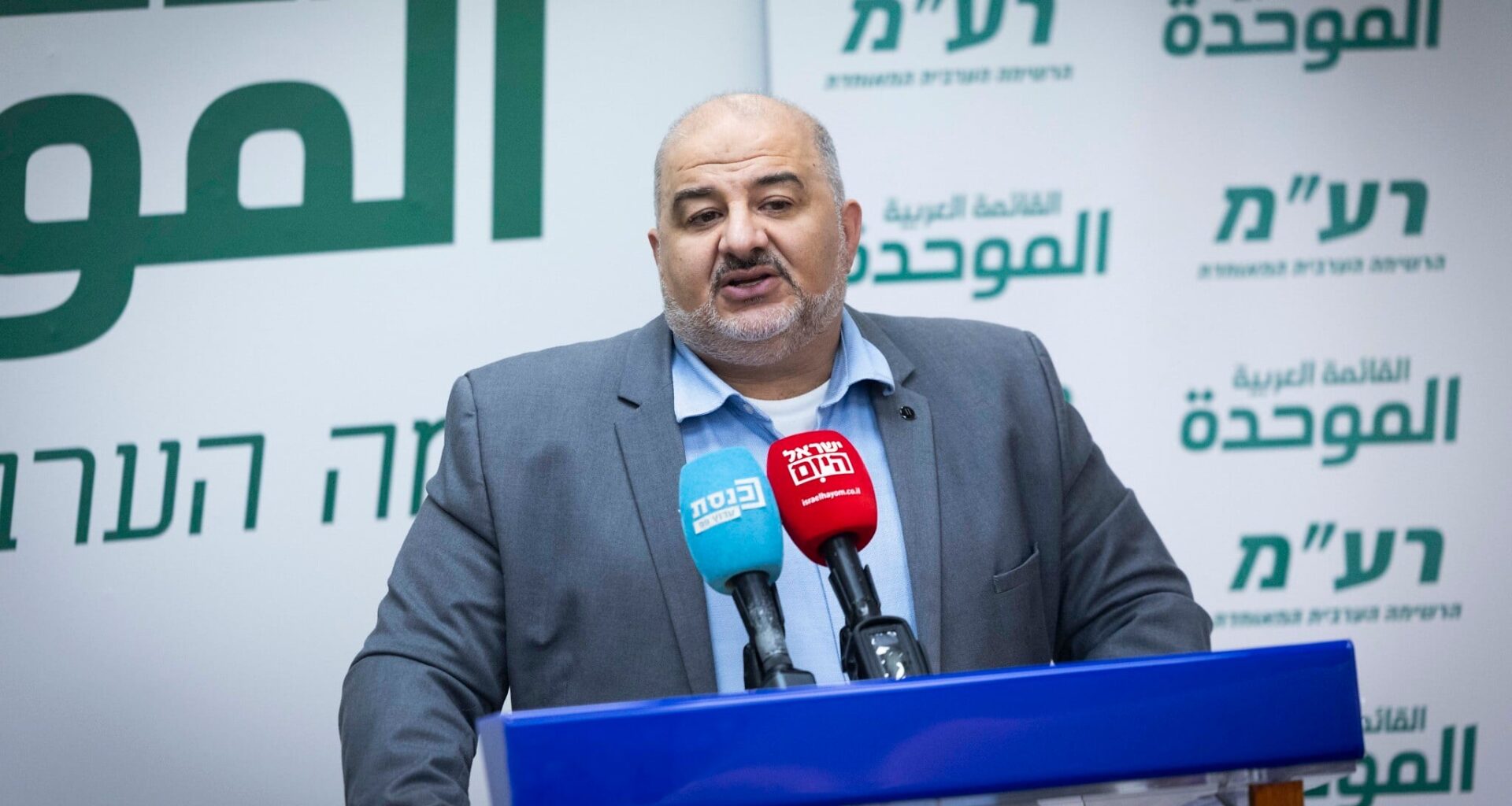
Ra’am chair Mansour Abbas said Saturday that his party will separate from the religious council that it is linked to and establish its own institutions, in a move that appeared to be aimed at distancing the Islamist political party from hardline Muslim organizations in order to boost its legitimacy among Zionist Israeli parties.
In the interview with Channel 12’s Meet the Press, Abbas also insisted that his party is not a part of the Islamist Muslim Brotherhood, weeks after Prime Minister Benjamin Netanyahu appeared to allude to that connection and to hint that he intended to outlaw the party.
“First of all, we are not a part of the Muslim Brotherhood. If we were part of the Muslim Brotherhood, I wouldn’t be in the Knesset, I wouldn’t even be sitting with you here,” said Abbas, who in 2021, after being courted by Netanyahu to become part of his coalition, decided to partner with his rivals and become the first Arab party in decades to be part of a ruling coalition, which was led by Naftali Bennett and Yair Lapid.
“The second thing is that we have learned lessons from what we had [in the Bennett-Lapid coalition]. Ra’am today is moving in the direction of being a completely civic party, with separate institutions,” he said.
Pressed if that meant his party would be separating from the Shura Council, Abbas responded: “Of course. This is the approach that has been advanced in recent years in Ra’am. Next month we have a conference, and it will approve the changes.”
Get The Times of Israel’s Daily Edition
by email and never miss our top stories
By signing up, you agree to the terms
Currently, the Islamist party is the political wing of the Southern Islamic Movement, a group inspired by the Muslim Brotherhood, a global Islamist organization that has been outlawed in around a dozen countries for alleged links to terrorism.
Abbas has repeatedly denied that his party is connected to the Brotherhood.
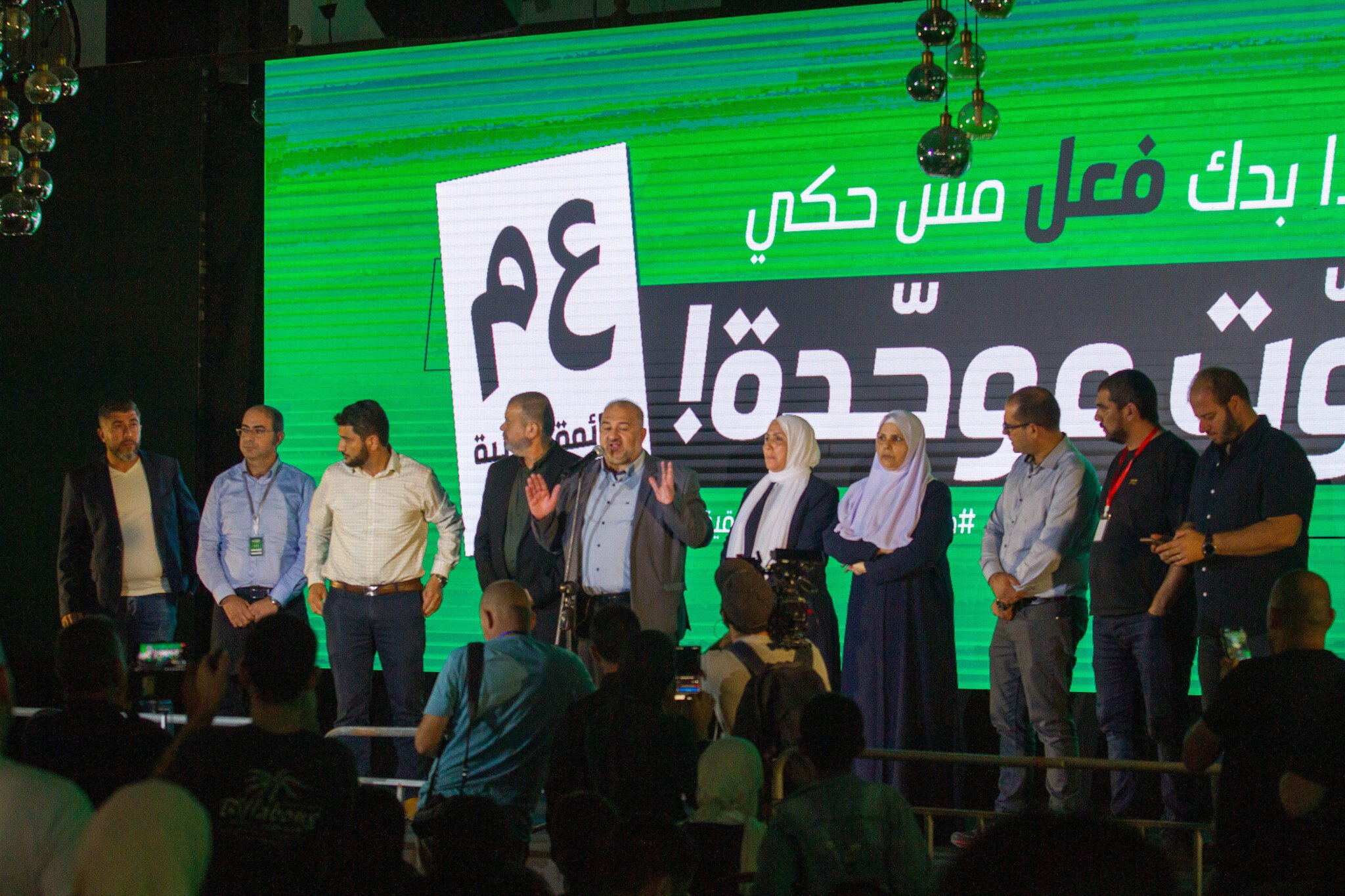
Ra’am party members at the campaign headquarters in the Arab Israeli town of Tamra, as the results of the Israeli elections are announced on November 1, 2022. (Flash90)
Ra’am has increasingly taken a relatively conciliatory stance toward Israel and is focused more on socioeconomic issues than its parent movement’s more radical sister branch, the Northern Islamic Movement, which is outlawed.
Ra’am holds five seats in the Knesset, and polls indicate it will likely retain that number in the next elections.
Smotrich responds, calling Abbas a ‘wolf in sheep’s clothing’
Finance Minister Bezalel Smotrich, who leads the far-right Religious Zionism party and whose opposition prevented Netanyahu from partnering with Ra’am at the time, responded to Saturday’s interview on X, writing: “Mansour Abbas was and remains a wolf in sheep’s clothing. An enemy who supports terror and leads a sister-movement to Hamas, and tries again and again to disguise himself and fool the Israeli public.”
“Abbas has refused, since the October 7 [2023] massacre, to condemn Hamas, or to describe it as a terror organization, and the right place for him is behind bars, not in the Knesset,” Smotrich said.
Abbas has repeatedly acknowledged and condemned the targeting of civilians during the Hamas-led onslaught that triggered the Gaza war. In the past, he has also called on Palestinian armed groups, including Hamas, to disarm, but his party later walked back those comments, and while Abbas has endorsed the US plan for Gaza, which includes the Strip’s demilitarization, he has declined, when pressed, to say that Hamas should be “destroyed.”
“After his previous deception ploy was exposed, he’s now trying to disguise himself again, as part of the left’s plans to return to power by joining forces with anti-Zionist terror supporters,” Smotrich wrote. The far-right minister vowed to “do everything I can to prevent the State of Israel being sold to its enemies by irresponsible, power-hungry politicians.”
Watch DocuNation Season 3: The Heart of Israel
when you join the ToI Community
In this season of DocuNation, you can stream five outstanding Israeli documentaries with English subtitles and then join a live online discussion with the filmmakers. The selected films show Israel beyond the conflict: a place of storytellers and musicians, of dreamers, makers, and communities rooted in meaning and trust.
When you watch DocuNation, you’re also supporting Israeli creators at a time when it’s increasingly difficult for them to share their work globally.
To learn more about DocuNation: The Heart of Israel, click here.
Support ToI and get DocuNation
Support ToI and get DocuNation
Already a member? Sign in to stop seeing this
You appreciate our journalism

You clearly find our careful reporting valuable, in a time when facts are often distorted and news coverage often lacks context.
Your support is essential to continue our work. We want to continue delivering the professional journalism you value, even as the demands on our newsroom have grown dramatically since October 7.
So today, please consider joining our reader support group, The Times of Israel Community. For as little as $6 a month you’ll become our partners while enjoying The Times of Israel AD-FREE, as well as accessing exclusive content available only to Times of Israel Community members.
Thank you,
David Horovitz, Founding Editor of The Times of Israel