
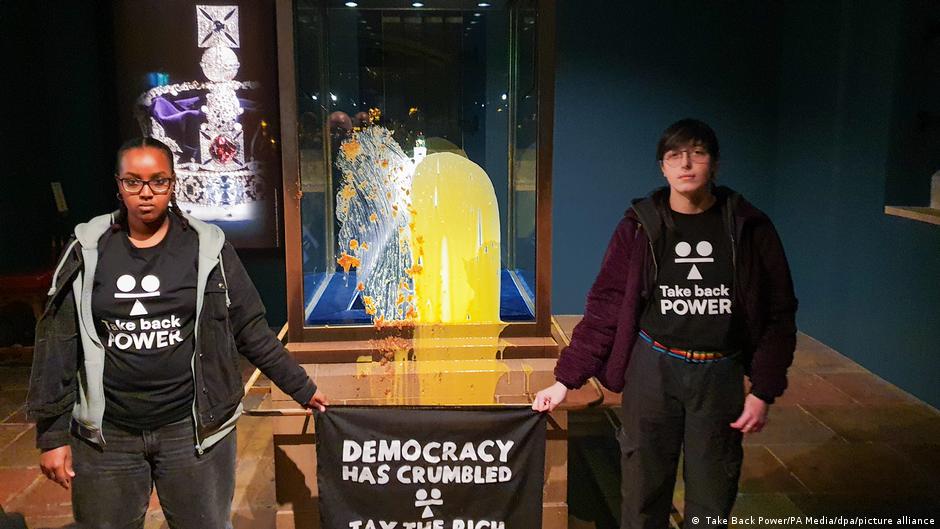
Four protesters were arrested on Saturday after throwing custard and apple crumble on the display case containing the Crown Jewels in the Tower of London, police said.
Take Back Power, an organization that describes itself as a civil resistance group, claimed responsibility.
The group posted the footage of the incident on social media. “Democracy has crumbled!” a young woman yelled, with a man adding, “Britain is broken.”
“We’ve come here, to the jewels of the nation, to take back power,” he added.
Take Back Power said in a statement that it is calling on the government to set up a permanent House of the People “that has the power to tax extreme wealth and fix Britain.”
What else do we know about the defacing of the Crown Jewels display case?
The Tower’s Jewel House was temporarily closed to the public after the incident.
Police said the protesters were arrested on suspicion of criminal damage.
But Britain‘s priceless Crown Jewels, which are a major tourist draw, were not damaged, according to Historic Royal Palaces, the independent charity which looks after the tower.
The incident at the Tower of London, one of London‘s most popular tourist attractions, is the second demonstration claimed by the Take Back Power group in the past few days.
On Wednesday, three protesters dumped bags of manure under The Ritz’s Christmas tree.
Tower of London: Crown jewels and royal history
To view this video please enable JavaScript, and consider upgrading to a web browser that supports HTML5 video
What are Britain’s Crown Jewels?
Containing 2,868 diamonds, 17 sapphires, 11 emeralds, four rubies and 269 pearls, the Crown Jewels are Britain’s most precious treasures.
Historic Royal Palaces describes the crown as “priceless, being of incalculable cultural, historical, and symbolic value.”
King Charles III wore the crown on his coronation day in 2023Image: LEON NEAL/AFP
Apart from coronations, the priceless crown is only brought out for formal occasions, such as the State Opening of Parliament, and is stored in the Tower of London’s Jewel House when not in use.
It was made for the coronation of King Charles III‘s grandfather, King George VI, in 1937.
Edited by: Rana Taha