
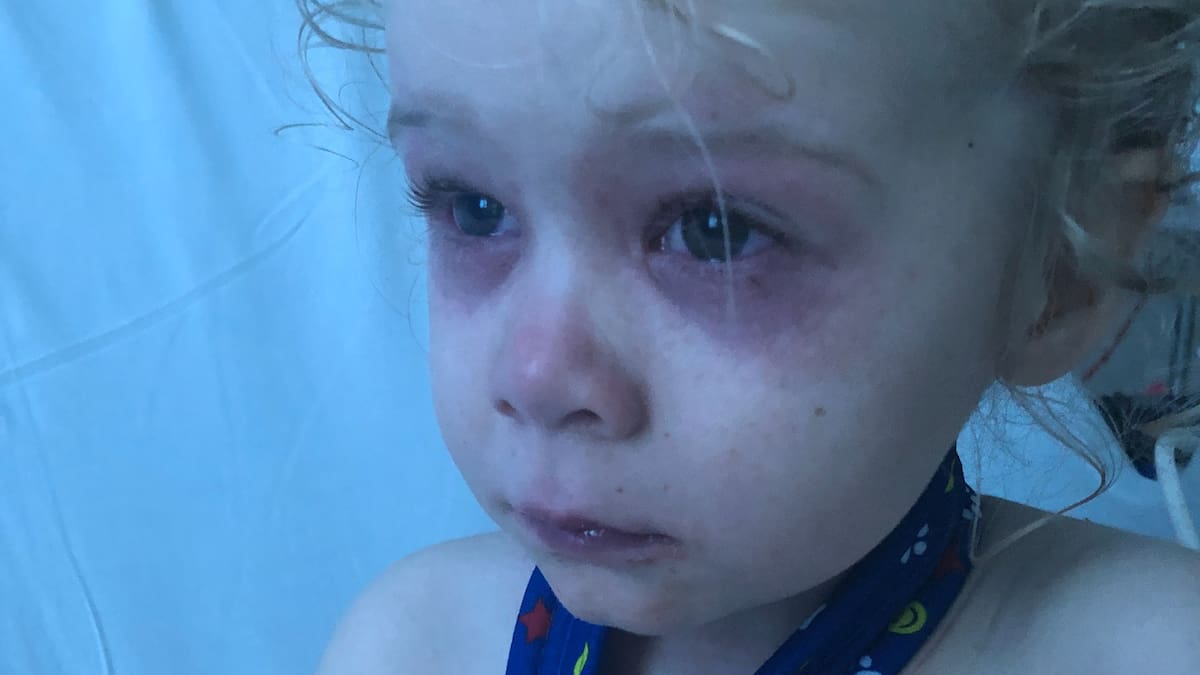
“It’s sad and confronting,” their mother Yvette Walker told news.com.au during an emotional interview.
“No amount of UV is safe for them.”
Even the smallest amount of UV causes severe burns. Photo / Gofundme
Doctors told the family they had nothing to worry about.
XP is so rare that the Walkers only know of six other families in Australia with the condition.
Amielle was diagnosed at 7, and by the time doctors confirmed it, the damage on her hands already resembled what would normally be seen on a 40-year-old.
Taya was diagnosed at 2 years old and doesn’t remember a world without these boundaries.
The doctors initially told the family they had nothing to worry about. Photo / Gofundme
“There’s an anxiety there for Ami because she knows it leads to cancer,” Yvette Walker said.
The disorder is genetic – a double recessive mutation causing a critical DNA process to fail.
Both parents are carriers, even though it hasn’t appeared in their family before.
Every day, the girls would return from school with major burns, particularly on their faces and lips.
When they decided to see a doctor, their concerns were initially dismissed.
“They told us it was fine and there was nothing to worry about,” Walker said.
After pushing for answers, the family was finally given a diagnosis, but it came at the cost of their lives “shrinking massively”.
Any exposure to UV is dangerous to the girls. Photo / Gofundme
Any exposure to the UV results in a high degree of burns.
“When we first told Ami, she put herself into bed and cried. There was a lot of resistance to everything we needed to implement,” Walker said.
The news was life-changing for Walker and their father, Nick Walker, yet alone 7-year-old Ami, who just wanted to play in the sun with her friends.
“We had to take her out of school for six weeks,” Yvette Walker said.
“We do far less than we did before and that’s a grief.
“We just hit these little grief pockets now and again.”
A normal day outside demands full-body protection.
A UV-blocking hat with German-made plastic face shields, gloves from the US, UV-rated tops and pants, thick socks, shoes and sunscreen.
If exposed to UV, their risk of cancer increases by 10,000 times.
The girls have to be fully protected against UV when they go outside. Photo / Gofundme
The family is hoping to raise awareness about the one-in-a-million condition.
Every item is monitored for rips or holes, and every outing must be planned down to the minute.
The girls’ school has been refitted with UV-filtered doors and windows and teachers co-ordinate daily to ensure precautions are being taken.
Even then, the girls will often miss out when the heat becomes too intense.
But the Walkers push hard to ensure the girls still get the chance to be “normal” kids.
When Amielle wanted to compete in her school swimming carnival, her parents made it happen.
She donned a full-length body suit, gloves, thick socks, a sports balaclava and full-face snorkel fitted with UV film.
“It was astounding,” Walker said.
“We told her that if she wanted to do it, we would make it happen.”
She’s also made the PSSA netball team – wearing a sports hood that connects under her arms – but still sits out on hot days.
They often have to choose between sleep, or enjoying the outdoors at night.
Year 6 camp in Canberra required an almost military level of planning.
“We checked every facility, every toilet and every meal situation,” Walker said.
Birthday parties, playgrounds and simple family outings come with layers of logistics that most parents can barely imagine.
Invitations have dropped off and, as much as it hurts, Walker said she understands why.
“It comes at a cost for a parent to have to consider,” she said.
Some of Amielle’s closest friends now host night-time movie nights, torch games and roast smores over fires so she can join in safely.
“Those beautiful modifications mean so much,” Walker said.
The Walkers’ biggest project – and highest hope – is a council-approved UV-safe backyard.
It’s a fully enclosed space that would finally allow the girls to play outside during the day.
It’s not just shade; it’s a precision-engineered structure where every millimetre must block UV. No gaps, no leaks, no risk.
They have spent most of their lives indoors.
The family wants to build a UV-safe play area for their children. Photo / Gofundme
Despite the many hurdles, Nick and Yvette Walker have worked hard to give the girls a normal childhood.
“It’s so meticously planned. It’s surreal,” Yvette Walker said.
The cost is enormous, with the family looking at A$560,000 ($643,000) for the full build, with more than A$100,000 for the roof alone.
Australia’s National Disability Insurance Scheme (NDIS) rejected their funding application, suggesting the girls could use a “local playground” instead. The family is taking the decision to the tribunal.
The NDIS has been contacted for comment.
“We’ve had so many knock-backs to get where we are today,” Walker said.
“We’re exhausted. But this would change their lives.”
The build is scheduled to be finished by December 19 and, if all goes to plan it will be the first Christmas the sisters will spend outside.
When news.com.au spoke to the sisters, they were overjoyed about the new backyard.
‘It’s the little things’
Little Taya said she was most excited to sunbathe and wear her favourite dresses outside.
“It’s the little things,” Walker said.
They will finally experience normalcy with a specially designed backyard build.
“We’ll be able to play outside and have the doors open. We’ll even have airflow throughout the house.”
Walker said she believed that people have a lot to learn from her daughters, who are immensely brave and positive given the situation they’ve been presented.
A friend of the Walker family has set up a GoFundMe, in the hopes of alleviating some financial pressure as they navigate their new build.
“We’re going public for awareness, education and fundraising, in the hope that people get a bit of an understanding about living a day in the life in our shoes,” Walker said.