

We use the Opta Power
Rankings to assess the strength of each group at the 2026 FIFA World
Cup following the draw at the Kennedy Center in Washington,
D.C. on Friday.
If your excitement for the 2026 FIFA World Cup had yet to truly
take off, it is surely now bubbling to the surface after Friday’s
draw confirmed the makeup of the groups.
Well, mostly. Of the 48 teams set to participate in Canada,
Mexico and the United States next June and July, six countries
won’t be confirmed until the final play-offs in March. So, while
there may still be a hint of uncertainty, for the most
part we know who’ll be meeting in the group stage.
Of course, we have to address the elephant in the room. With 48
teams taking part, the 2026 edition will be the biggest World Cup
tournament ever, representing a 50% increase in the number of
qualified countries. That means there’ll be plenty of debutant
nations and those who’ve never been regular participants. As such,
the range in ability is likely to be the broadest we’ve ever seen
at a men’s World Cup.
That doesn’t mean we shouldn’t expect entertainment, drama and
tension. But as with any World Cup, some groups appear a little
likelier to attract neutral eyeballs than others.
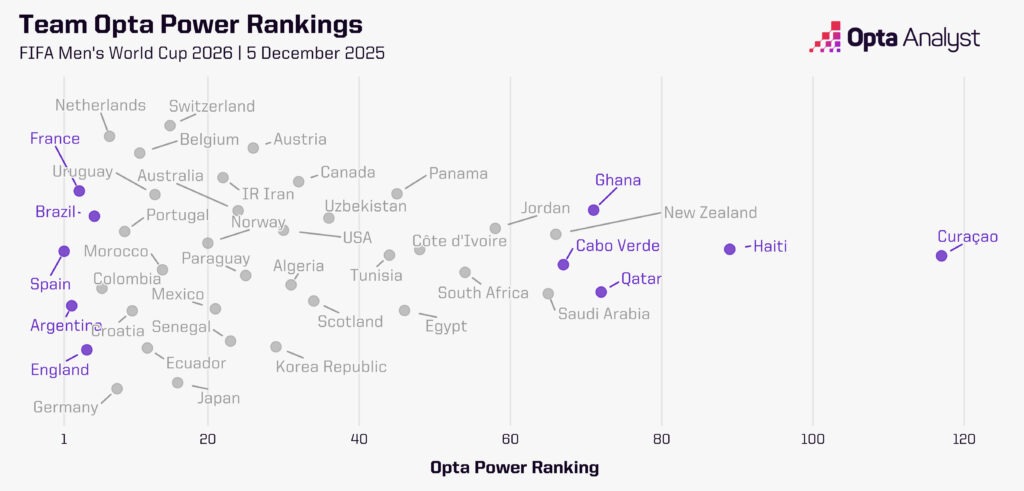
To identify which groups are the strongest, we’ve used the
Opta Power Rankings (a global ranking system that assigns an
Opta Power Rating between zero and 100 to every international team,
where zero is the worst-rated team in the world and 100 is the
best) to give each group an average rating.
Without any further ado, these are the 2026 World Cup groups
ranked from strongest to weakest…
Group
J
Average Rating: 77.1
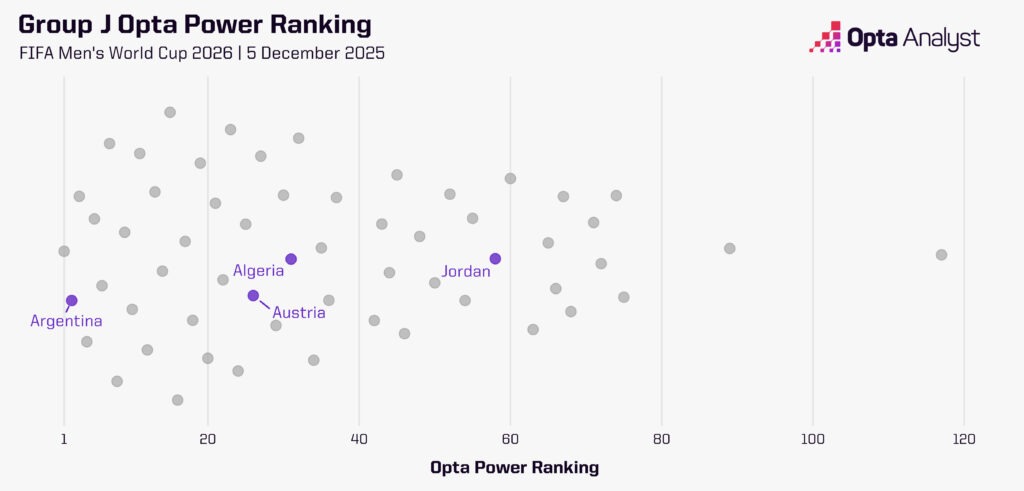
According to the Opta Power Rankings, Group J is statistically
the strongest of the 12 pools at the 2026 FIFA World Cup. Our model
says this is next summer’s ‘group of death’.
Headlined by reigning champions Argentina, the four teams drawn
into Group J have an average Opta Power Rating of 77.1. Lionel
Scaloni’s side obviously contribute heavily to that, with their
rating of 97.8 putting them second in the Opta Power Rankings,
though there are two other sides ranked 31st or higher as well.
Austria’s Opta Power Rating is 75.3, making them statistically
the second-strongest side in the group, followed by Algeria
(72.2).
The lowest-ranked side in the group are Jordan (ranking: 58,
rating: 63.1). The average ranking of the teams in Group J is 29.3,
though Argentina will surely still fancy their chances of
progressing unscathed.
Group
I
Average Rating: 76.7
While the Opta Power Rankings may not agree, many fans will
likely pinpoint Group I as the closest to a so-called ‘group of
death’.
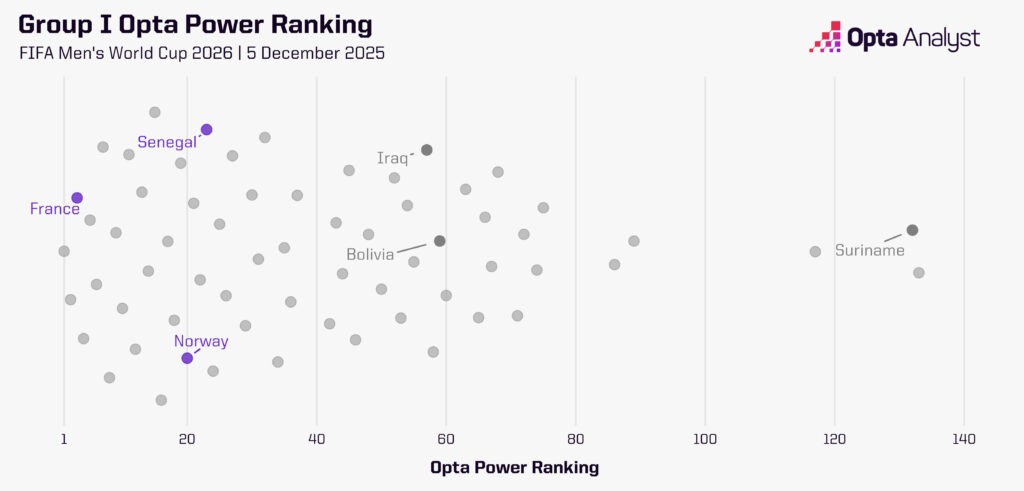
France, runners-up at Qatar 2022, will be fancied to win the
group and ultimately do well thereafter, but Les Bleus – who have
an Opta Power Rating of 96.8 – could find resistance.
Norway (rating: 77.6) and Senegal (rating 76.1) have the talent
to trouble any team on their day and will each think they have what
it takes to reach the knockout stages.
The reason why Group I comes in below Group J with respect to
average team rating is the fact the fourth team in the pool will be
the winner of the second intercontinental play-off. That team will
either be Iraq (rating: 63.2), Bolivia (63.0) or Suriname (42.3) –
none of them will be expected to do much of note, hence they bring
the group’s average down slightly.
Group
F
Average Rating: 76.6
The group with the best average Opta Power Ranking is
actually Group F – the three confirmed teams and UEFA Path B
winners have an average ranking of 27.8.
But when it comes to average ratings, they fall
slightly, essentially because the best-rated team aren’t deemed as
good as France or Argentina.
The Netherlands (rating: 88.7) will be favourites to top Group
F, but if anyone is confident of usurping them, it’ll be Japan
(81.2). Tunisia (68.3) are the lowest-rated confirmed side in this
section.
But of course, this is another group that isn’t completely
confirmed yet. The winners of the UEFA Path B play-offs will slot
in here, and among them are teams who could cause trouble.
Ukraine (74.7), Sweden (65.4), Poland (70.5) and Albania (62.2)
have an average Opta Power Rating of 68.2 – clearly, the Opta Power
Rankings suggest everyone in Group F will want to avoid
Ukraine.
Get stories and insights like this delivered weekly
into your inbox:
Group
H
Average Rating: 76.04
Spain top the Opta Power Rankings and are currently regarded as the
Opta supercomputer’s favourites.
Blessed with an Opta Power Rating of 100, no one will have been
happy to be drawn alongside them – Uruguay, Saudi Arabia and Cape
Verde have that dubious honour.
Marcelo Bielsa’s Uruguay (rating: 82.6) would appear the
likeliest to trouble La Roja, though their record at
recent tournaments isn’t great.
Saudi Arabia (61.7) might be written off by many, but don’t
forget they were the only team to beat eventual champions Argentina
at the 2022 World Cup. Cape Verde (59.8) may not be fancied either,
though they are only two spots below the Saudis in the Opta Power
Rankings.
Group
L
Average Rating: 75.9
It might be a little surprising to see Group L as low as this in
these rankings, but there is a plausible explanation.
With England, Croatia, Ghana and Panama, on paper it definitely
looks as though it’s among the strongest groups. However, Ghana
haven’t had a great few years, and they’ve fallen to a surprisingly
low 71st in the Opta Power Rankings (rating: 59.4) – that makes
them the weakest team in this section.
We know Ghana can call upon some talented players, though, and
generally they’ll be regarded as a bigger threat – at least in the
talent stakes – than Panama (ranking: 45, rating: 68.3).
But if the group goes with expectations, England (rating: 92.6)
and Croatia (83.4) – semi-final rivals in 2018 – will be battling
it out for first and second in Group L.
England are currently regarded as the fourth-best team in the
world, according to the Opta Power Rankings, after breezing through
qualification without even conceding a goal.
England’s route to the final
Group
K
Average Rating: 75.3
You’re probably thinking Portugal are the side to beat here –
however, the top-rated team from Group K in the Opta Power Rankings
are Colombia (ranking: 6, rating: 90.1).
Colombia came third in South American qualifying, with their 28
goals bettered only Argentina (31) in that section.
Portugal are ranked ninth (rating: 87.0), so slightly below
Colombia. Either way, it’ll be a significant shock if either fail
to make it out of a group that also includes Uzbekistan (ranking:
36, rating: 70.4) and the other intercontinental play-off winner –
so, one of the Democratic Republic of Congo (rating: 65.0), Jamaica
(rating: 53.9) or New Caledonia (42.1).
Those three have an average rating of just 53.7 – admittedly
that is heavily influenced by New Caledonia, who realistically are
the massive outsiders.
Group
C
Average Rating: 74.0
If the draw had pulled out a higher-rated team from Pot 4 than
Haiti (rating: 52.3), then Group C would likely be a bit higher up.
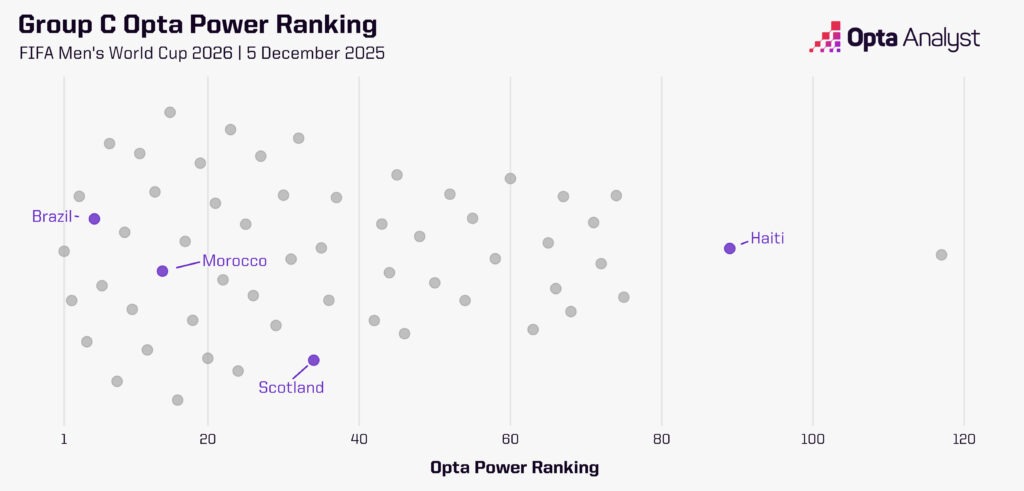
With Brazil, Scotland and Morocco all involved, it has the
potential to be tasty.
Five-time winners Brazil (rating: 90.5) will be massively backed
to top the group, but Morocco (82.3) became the first African
nation to reach the semi-finals in 2022, while Scotland (70.6)
qualified ahead of Denmark – there’s enough quality here to keep
things interesting.
Haiti will likely be happy to take a single point from this
group. They are ranked 55 places lower (89) in the Opta Power
Rankings than the lowest of the other three (Scotland – 34).
Group
D
Average Rating: 73.2
The average rating of Group D – much
like those of Mexico and Canada – is held back because co-hosts
United States are one of the weaker teams from Pot 1 in the
draw.
USA’s Opta Power Rating is 73.1, which actually makes them the
weakest of the three confirmed teams in Group D.
Paraguay (75.4) and Australia (75.6) should see this as a
massive opportunity to get out of the group, though there’s
potential for tricky opposition to come out of the UEFA Path C
play-offs.
Turkey (78.2), Slovakia (68.8), Romania (64.6) and Kosovo (62.7)
could all put a cat among the pigeons. So, don’t be surprised if
Group D ends up among the closest in the tournament.
Group
G
Average Rating: 72.1
Group G isn’t exactly filled with World Cup heritage. Belgium,
Egypt, Iran and New Zealand are the four members of this group, and
it won’t be getting too many pulses racing before a ball is
kicked.
Belgium (rating: 83.3) are always going to have a chance of
making an impression at the tournament, but Iran (76.4) aren’t a
million miles behind and could challenge them for top spot.
Egypt (67.7) will be looking to Mohamed Salah for inspiration,
but again, New Zealand (60.9) could be in with a chance of causing
a (small) upset or two, as well.
It’s far from the most exciting group, but it could produce some
tight battles.
Group
A
Average Rating: 71.3
With no team from the world’s top 20 in it, Group A doesn’t look
as strong as many of the other groups, but that may also mean it is
one of the most open.
Hosts Mexico went into this group from Pot 1, and their Opta
Power Rating of 77.2 leaves the door wide open for one of the other
three participants to challenge for the group-winners spot (the
winner of this group will play the winner of England’s group in the
round of 16, by the way).
South Korea are the next strongest, rated at 74.6, and South
Africa are also in there, with a rating of 64.8. The group will be
completed by a UEFA play-off winner: one of Czech Republic (rating:
70.0), Denmark (78.9), Republic of Ireland (65.9) or North
Macedonia (59.0) will be in Group A. Each of them would fancy their
chances of making it into the knockouts.
Group
E
Average Rating: 70.7
At eighth and 12th in the world, respectively, Germany and
Ecuador are the clear frontrunners in Group E. They will be the
favourites to run away with things at the top of an otherwise weak
group according to the Opta Power Rankings model.
This foursome is completed by Ivory Coast, who are ranked 48th
in the world, and lowly Curaçao who, at 117th in the world, are the
worst team at the tournament. Their Power Rating of 45.7 puts them
between Sierra Leone and Trinidad & Tobago in our global
rankings.
Making their debut at the World Cup, they may well be there just
to make up the numbers.
Group
B
Average Rating: 69.9
The lowest-quality group at the World Cup next summer is
unsurprisingly the one that contains the worst of the Pot 1 teams:
co-hosts Canada.
Ranked 32nd in the world with an Opta Power Rating of 71.7, just
behind Algeria and just ahead of Serbia, who failed to qualify for
the tournament, Canada were easily the weakest team in the first
pot. Now led by former Leeds manager Jesse Marsch, they’ll be out
to prove they’re better many think on home soil in the summer.
Switzerland, ranked 15th in the world according to the Power
Rankings, are the strongest team in the group, and are better than
many other Pot 2 teams, but their rating of 81.9 doesn’t drag the
group up enough.
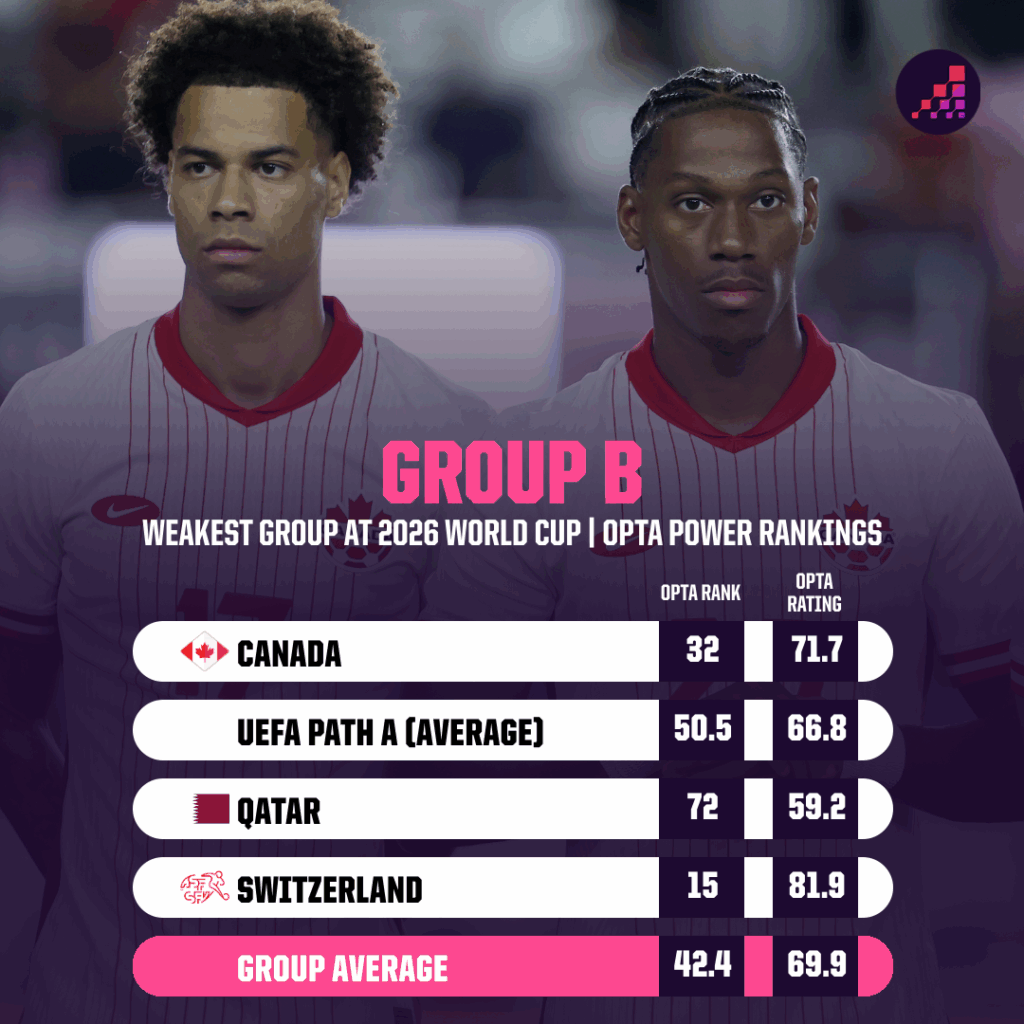
Meanwhile, Qatar bring the average down significantly with their
rating of 59.2.
This group may not actually end up quite as weak-looking in
reality, because they will be joined by the winner of the UEFA Path
A play-off, and that could be Italy, who are the 17th-best team in
the world according to our system. That said, that play-off could
also be won by Wales (42nd), Northern Ireland (68th) or Bosnia and
Herzegovina (75th), none of whom would do much for the group’s
average.

Enjoy this? Subscribe
to our football
newsletter to receive exclusive weekly content. You should
also follow our social accounts over on X, Instagram, TikTok and Facebook.