
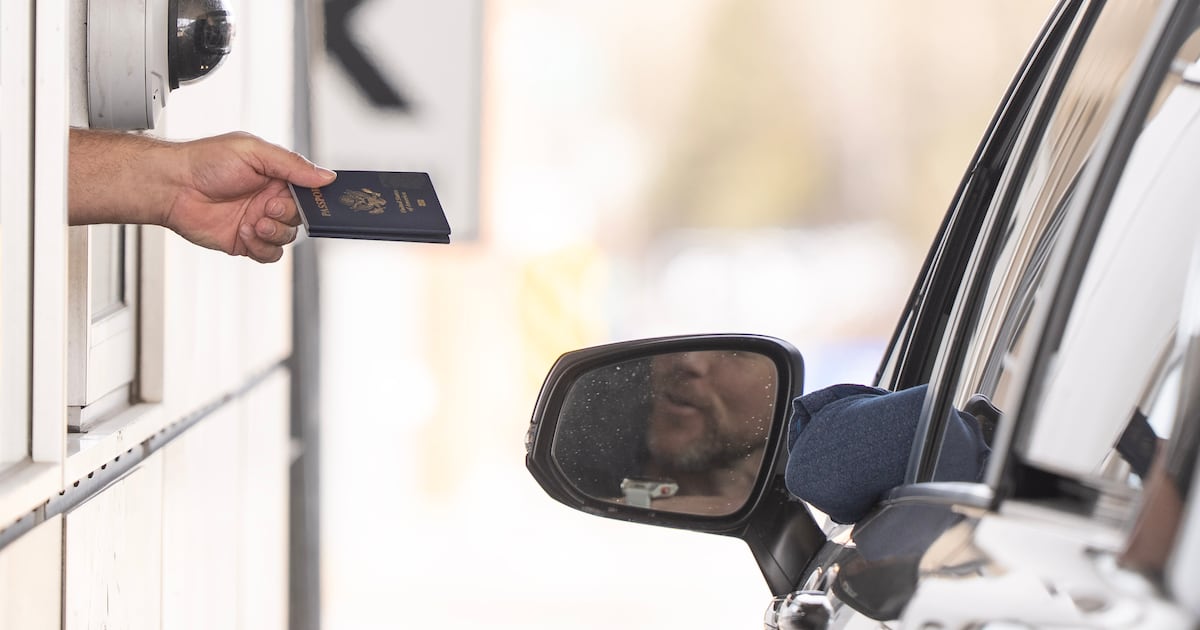
The changing political climate between Canada and the U.S. has some snowbirds rethinking their travel plans. Alex Karpa explains.
Angela and Leigh Faubert have been going to the U.S. for many years, travelling months on end throughout the winter.
On Nov. 6, they crossed the border between Aldergrove, B.C. and Washington.
This border crossing, however, was unlike any other they’d done before.
“We crossed the border, and they asked me to pull up on the other side of the border and told to walk into this little building,” said Leigh. “I had to get fingerprinted, show my passport. I think it was $30 that we had to pay, and I had to get my photo taken.”
“The picture was okay, but the fingerprinted thing was a little but excessive, I think,” he said.
Although Leigh was forced to go through the process, Angela did not. She crossed with her Secure Certificate of Indian Status (SCIS) card, which made her exempt.
“I was very surprised that I had no issue crossing with my SCIS card, and not my passport,” she said.
New border rules
Canadians travelling to the U.S. are facing new rules at the border.
On Jan. 20, 2025, U.S. President Donald Trump signed an executive order titled Protecting the American People Against Invasion, introducing stricter requirements for foreign visitors.
Under the order, the U.S. Department of Homeland Security must ensure that all non-Americans staying in the country for more than 30 days register with the government.
Canadians staying in the U.S. for more than 30 days must complete an I-94 form and register with U.S. Citizenship and Immigration Services upon entry.
The new measures, effective Dec. 26, also expand security screening, including mandatory fingerprinting and photographs for visitors.
Both Leigh and Angela said they were a little nervous crossing the border, as they both heard stories of Canadians being turned away.
“It was a little intimidating getting to the border because of all the confusion,” Angela said.
That confusion is something other Canadians have also experienced.
Winnipeggers Owa Schlaikjar and Yvonne Fostey travel south every winter, owning property in Arizona.
With the new changes, they were advised to fill out the I-94 forms in order to get into the U.S., which they did with no issue.
But Yvonne says when they crossed the border on Nov. 18, the border agent was confused about the paper they were holding.
“The customs officer said what are you flagging this paper around for,” she said. “We said it was a form we understood we had to fill out.”
“She (the customs officer) said for next time, just call the port directly. It’s business as usual. You don’t need that form filled out,” she said.
Owa said he was surprised and a little annoyed because he spent time filling out forms and paperwork ahead of their crossing date.
“You had to pay in advance, and this is the first time I’ve experienced paying money to get into the United States,” he said. “It was just basically a waste of time.”
“It leaves people in distress. It leaves them confused and they don’t know what to do. I want to spread the message that everything is normal,” he said.
Important to be prepared
Ksenia Tchern McCallum is a U.S.-Canadian Attorney in Toronto. She says it’s important for Canadians to have a plan before crossing the border.
“Where are you staying? Have the address. How long are you staying? Have your return ticket booked,” she said.
“How are you going to support yourself? Do you have health insurance? Do you have a job back home? What are your ties back home? Do you have a family? Do you have pets?” she said.
“They just want to determine, you know, what are you planning on doing for the time that you’re going to be in the States, because they are pretty much just looking out for anybody that’s coming in to do some unlawful work, or have some other intentions that they are not presenting to be quite honest and truthful at the time of their entry.”
Tchern McCallum says each border guard may have different questions or requirements with travellers coming into the U.S., which may be the reason why some Canadians are experiencing different outcomes.
“Yes, there is additional scrutiny, but at the end of the day, if you are being honest and you are being truthful and you have a plan in hand, you should not have any issues entering,” she said.
Some Canadians avoiding the U.S. altogether
Eric Fagen and his family have always spent their winters in Florida, RVing for five months at a time, but this year, that will not be the case.
“We originally were planning on going back this year until the attacks on Canada from the current (U.S.) administration,” he said.
The changing political atmosphere in the U.S. was something he wanted to avoid, calling it a tough decision.
“We regret that we’re not going down in the sense that we met some great people, some great Americans, some great Canadians at the RV Parks we stayed at, and we enjoyed our stay down there,” he said.
Although Fagen’s family made plans to travel south elsewhere, he still hopes one day he can return to the RV park he called home for many winters.
“We’re not totally divorcing ourselves from going into the U.S.,” he said.
With files from CTV News’ Kristen Yu