
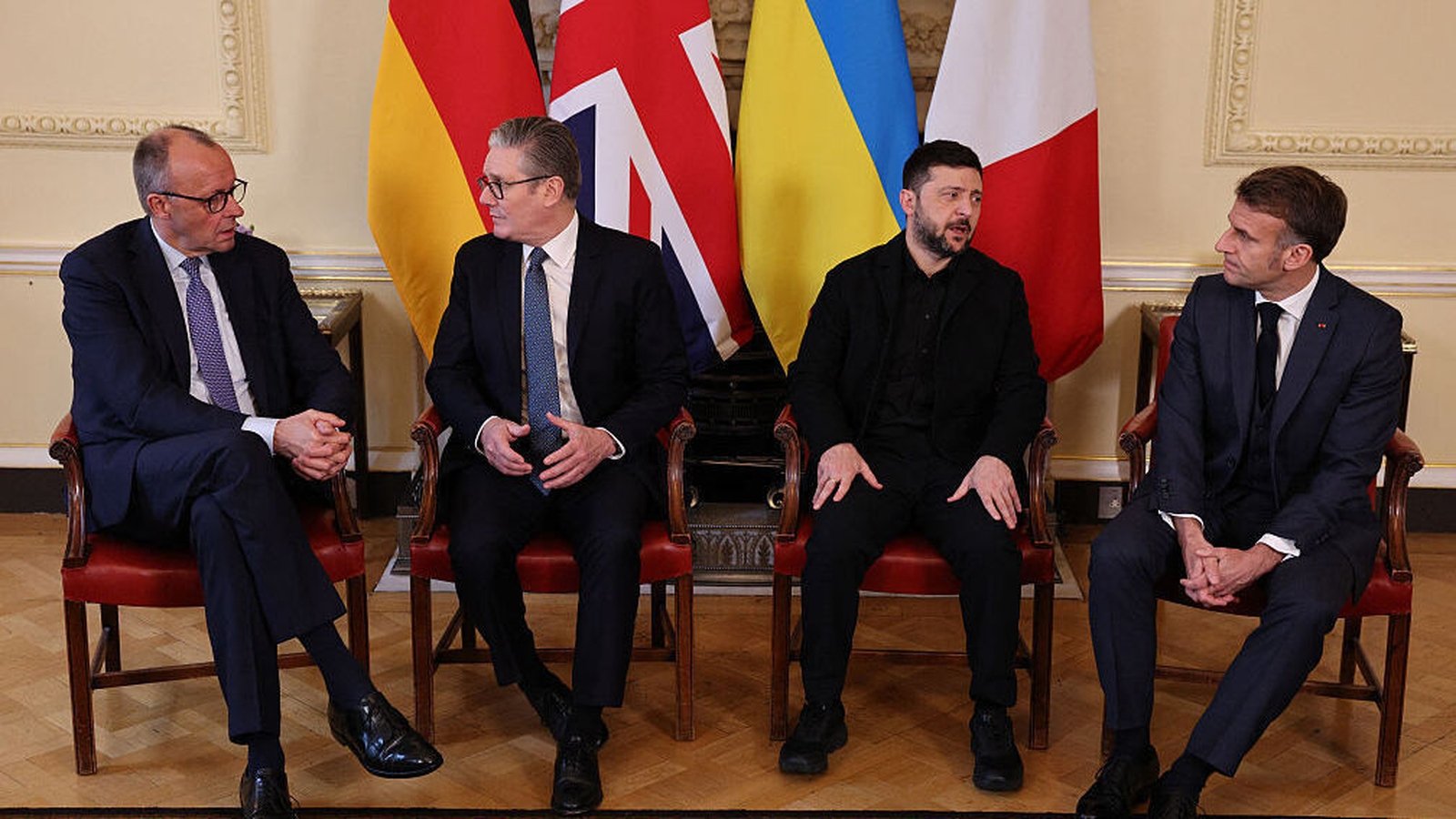
French President Emmanuel Macron has said talks in London with Ukraine’s President Volodymyr Zelensky were aimed at finding a “convergence” between US, European and Ukrainian allies on a possible peace deal to end Russia’s invasion.
“I think the main issue is the convergence between our common positions, Europeans and Ukrainians and the US to finalise these peace negotiations”, Mr Macron said.
All parties could then move to a “new phase” in which they would aim to secure “the best possible conditions for Ukraine, for the Europeans and for collective security”, he added.
Mr Zelensky is meeting European allies, after US President Donald Trump accused him of not reading the US proposal to end the war with Russia.
It comes after days of talks between Ukrainian and US officials in Miami ended on Saturday with no apparent breakthrough, with Mr Zelensky committing to further negotiations.
The Ukrainian president is meeting British Prime Minister Keir Starmer, along with German Chancellor Friedrich Merz and French President Emmanuel Macron to discuss the negotiations.
Speaking ahead of the talks Mr Zelensky said his country “can’t manage” without European and US support.
“I think that now it’s very important to organise sessions to meet and discuss very sensitive issues regarding these talks (we had) in the United States.
“A lot of what we have to discuss… are things that are very important for unity between Europe and Ukraine, and also unity between Europe and Ukraine and the United States.
“We can’t manage without Americans, we can’t manage without Europe and that is why we need to make some important decisions,” he said.
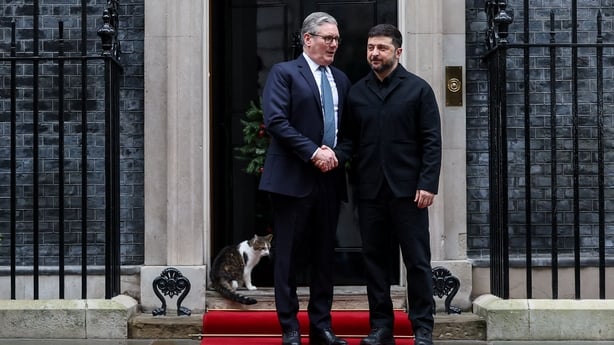
Keir Starmer welcomes the Ukrainian President to Downing Street
Mr Starmer said any ceasefire in Ukraine must be “just” and “lasting”, adding, “we are at a critical stage in the push for peace.
“The principles remain the same: we stand with Ukraine, and if there is to be a ceasefire, it needs to be a just and lasting ceasefire.”
Mr Zelensky is also due to meet the heads of NATO and the European Union in Brussels later today.
Meanwhile, British Foreign Secretary Yvette Cooper is expected in Washington, where she will meet her US counterpart Marco Rubio.
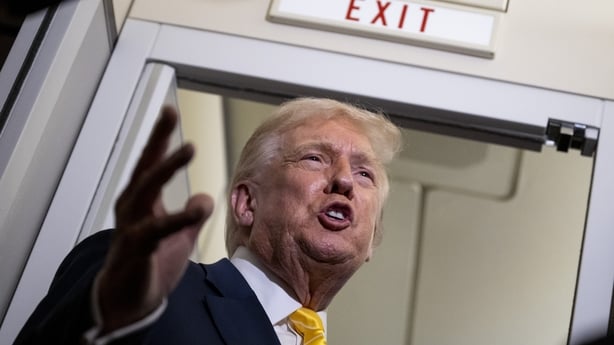
Donald Trump has blown hot and cold on Ukraine since returning to office in January
Mr Trump criticised his Ukrainian counterpart, telling reporters that he was “a little bit disappointed that President Zelensky hasn’t yet read the proposal, that was as of a few hours ago”.
Mr Witkoff and Mr Kushner had met Russian President Vladimir Putin at the Kremlin last week, with Moscow rejecting parts of the US proposal.
The initial US plan to bring an end to the almost four-year war involved Ukraine surrendering land that Russia has not been able to win on the battlefield in return for security promises that fall short of Kyiv’s aspirations to join NATO.
However, the nature of the security guarantees that Ukraine could get has so far been shrouded in uncertainty, beyond an initial plan saying that jets to defend Kyiv could be based in Poland.
Mr Trump has blown hot and cold on Ukraine since returning to office in January, initially embracing Mr Putin and chastising the Ukrainian president for not being grateful for US support.
But he has also grown frustrated that his efforts to persuade Mr Putin to end the war, including a summit in Alaska, have failed to produce results and he recently slapped sanctions on Russian oil firms.
Taoiseach signs joint letter supporting using frozen Russian assets to underwrite Ukraine loan
Meanwhile, Taoiseach Micheál Martin has signed a joint letter strongly supporting the use of frozen Russian assets to underwrite a multi-billion euro loan to Ukraine.
A proposal to convert up to €210bn in Russian assets into a long term loan to meet Ukraine’s budgetary and military needs in the coming years is being assessed by member states ahead of a summit of EU leaders in Brussels on 18 December.
Belgium remains opposed to the plan, fearing retaliation and legal claims by Russia. The bulk of immobilised assets in Europe are held by the Belgian securities depository, Euroclear.
In a joint letter to European Commission President Ursula von der Leyen and European Council President António Costa, seven EU leaders, including the Taoiseach, warn that “time is of the essence” and that the use of Russian assets was “the most financially feasible and politically realistic solution, [as] it addresses the fundamental principle of Ukraine’s right to compensation for damages caused by the [Russian] aggression.”
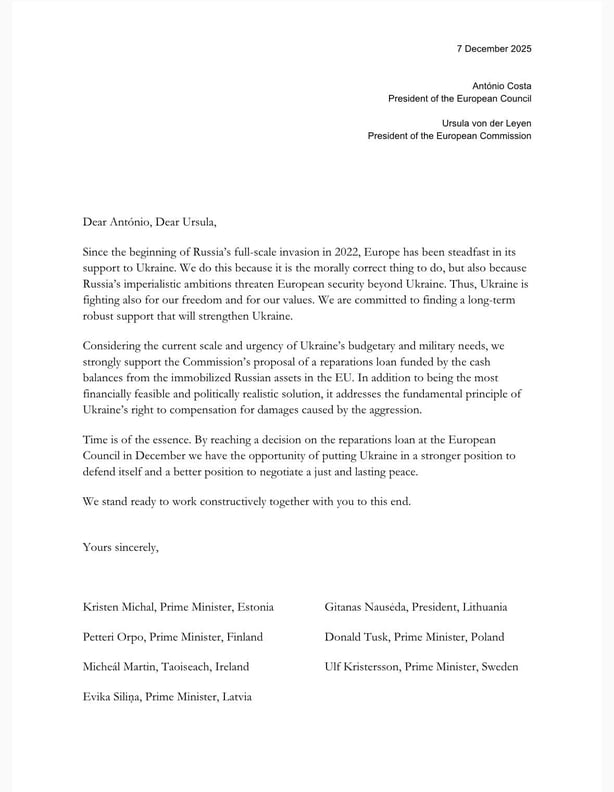
The letter, seen by RTÉ News, was also signed by the leaders of Poland, Sweden, Latvia, Estonia, Lithuania and Finland.
It states that the EU’s steadfast support for Ukraine was both the morally right thing to do and because “Russia’s imperialist ambitions threaten the security of Europe beyond Ukraine.”
The leaders add: “Considering the scale and urgency of Ukraine’s budgetary and military needs, we strongly support the Commission’s proposal of a reparations loan funded by the cash balances from the immobilised Russian assets in the EU…
“By reaching a decision on the Reparations Loan at the European Council in December we have the opportunity of putting Ukraine in a stronger position to defend itself and a better position to negotiate a just and lasting peace.”
Additional reporting Tony Connelly, PA