
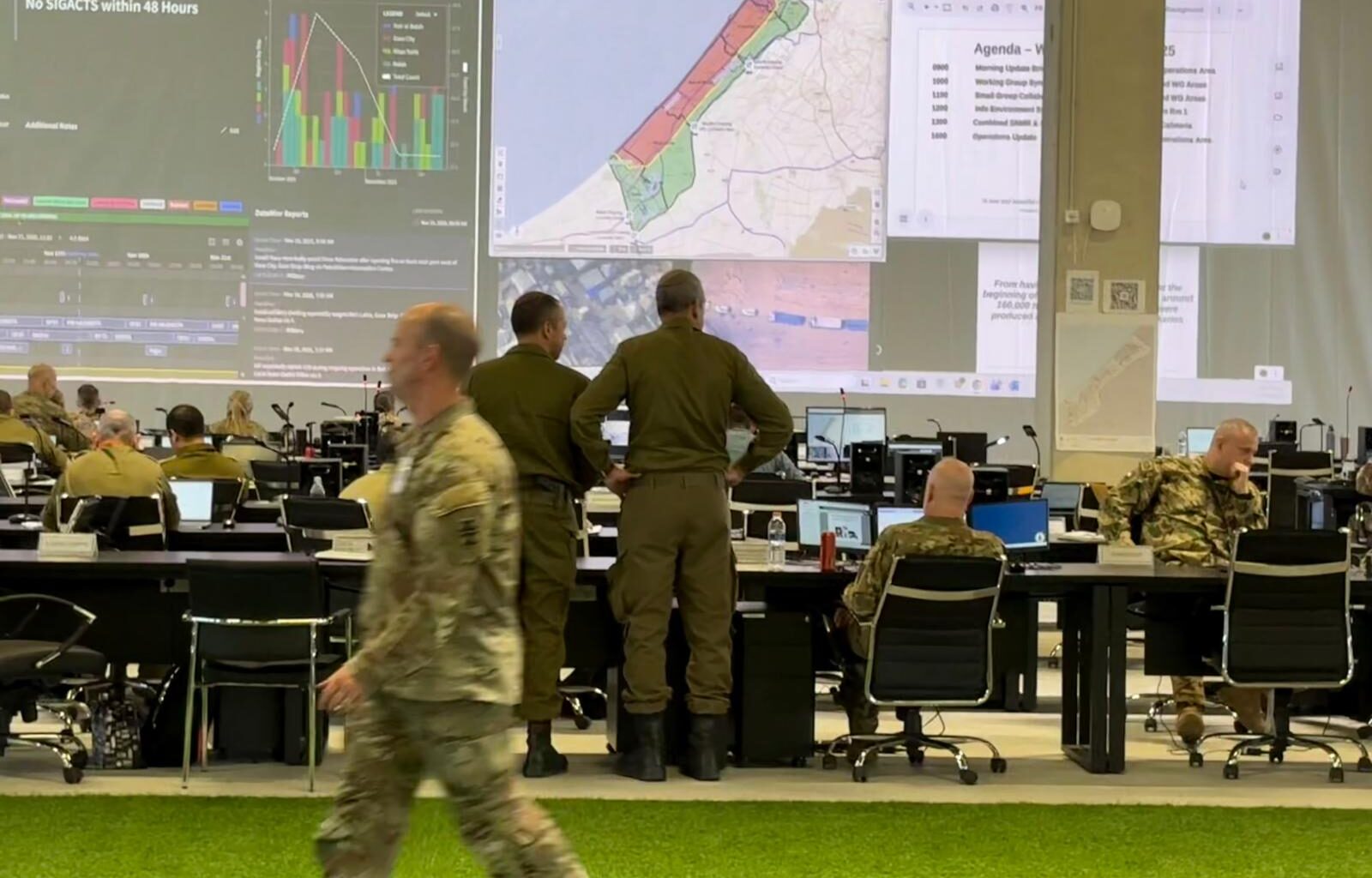
US forces stationed at the Kiryat Gat facility where the ceasefire in Gaza is being monitored have reportedly accused their Israeli counterparts of conducting widespread surveillance of those working there.
The Israel Defense Forces called the claim, which appeared in the Guardian on Monday, “absurd.”
The report, citing unnamed sources familiar with the matter, alleged that Israeli forces have made a habit of recording meetings inside the Civil-Military Coordination Center, both openly and covertly, drawing ire from the US and other allied countries that have a presence at the southern Israel base.
According to the sources, the Israeli intelligence gathering at the CMCC, which hosts representatives from dozens of countries and organizations, led the US commander of the base, Lt. Gen. Patrick Frank, to summon his Israeli counterpart for a meeting, in which he informed him that “recording has to stop here.”
The practice has reportedly led some of Israel’s allies to instruct their forces at the compound to avoid revealing sensitive information, for fear that it could be “collected and exploited,” the report added.
Get The Times of Israel’s Daily Edition
by email and never miss our top stories
By signing up, you agree to the terms
The IDF declined to comment to The Guardian on Frank’s alleged demand and noted that conversations within the CMCC are not classified.
“The IDF documents and summarizes meetings in which it is present through protocols, as any professional organization of this nature does in a transparent and agreed-upon manner,” the Israeli military told the newspaper in a statement.
“The claim that the IDF is gathering intelligence on its partners in meetings in which the IDF is an active participant is absurd,” the statement added.
The US military declined to comment to The Guardian on the allegations.
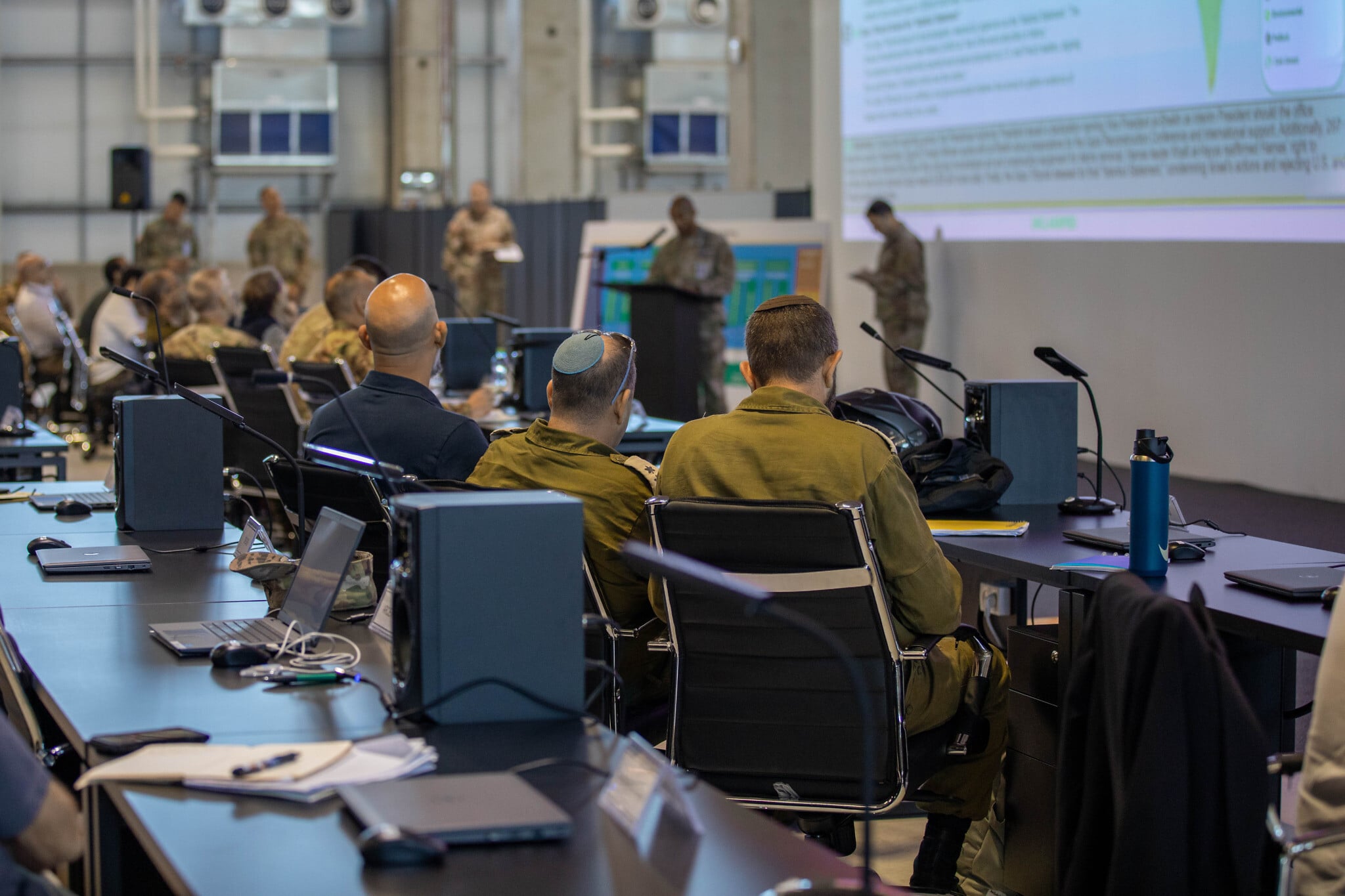
Israeli and US Army soldiers discuss civil-military operations inside the Civil-Military Coordination Center (CMCC) on October 28, 2025. (US Army)
The CMCC, established under US leadership, is designed to coordinate humanitarian, logistical, and security assistance into Gaza while helping oversee the postwar stabilization phase. It is located inside a logistics company building in an industrial zone in Kiryat Gat, some 20 kilometers (13 miles) from Gaza.
The CMCC uses the first three floors of the building. The second floor is where the various countries come together in a cavernous space with massive screens and whiteboards, while the first floor is reserved for Israel and the third for the US.
Along with Israel and the US, countries that have sent troops to the compound include Jordan, the UK, Germany, Denmark, Canada, Australia, France, Spain, and the United Arab Emirates.
Last month, an Israeli official told The Times of Israel that Jerusalem was playing a secondary role at the CMCC, and that the US had become the prime decision-maker, including on issues pertaining to the delivery of humanitarian aid to Gaza, where Israel has accused Hamas of looting aid convoys and placed restrictions on the shipments.
A US official speaking to The Guardian on the condition of anonymity disputed that Washington had the final say on aid deliveries to Gaza and characterized the efforts in that area as “hand in glove,” with Israel as the hand and the CMCC acting as “the glove over that hand.”
Unnamed diplomats told The Guardian that the talks at the CMCC have led Israel to ease restrictions on several items that had been considered to have “dual use” applications that Israel believes could be repurposed by Hamas, and had been banned from entering Gaza until now.
Last month, CMCC officers said that an average of 800 trucks of humanitarian aid have entered the Gaza Strip each day since the ceasefire took effect.
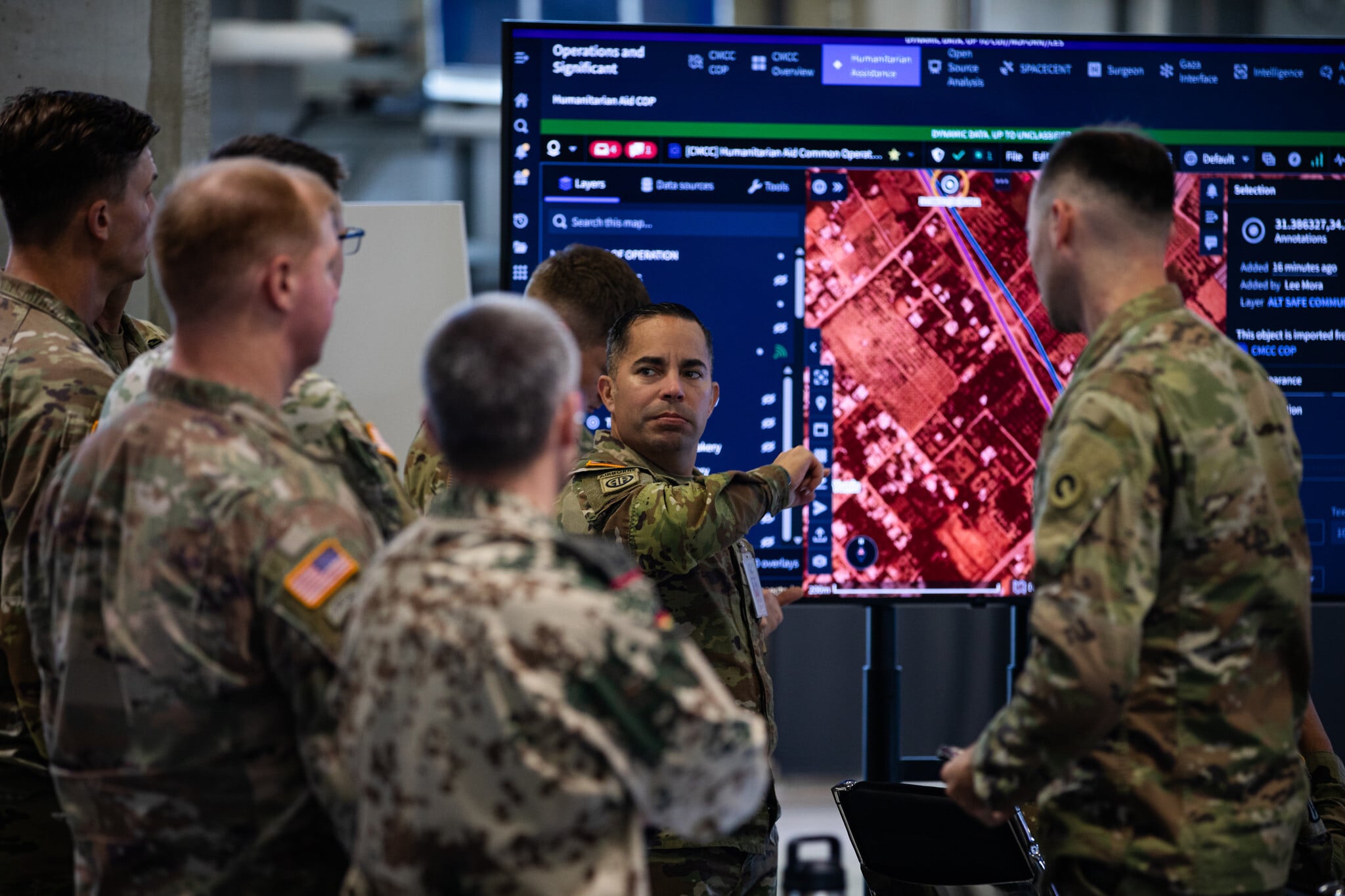
US Army Col. Anthony Marante meets with US soldiers and a member of the German Armed Forces regarding humanitarian aid delivery and distribution on November 12, 2025, at the Civil-Military Coordination Center in Israel. (Spc. Aiden Griffitts/US Army)
Since its inauguration in October, the CMCC’s precise structure, command hierarchy, and legal status have remained undefined, even as the first phase of US President Donald Trump’s 20-point plan for the Gaza Strip draws to a close.
The second phase, as laid out in Trump’s plan, outlines governing arrangements for the enclave and is expected to begin soon, though Israel is still awaiting the return of the final deceased hostage, Master Sgt. Ran Gvili, which is to be completed under the first phase.
The next step of the plan envisions Hamas disarming and Israel withdrawing as a multinational force deploys across the Strip at the same time as a Palestinian technocratic body begins managing Gaza’s day-to-day affairs.
Jacob Magid contributed to this report.
You appreciate our journalism

You clearly find our careful reporting valuable, in a time when facts are often distorted and news coverage often lacks context.
Your support is essential to continue our work. We want to continue delivering the professional journalism you value, even as the demands on our newsroom have grown dramatically since October 7.
So today, please consider joining our reader support group, The Times of Israel Community. For as little as $6 a month you’ll become our partners while enjoying The Times of Israel AD-FREE, as well as accessing exclusive content available only to Times of Israel Community members.
Thank you,
David Horovitz, Founding Editor of The Times of Israel