

Listen to this article
Estimated 4 minutes
The audio version of this article is generated by text-to-speech, a technology based on artificial intelligence.
Mayor Olivia Chow wants Toronto Transit Commission (TTC) riders to automatically ride for free for the rest of the month after taking 47 trips, announcing Monday she’s proposing a system known as fare capping to reduce up front costs for riders.
The current monthly passes cost $156 (about 47 fares) for an adult, meaning riders need to take a certain number of trips to get its full value. Fare capping means people wouldn’t have to make that spend without being certain their trips will cover the cost.
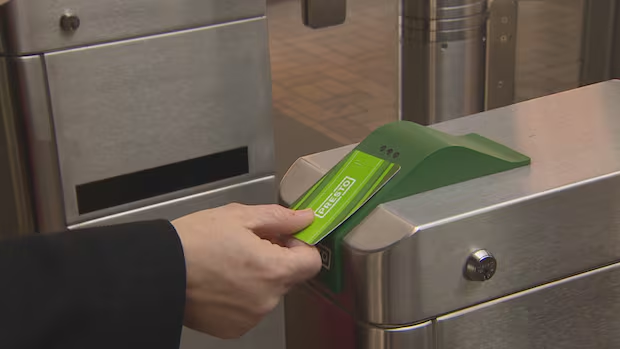
If the mayor’s proposal is approved, starting September 2026, TTC riders will automatically ride the rest of the month for free after taking 47 trips in that calendar month, according to a news release issued Monday. The system will work automatically for anyone of any age using PRESTO, debit or credit.
“No family should have to choose between rent, food or getting around,” Toronto Mayor Olivia Chow said at a news conference Monday.
“If you use the TTC to get to work, to keep our city running, to get to school, you deserve to save money. You take care of your family, you show up, you do your part. This city should work for you.”
The mayor went on to list the ways in which her administration has improved public transit, including the One Fare program, the addition of crisis prevention workers on platforms and reduced wait times on Line
“Transit should fit your life, not the other way around. Together, we’re building a caring, safe, affordable city that delivers for you. A safer, more reliable, more affordable TTC is getting us there,” she said.
In Monday’s release, the city said the project will cost a total of $3.5 million in 2026 — $2.9 million from the TTC and $600,000 from the city.
WATCH | Residents react to Toronto’s Finch West LRT opening: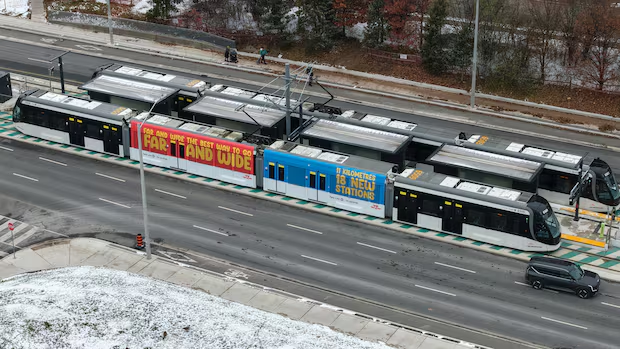
Residents react to Toronto’s Finch West LRT opening
Sunday marks the opening of the Finch West LRT, which becomes Line 6 on the TTC. It’s the first time a new transit line has opened in the city in more than two decades. CBC’s Haydn Watters travelled the line’s route to hear how locals are feeling.
Advocates have been calling for fare capping on the TTC, saying many people wouldn’t buy their passes on the first of the month because it’s the same day rent is due. Fare capping is quickly becoming widespread in the industry, according to a TTC report from early this year, already implemented in London, New York and Los Angeles.
Transit advocacy group TTC Riders has been pushing for the move since 2021, its executive director, Andrew Pulsifer, said.
“We’re thrilled to see it implemented,” he told CBC Toronto. “Would love more faster, but we’ll take what we can get at this point.”
Pulsifer said fare capping will allow for more flexibility, especially since it’s automatic and applies to every level of fare, from seniors to students. But, he noted now it’s time to start thinking bigger: daily or weekly caps.
“That’s something that a lot of other jurisdictions do [with] great success. It’s really good for tourists and people visiting the city, people who want to travel around and do an activity,” he said.
Commuter Caroline Goveas said she doesn’t use the TTC a whole lot, but this might just incentivize her to do so more often.
“I don’t keep track of how much I use the subway. So that would be awesome as a student,” she said. “I always think, ‘can I walk a couple stops rather than taking the subway?'”
Rider Elton Campbell said the fare cap drives accessibility.
“I am rolling with life’s punches, just like many riders of the TTC. Our circumstances during each month are always evolving,” he said.
The mayor, who has not yet said whether she’s running for reelection in 2026, is also asking the TTC to plan for a 40-ride fare cap in the 2027 budget.