
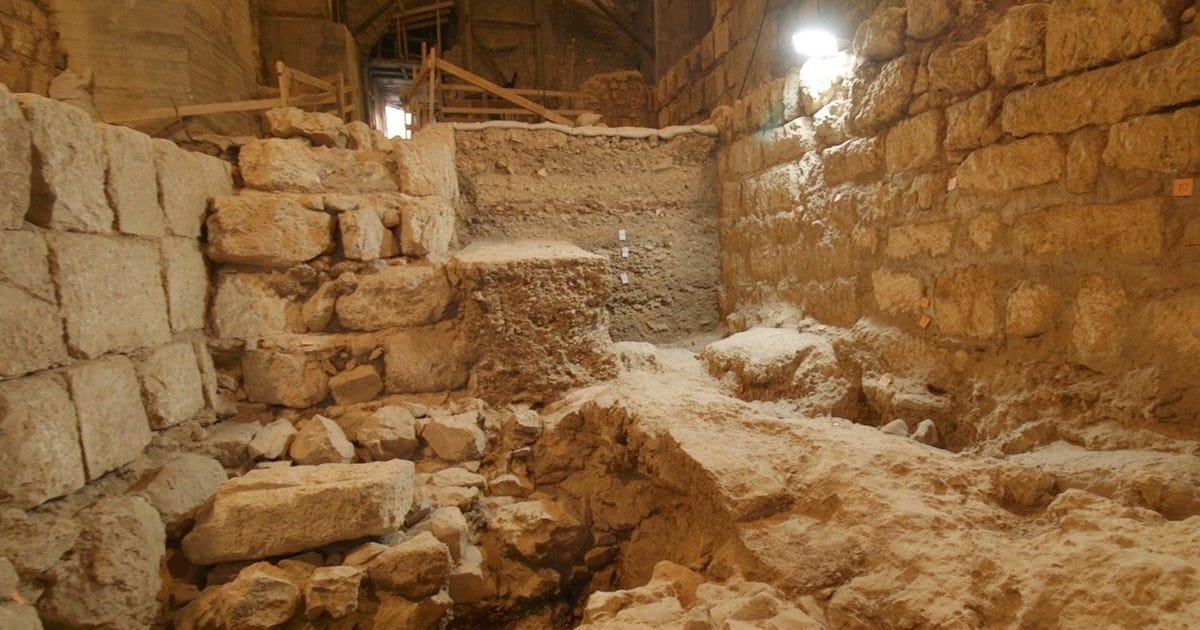
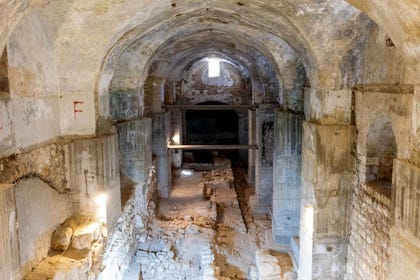
A 40-meter-long section of the ancient city wall of Jerusalem, a monster edifice around five meters thick, has been unearthed within the grounds of the Kishle prison complex that dates to the Turkish and British periods. It was found right by “David’s Citadel,” which actually dates to King Herod’s time.
The newly uncovered section of wall is one of the most complete and longest to be discovered in ancient Jerusalem to date, the Israel Antiquities Authority said on Monday. They date it to the Hasmonean period, which began in the second century B.C.E., the period of the Second Temple, and it must have been a daunting sight to the foul enemy.
This Hasmonean city wall may have risen as tall as 10 meters in height, the archaeologists guess based largely on precedent, and the width of its foundations. That is well above the height of the present city wall, which dates to the Ottoman period. Nor was any of that the baked mud brick used to wall lesser cities. It was constructed using the white limestone typical of Jerusalem construction.
Related Articles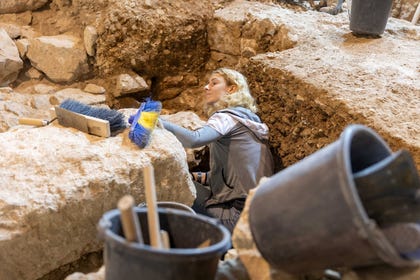 Close
Close
Dr. Marion Zindel, excavation co-director Credit: Dor Pazuelo/Tower of David Museum
Dr. Marion Zindel, excavation co-director Credit: Dor Pazuelo/Tower of David Museum
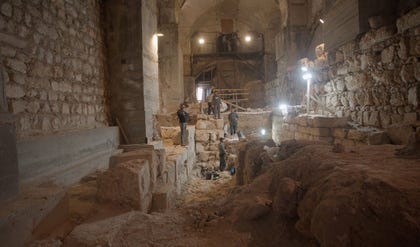
The excavation in the prison, directed by Dr. Amit Re’em and Dr. Marion Zindel of the IAA, is being done ahead of construction works, the IAA reveals – an archaeology and art wing is to arise in the complex of incarceration.
The archaeologists call this this the “first city wall” of Jerusalem, but that may be something of a misnomer, Re’em tells Haaretz by telephone. It seems this wall followed the trajectory of older fortifications. It was built some decades after the “Hanukkah event” (a rebellion against the Seleucids) and makes the present city wall, which mostly dates to Ottoman reconstruction, look pitiful.
During the Second Temple period, the wall would have also surrounded Mount Zion, which the Ottoman wall does not. Mount Zion is outside today’s wall, but sections of the ancient wall have been found there as well as in the City of David, located south of Temple Mount, and elsewhere.
 Close
Close
The excavation took place in Jerusalem’s Old City, south of the Tower of David. Credit: Gabriel Volcovich/Tower of David Museum
The excavation took place in Jerusalem’s Old City, south of the Tower of David. Credit: Gabriel Volcovich/Tower of David Museum
For all its might, the wall was destroyed, dismantled, pulled down and was thereafter gone; this was not done by howling enemy soldiers with bloodied spears, but by workers laboring under meticulous instructions, the archaeologists believe; and the million-shekel question is who did it.
The Roman-Jewish historian of dubious reputation, Yosef ben Matityahu or Josephus, who would be captured by the Romans in the battle over Yodfat, wrote in detail about the mighty Jerusalem wall and its gates, calling it “impregnable” with no less than 60 guard towers along its length.
Maybe it was impregnable. “It is clear that it was systematically destroyed and razed to the ground. This is predetermined destruction – not the result of the ravages of time, nor of enemy attack,” says Re’em. “This raises questions about who was responsible for the wall’s destruction.”
That it does. One theory is that it was dismantled by the very people who built it – the Hasmoneans, as part of the settlement reached with the overlord – at the time, Antiochus VII Sidetes, the last Seleucid king, who ruled from 138 to 129 B.C.E. He besieged Jerusalem, but that didn’t end in fiery conquest but in an agreement.
 Close
Close
Who destroyed the wall? maybe the very Hasmonean regime that built it Credit: Dor Pazuelo/Tower of David Jerusalem
Who destroyed the wall? maybe the very Hasmonean regime that built it Credit: Dor Pazuelo/Tower of David Jerusalem
According to Josephus, the cowed Hasmonean leader John Hyrcanus I reached a peace agreement with Sidetes, who may have been richly bribed with treasures pilfered from the tomb of King David. Sidetes also demanded that the city wall be pulled down and maybe that is exactly what happened, leaving behind only the stumps that archaeologists have been uncovering today.
Another possibility, however, is that perhaps King Herod “the builder” did it himself, jealously bidding to distinguish the wonder that was he from the Hasmonean kings. He may have deliberately pulled down their hallmark construction projects, including their monumental city wall, as a political statement, the archaeologists say, as in – Here today, gone tomorrow, but right now I am here.
Supporting this thesis is the fact, Re’em explains, that this great wall was found dug into the foundations of Herod’s palace, which was one of the great structures of ancient Jerusalem, hailed for its treasures by Josephus, who compares its dimensions and beauty to the great Temple itself.
 Close
Close
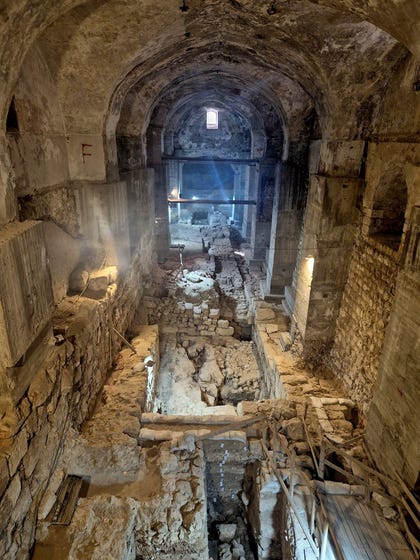
The excavation site in the Kishle, which served as a prison complex in the Ottoman and British eras. Credit: Yoli Schwartz/IAA
The excavation site in the Kishle, which served as a prison complex in the Ottoman and British eras. Credit: Yoli Schwartz/IAA
“So we think the one who pulled it down may have been Herod,” Re’em sums up. “Why would he do that? Why not use the wall to continue protecting his palace and city? We think Herod wanted to send a message to the Jewish population: ‘Guys, the time of the Hasmoneans is over; the Jewish kings are over; I’m here.’ How do you send such a message at the time? You destroy the Hasmonean monuments, dismantle them and get the message through loud and clear.”
Anyway this likely wasn’t the first fortification of Jerusalem. Josephus speaks of an old wall that he thinks was built by David and Solomon, which would place its construction in about the 10th or ninth century B.C.E. The archaeologists may now have uncovered what could be the smoking gun of an earlier wall before the Hasmonean one, from the time of the First Temple, Re’em sums up.
 Close
Close
Hasmonean-period arrowheads and catapult stones, Tower of David Jerusalem Museum. Credit: Emil Aladjem / Israel Antiquities Authority
Hasmonean-period arrowheads and catapult stones, Tower of David Jerusalem Museum. Credit: Emil Aladjem / Israel Antiquities Authority
In any case, the great wall surrounding Hasmonean Jerusalem hadn’t been a victim of war because the dismantling was too systematic, yet terrible battle had been done there. Earlier excavations at the base of the “First Wall,” done by Renee Sivan and Giora Solar, discovered a vast amount of catapult stones, hundreds of arrowheads, sling-stones and lead “bullets” from the Hellenistic period, which they identify with the Seleucid siege. Unable to penetrate that monster wall, the weapons of destruction raining down from the foul enemy fell uselessly at its base.