
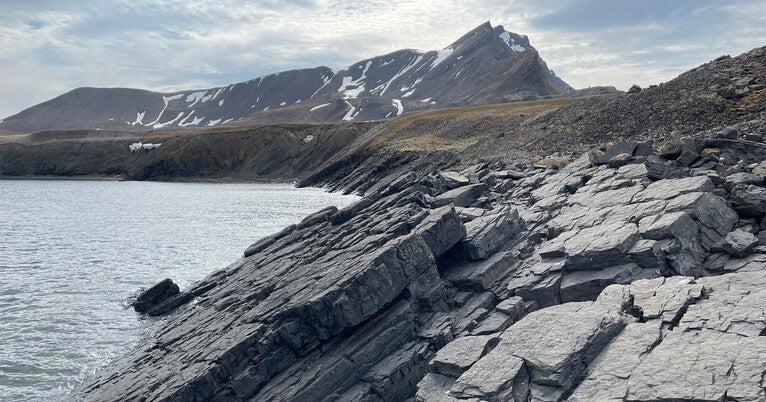
Bioturbation is the process by which burrowing and tunneling animals churn up sediments and help shape ecosystems along the way. It plays a critical role in ocean ecosystems.
The researchers found that although some bioturbation resumed on the seafloor after the Permian mass extinction, the burrowing was sparse and horizontal — delaying the recycling of nutrients in ocean floor sediments.
“Our study has relevance to the health of modern and future marine ecosystems, informing how nutrient cycling in the oceans may shift as a result of seafloor animals responding to ocean warming over the coming decades and centuries,” Beaty said.
Yale co-authors of the study included Spencer Moller and Noah Planavsky.
Bringing the brain’s hidden networks into focus
Getting a clear look at the intricate connections between cells and structures throughout the brain has been a challenge for researchers exploring neurological conditions, but a Yale team led by Joerg Bewersdorf and Aaron Kuan has now brought the breakthrough power of a new imaging technique to the effort.
The technique known as pan-expansion microscopy, which was developed by Bewersdorf’s lab in 2020, lets scientists look inside tissue to see both where specific molecules are located and what the surrounding cellular structures look like in fine detail. The process involves expanding tissue samples with a special gel, labeling proteins and lipids to reveal tissue structure, and using antibodies to mark specific molecules.
In a new study, published in the journal Nature Biotechnology, researchers updated this technique to work on brain tissue, providing a nanoscale view of both the structure and molecular makeup of brain circuits.
“This gets us closer to understanding cell biological mechanisms in the context of the tissue where the cells are embedded,” said study co-author Bewersdorf, the Harvey and Kate Cushing Professor of Cell Biology at Yale School of Medicine (YSM) who is also a professor of biomedical engineering and of physics, in FAS.
“It’s a big step,” Bewersdorf said. “It allows us to address the big question — namely how is the brain connected?”
The team demonstrated how this new approach can reveal wiring and connectivity in brain circuits, creating comprehensive circuit maps known as “connectomes”. These circuit-mapping efforts were spear-headed by co-lead author Allison Cairns, a GSAS student in the Department of Applied Physics at the Yale School of Engineering & Applied Science.
“Pan-expansion is now making connectomics possible with light microscopy,” said study co-author Kuan, an assistant professor of neuroscience at YSM, assistant professor of biomedical engineering, and a Wu Tsai Institute investigator. “This adds a new molecular dimension and makes it more accessible to researchers.”
Bewersdorf and the study’s co-lead author Ons M’Saad, a former Yale biomedical engineering graduate student, co-founded the New Haven-based startup Panluminate, which is commercializing the use of pan-expansion microscopy.
Lights, cameras — physics!
A new film documentary about faraway physics experiments includes a Yale-affiliated project in the South Pole.
“Messengers,” directed by Jeffrey Zablotny, profiles three underground neutrino detector experiments around the world: SNO+ in Canada, Super-Kamiokande in Japan, and IceCube in Antarctica. The 45-minute movie, which premiered earlier this year at the Visions du Réel film festival in Switzerland, continues to make the rounds at festivals around the world.
The film’s final segment, on IceCube, features Reina Maruyama, a professor of physics and astronomy in Yale’s FAS and a member of the IceCube collaboration.
IceCube, buried below the surface in the Antarctic ice shield, detects an average 275 atmospheric neutrinos daily. A neutrino is a subatomic particle that contains almost no mass and travels through the universe almost completely undisturbed by other matter. Studying neutrinos, physicists say, offers insight into high-energy astrophysical phenomena such as exploding stars and black holes.
Manafzadeh wins young investigator award for paleontology research
Armita Manafzadeh, a postdoctoral researcher affiliated with the Yale Institute for Biospheric Studies, the Department of Earth & Planetary Science, and the Yale Peabody Museum, has won the 2026 Carl Gans Young Investigator Award from the Society for Integrative and Comparative Biology (SICB).
The award honors young researchers for distinguished contributions to the field of comparative biomechanics. Winners are invited to deliver a featured lecture at the SICB annual meeting.
Manafzadeh’s work combined high-speed X-ray imaging with comparative anatomy to reveal how joints move and evolve across vertebrates. Her research bridges biomechanics, evolution, and development to explain the diversity of motion in animals.
The SICB commended Manafzadeh’s “creativity and originality in comparative biomechanics research as well as her strong mentoring contributions.”
In 2024, she was first author of two paleontology papers: one on the evolutionary significance of leg joints in bird species, and the other on a new approach for visualizing how long-extinct animals moved.
Next fall, Manafzadeh will open her own lab as an assistant professor at Georgia Tech.
Weathering heights
Yale researchers figured prominently at a recent scientific meeting at The Royal Society in London on enhanced weathering with agriculture for atmospheric carbon dioxide removal.
Enhanced weathering — a carbon dioxide removal process that speeds up natural rock weathering to capture atmospheric carbon — is a focus area of the Yale Center for Natural Carbon Capture (YCNCC), which was founded in 2021 to explore fundamental and applied science relating to how natural processes can be enhanced to create effective, safe, and scalable methods to reduce greenhouse gas concentrations in the atmosphere to address the threat of climate change.
Noah Planavsky, a professor of Earth and planetary sciences in the (FAS) and scientific leadership team member of YCNCC, co-convened the meeting, chaired a session on social acceptance of enhanced weathering implementation, moderated a panel at the meeting, and closed the program. YCNCC co-director Peter Raymond, the Oastler Professor of Biogeochemistry at Yale School of the Environment (YSE), gave a talk on “rivers, enhanced weathering, and carbon cycling.”
“The YCNCC continues to lead on enhanced weathering,” Raymond said. “Collaboration and coordination on research objectives are essential at this moment as we seek to move from field trials and initial commercial projects to scaled deployments.”
In addition, Tim Jesper Suhrhoff, a YCNCC postdoctoral fellow, gave a presentation on river catchments as “natural monitors of enhanced weathering” based on his work on the Mississippi River watershed, and Samuel Tsao, a member of Raymond’s lab, presented a poster on how flow and temperature variation influence calcite saturation in river systems with possible implications for enhanced weathering.
Two Yale researchers, one centennial honor
A renowned Yale paleontologist has been honored with an award named after another renowned Yale paleontologist.
Derek Briggs, the G. Evelyn Hutchinson Professor of Earth and Planetary Sciences in FAS and former director of the Yale Peabody Museum, is the inaugural winner of the Seilacher Medal —named for the late Adolf Seilacher, who taught at Yale from 1987 to 2009.
The Seilacher Medal, awarded by the Göttingen Academy of Sciences and Humanities in Germany, honors those whose work has enriched palaeontological and geobiological research across disciplinary boundaries and who are expected to continue advancing the field.
Briggs is a leading authority on fossils from the Burgess Shale of British Columbia, a 508-million-year-old deposit containing a trove of fossils from the Cambrian explosion of animal diversity on Earth. His research has focused on the preservation and evolutionary significance of exceptionally preserved fossil biotas. He also taught classes with Seilacher from 2003 to 2009.
Seilacher, who died in 2014, would have turned 100 this year. As a researcher, he made fundamental contributions to the understanding of the evolution of form, trace fossils, and the unusual creatures of the Ediacaran Period.
Karen Guzman and Jim Shelton contributed to this report.
Research Redux:
Uncovering the hidden cellular connections that bridge aging and disease
Soaking up the anti-cancer properties of a South Korean sea sponge
Measuring temptation one mouse click at a time
For incarcerated people, gaps exist in quality of cancer care