
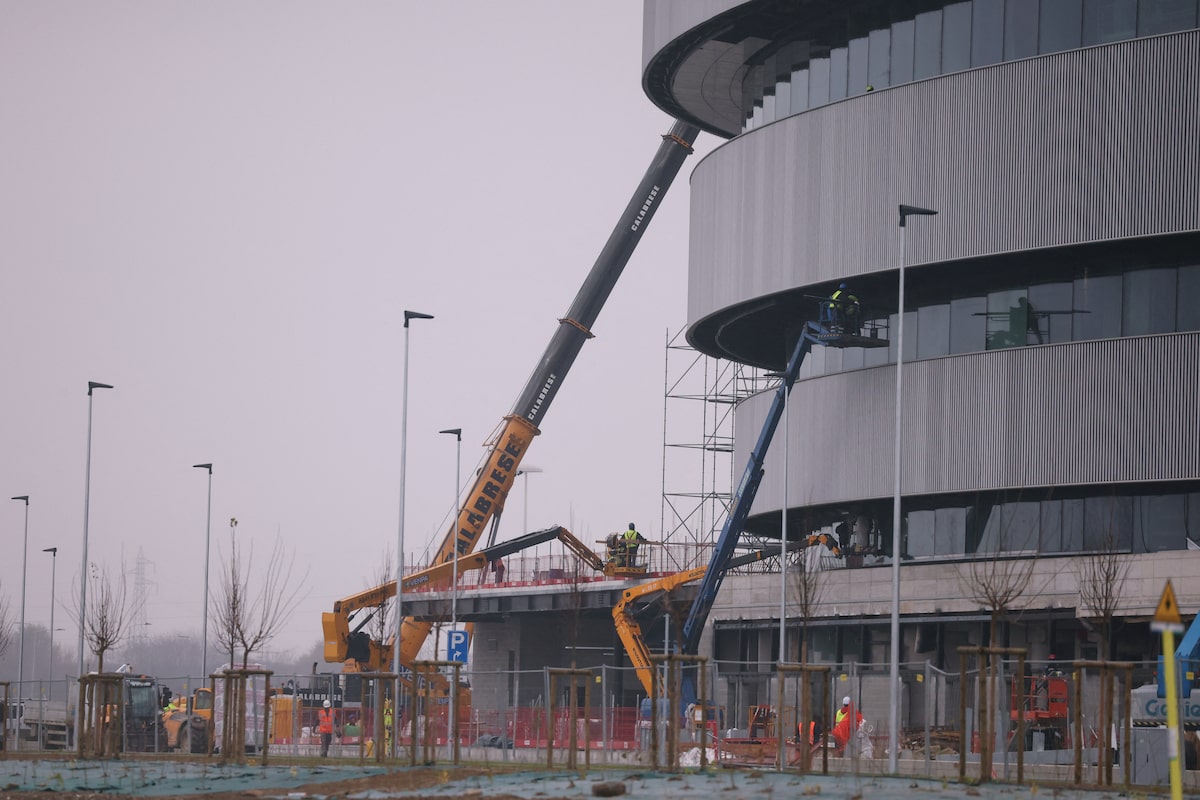
The construction site of the PalaItalia Santagiulia ice hockey arena, which will host the hockey and para hockey competitions at the Milano Cortina 2026 Winter Olympic Games, in Milan, Italy, on Dec. 1.Claudia Greco/Reuters
The Santagiulia hockey arena in the distant suburbs of Milan appears to be following a great Italian Olympic tradition: Build it late, panic, then work 24/7 to get the job done before the start of the Games.
On Sunday, with the help of the clever, evasive maneuvers of a local taxi driver, The Globe and Mail got close to the arena but not into it. Less than two months ahead of the opening of the Milano Cortina 2026 Winter Olympics, the arena was surrounded by construction machines and material, though the three-tiered building’s exterior seemed largely completed.
There were a few workers outside; one of them said most of the workers were inside. The arena’s private manager, Germany’s CTS Eventim, has said that 580 workers on two shifts are rushing to finish the arena, which will be Italy’s largest indoor events space, with 16,000 seats, in January, a month later than originally planned.
In other words, the completion date is going down to the wire and there is no Plan B if the arena does not get finished in time. If that weren’t problem enough, another biggie has surfaced. The rink is smaller than standard NHL version and no one seems to know who forgot to bring the tape measure.
And the NHL rink is smaller than the standard international rink. At Santagiulia, hockey fans will see outsized players battling each other in an undersized space, a possibly riveting bumper-cars-on-blades spectacle.
Cathal Kelly: Italy relying on Olympic charm to gloss over the imperfections
Santagiulia’s first test event – the one that determines whether the ice is hard enough to avoid water-slide status, and all the fancy electronics work – has been put off until mid-January. That’s only three weeks before the hockey extravaganza, one of the Olympics’ most popular sports, is to start.
The debut game is on Feb. 5, the day before the Olympics’ opening ceremonies; it will see the Italian and French women’s teams face off (the Canadian women make their debut on the same day, against Finland, in the Milano Rho secondary hockey arena. The Canadian men will first take to the ice on Feb. 12, against Czechia, in Santagiulia).
The rink-size issue surfaced early this month, when Team Canada assistant coach Peter DeBoer, appearing on Sportsnet, said he did not know how the measurements got messed up. “The ice surface, it looks like it’s going to be smaller than NHL rink standard by probably three or four feet,” he said. “I don’t know how that happened.”
The Athletic reported that the International Ice Hockey Federation (IIHF) approved a rink that measures 196.85-foot by 85.3-foot in Milan, which is more than three feet shorter, or almost a metre, than the NHL’s standard 200-foot by 85-foot dimensions.
Olympic hockey GMs taking their time with New Year’s Eve roster deadline
Making its first Olympics appearance since 2014, the NHL had lobbied for an NHL-sized rink. Whether the IIHF or Santagiulia’s builders of the Olympics’ organizing committee overruled the NHL, or misinterpreted the dimensions isn’t known.
The rink at the Turin Olympics in 2006, the last time Italy hosted the Games, seemed enormous because its dimensions complied with international standards. The rink measured 197 feet by 98.5 feet (about 60 metres by 30 metres) – lots of space for passing in a proper Olympic-style game.
Foundation Milano Cortina 2026, the organizing committee for the games, on Monday confirmed to The Globe that dimensions of the Santagiulia rink, as reported by the Athletic, are accurate, that is, smaller than the standard NHL rink.
“While these dimensions differ slightly from a typical NHL rink, they are consistent with IIHF regulations, match the rink size used at the Beijing 2022 Olympic Winter Games and are fully consistent with the dimensions the NHL requires as part of its Global Series Game arena specifications,“ the committee said in a statement, adding that all the relevant venue authorities, including the NHL, ”agree that the differences in rink specifications are insignificant.“
The committee did not say why the smaller size was chosen.
The Milano Rho arena, the second, smaller hockey venue for the 2026 Milan Cortina Winter Olympics, is getting a test run with the U-20 Ice Hockey World Championship taking place there. On its own, it couldn’t handle the scheduling of all of the Games’ hockey activity.Antonio Calanni/The Associated Press
No one from the NHL is threatening to boycott the Olympics because the rink is too small, and the shriveled dimensions present no apparent safety issues. The bigger issue is completing Santagiulia in time and making sure the ice is not mushy.
If the arena is not finished soon, Olympic hockey is in trouble and NHL players won’t bother showing up. The smaller Rho arena, where some of the men’s games will take place, simply cannot handle the full hockey schedule over 18 days (the women’s gold game is on Feb. 19, the men’s on Feb. 22, both scheduled for Santagiulia).
While low-grade panic among coaches and players has set in about the state of the arena, they should remember that Italian Olympics organizers usually get it right in the end.
The media was full of stories ahead of the 2006 Winter Olympics in Turin about incomplete event sites. To be sure, the city, in Italy’s far northwest, did look like a construction site a few weeks before the start of the games. The builders went flat out and event sites were finished in time, some even ahead of time.
The Italians are fond of saying “Prima, il caffè” – First, the coffee – before starting a job. That little caffeine habit will no doubt vanish in the next few weeks as workers go into overdrive.