
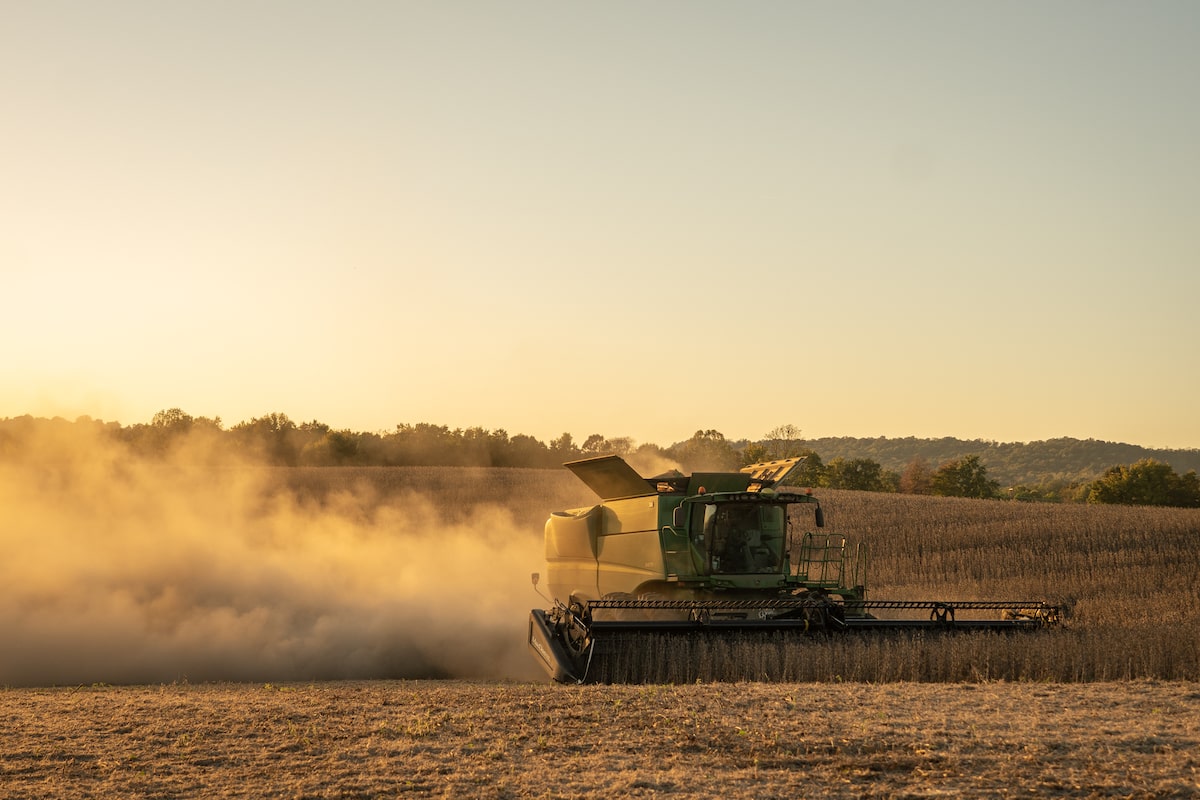
A combine harvests soybeans on Oct. 14 in Marion, Kentucky.Jan Sonnenmair/Getty Images
Donald Trump said he is considering “very severe” tariffs on imports of fertilizer from Canada, as the U.S. prepares a multibillion-dollar funding package for its own farmers, who have been battered by months of trade-war uncertainty.
The new White House focus on agriculture suggests the possibility of fresh trade turbulence, with little sign that the White House intends to depart from its pursuit of tariffs, whose revenue Mr. Trump said will be used to deliver US$11-billion in new money to row-crop farmers.
The White House called it a financial bridge to a less subsidy-dependent future.
The funds, which will be paid by the end of February, are an echo of payments made to farmers during Mr. Trump’s first term, when they were called trade aid and explicitly described as compensation for Chinese reprisals against White House policies.
This year, U.S. Agriculture Secretary Brooke Rollins called the cash a restitution for the policies of former president Joe Biden.
The US$11-billion, and an additional US$1-billion held in reserve to help farmers of specialty crops, is needed to transition to a “new golden age for farmers, where, instead of farming for government cheques, they can farm to feed their family and sell their products and pass it on to the next generation,” she said.
“This bridge is absolutely necessary based on where we are right now.”
In hearings on the future of the USMCA, business leaders call on Trump to drop tariffs
The funds amount to “Christmas early for farmers,” Iowa farmer Cordt Holub told Mr. Trump Monday, speaking from inside the White House.
But it’s not clear how much the new funds will accomplish for an agricultural sector doubly bruised by Mr. Trump’s trade war, which has raised input costs and, for much of the fall, led to a plunge in prices after China staged a retaliatory pause in the purchase of goods such as soybeans.
The White House has said China agreed to purchase 12 million tons of soybeans this year, a deal that prompted a late-fall rally in prices. Those prices, however, have more recently sagged as Chinese purchases of 2.25 million tons for the current harvest remain far from the target.
For some farmers, the White House funds brought little reason for celebration.
“I’m not thrilled about it,” said Elliott Uphoff, who farms 2,000 acres with his father in central Illinois.
What he hoped for was “an official trade deal with China, and then we would see the price rally. That would have been the ultimate win.”
Instead, he said, what farmers have seen is “the same cycle from the first presidency,” which was marked by trade havoc and many billions of dollars in payments to those who suffered.
How Trump’s tariffs are squeezing Canadian factories
Worse, he said, is the idea that Mr. Trump may hike tariffs on fertilizer, a product that makes up more than a fifth of total U.S. production costs for crops such as corn, the U.S. Department of Agriculture has estimated.
One key product, potash, is largely mined outside the U.S., which imports 90 per cent of what it uses – with 80 per cent of that coming from Canada.
Raising the cost of those imports “would be very painful,” Mr. Uphoff said.
Mr. Trump, however, continues to see tariffs as a versatile solution to a broad range of problems, from foreign wars to domestic agricultural needs.
“A lot of it does come in from Canada. And so we’ll end up putting very severe tariffs on that, if we have to” to bolster U.S. output, Mr. Trump said Monday. Do that, he said, and “you’ll be making your own fertilizer.”
It was only last month that Mr. Trump signed a presidential order lifting tariffs on most fertilizers.
But the U.S. Department of Agriculture has “a whole plan in place, including the reshoring of fertilizer and the opportunity to do it in America,” Ms. Rollins said Monday.
Trump may use USMCA withdrawal as a bargaining tactic, trade experts warn
What’s not clear is what that can accomplish. Canadian reserves of potash, for example, are nearly five times larger than those in the U.S., according to the U.S. Geological Survey.
It may be possible for the U.S. to expand its production of nitrogen fertilizer, but that may not benefit farmers.
“It seems like it would be expensive,” said Joe Janzen, an agricultural economist at the University of Illinois.
Any rise in U.S. fertilizer output that is propelled by tariffs, he said, would mean producers in that country “are being protected from cheaper foreign imports.” For farmers, all of that “would raise costs.”
It all suggests that the US$11-billion in new funds to farmers marks not an end of the cycle of agricultural subsidies, but a new beginning.
Indeed, the Trump administration’s approach may prove counterproductive, said Michael Langemeier, who is director of the Center For Commercial Agriculture at Purdue University, where he is a professor of agricultural economics.
“In some ways, these trade and tariffs discussions just distort things temporarily,” he said. For export-dependent commodities such as soybeans, anything that keeps U.S. goods from competing globally risks ceding ground to competitors.
“We have to be competitive in soybeans, because Brazil just keeps ramping up production,” he said.
“If we really do not want to subsidize in the long-term, we need to move towards open markets – free markets, in terms of exports.”