
Alberta First Nations are applauding a ruling by an Alberta Court of Kings Bench judge on Friday that a proposed question for a referendum on the province’s separation from Canada is unconstitutional.

The question being proposed in a citizen initiative petition by the Alberta Prosperity Project would ask, “Do you agree that the Province of Alberta shall become a sovereign country and cease to be a province in Canada?”
Alberta’s chief electoral officer, Gordon McClure, had requested a judge review the proposed question to determine if it violates the Constitution.
In his ruling, released late Friday, Justice Colin Feasby focused much of his ruling on the failure of the proposed question to guarantee First Nation treaty rights.
“First Nations, as founding partners in the creation of Alberta, cannot be ignored or bypassed as Alberta contemplates its future whether that is part of Canada or not,” said Feasby.
Story continues below advertisement
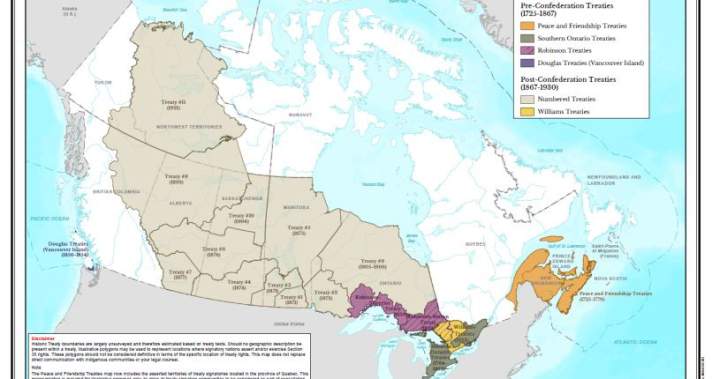
“Moreover, this decision has concluded that the transformation of provincial and territorial borders into international borders would contravene the Numbered Treaties by significantly impairing the exercise of treaty rights by First Nations,” added Feasby.
1:58
Alberta judge finds proposed referendum question on separation is unconstitutional
In a written statement reacting to the decision, the Piikani Nation said the “ruling underscores the critical role of First Nations in any discussions about Alberta’s future and affirms the enduring legitimacy conferred by Numbered Treaties.”

Get breaking National news
For news impacting Canada and around the world, sign up for breaking news alerts delivered directly to you when they happen.
Calling the ruling “a victory for treaty rights,” Chief Troy Knowlton said, “We are heartened by Justice Feasby’s recognition of the Blackfoot Nations’ foundational partnership in the creation of Alberta. “The Court’s reliance on our evidence and arguments highlights that First Nations cannot be ignored or bypassed in matters of sovereignty.
“As the Court stated, our consent memorialized in the Treaties led to Alberta’s existence and continues to legitimize it.”
Story continues below advertisement
The Confederacy of Treaty 6 First Nations also describes the Feasby’s ruling as “a victory for treaty rights and the inherent rights of all First Nations.”
A written statement, released following the ruling, says that “the Numbered Treaties are legally binding on First Nations, Canada, and Alberta.”
“We will never be silent when Treaty is threatened,” adds the statement.
A map showing the various First Nation treaties in place in Canada that was released along with Friday’s court ruling by Alberta Court of King’s Bench Justice Colin C.J. Feasby.
Source: Government of Canada
The court’s ruling was released just a day after the Alberta government had tabled new legislation (Bill 14) that would have halted the court proceedings and prevented it from ruling on the constitutionality of the proposed referendum question, a move Feasby called “contrary to the rule of law.”
He further admonished the government’s move by ruling that, “Alberta’s cavalier disregard for court resources and lack of consideration for the parties and First Nations intervenors who participated in this proceeding in good faith is disappointing, to say the least.”
Story continues below advertisement
Premier Danielle Smith reacted to the judge’s decision during her weekly radio talk show by accusing the court of acting as a gatekeeper “standing in the way of questions that the public wants to ask in good faith.
However, in its statement, the Piikani Nation accused the UCP government of showing “a blatant lack of respect for democratic processes, court resources, and First Nations.”
“Such actions echo a troubling history of sidelining First Nations in decisions that affect our lands and futures. Despite this legislative overreach, Piikani Nation remains resolute in our commitment to fight against any efforts towards Alberta separation.”
The Alberta Prosperity Project says it plans to resubmit its proposed question for a referendum on separation.
1:52
Alberta bill aims to clear further obstacles to citizen-driven referendum questions
© 2025 Global News, a division of Corus Entertainment Inc.