
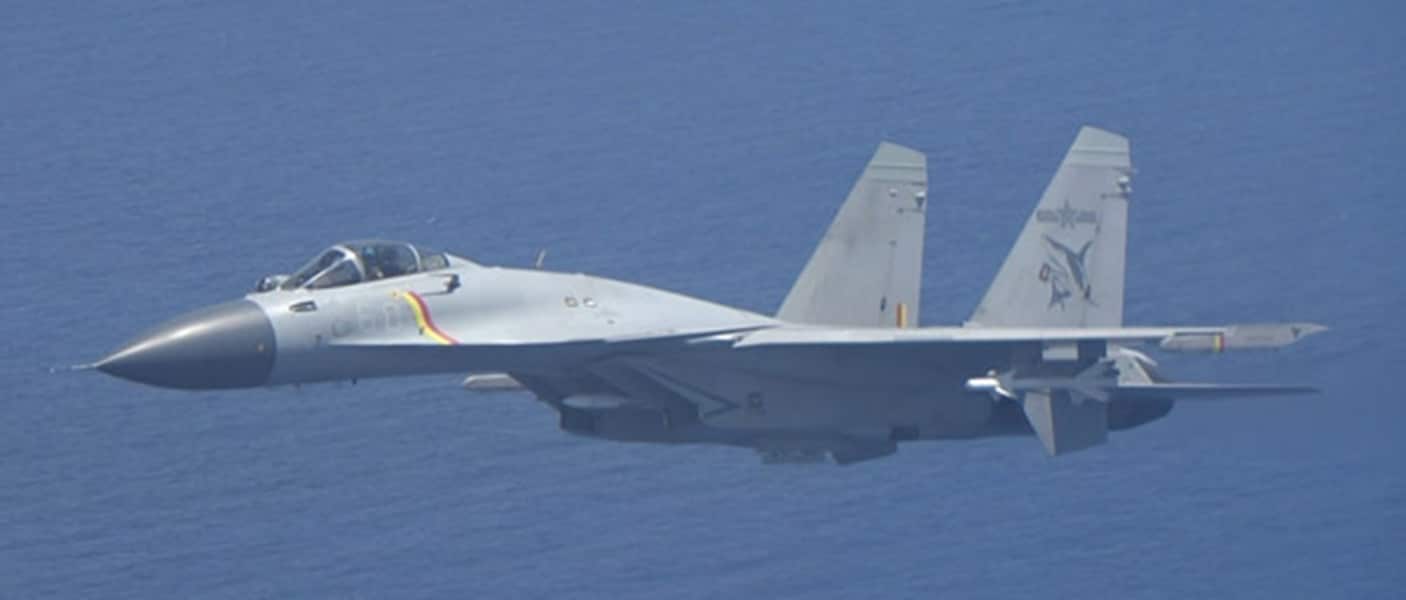
The Japanese Defense Ministry has announced that Chinese J-15 fighter aircraft took off from China’s Liaoning aircraft carrier near the southern island of Okinawa and intermittently locked its radar onto Japan’s Air Self-Defense Force fighter jets twice on December 6.
Holding a press conference at the unusual time of 2:00 a.m. on December 7, Japanese Defense Minister Shinjiro Koizumi announced Tokyo formally protested to China, calling the incidents “an extremely regrettable” act and “a dangerous” one that “exceeded the scope necessary for safe aircraft operations.”
The latest incidents occurred at a time when Japan–China relations are rapidly deteriorating following Prime Minister Sanae Takaichi’s remarks on November 7 indicating Japan’s involvement in a potential Taiwan contingency.
A J-15 fighter jet launched from the Chinese Navy’s aircraft carrier Liaoning intermittently directed its radar at a JASDF F-15 that was conducting an intercept response over international airspace southeast of Okinawa Island between around 4:32 p.m. and 4:35 p.m. on December 6, the defense ministry said.
A second incident occurred the same day between around 6:37 p.m. and 7:08 p.m., when a J-15 from the carrier Liaoning intermittently illuminated its radar at a different JASDF F-15 operating in the area, it also said.
The defense ministry said no damage to Japanese aircraft or injuries to crew have been reported.
According to the ministry, this marks the first time Tokyo has formally disclosed an incident in which Chinese military aircraft locked their radar onto Japan’s Self-Defense Forces jets.
It is widely known that fighter aircraft radars generally operate in two main modes: a wide-area search mode used to detect and track multiple targets, and a fire-control mode that provides the precise tracking needed to guide weapons. In search mode, the radar sweeps broad sections of the sky, causing only brief, intermittent illumination of any single aircraft. Fire-control mode, by contrast, focuses sustained tracking energy on a specific target and uses different waveforms optimized for weapon guidance.
Because space and weight are limited on fighter aircraft, the same radar system typically performs both functions and can switch rapidly between them. Modern radars, including advanced AESA(Active Electronically Scanned Array) systems, can also shift automatically from search to fire-control tracking when designating a target.
The activation of a fire-control mode—commonly referred to as a “lock-on”—is widely regarded in international military practice as a dangerous and escalatory act, as it signals preparation for potential weapons release.
Koizumi did not specify what type of radar had been used by the Chinese fighter aircraft. Analysts say he likely avoided doing so in order not to reveal whether the Self-Defense Forces are capable of detecting the specific frequencies of the Chinese military’s search and fire-control radars.
In response to Japan’s announcement and protest, a Chinese navy spokesperson said on December 7 that the Liaoning aircraft carrier strike group recently conducted flight training of carrier-based fighter jets over international waters off Okinawa Prefecture, and that during the training, JASDF aircraft repeatedly approached the Chinese navy’s training airspace and sea area to harass operations, severely disrupting China’s normal training activities and posing a serious threat to flight safety.
At the same time, the spokesperson for the Chinese Navy did not address whether the radar illumination alleged by Japan had actually occurred.
Meanwhile, Japan’s Joint Staff announced on December 7 that the Liaoning, which has been operating in the Pacific near Okinawa, conducted roughly 100 take-offs and landings of its embarked fighter jets and helicopters between December 6 and 7.
According to the Ministry of Defense, the Liaoning sailed into the Pacific on the morning of December 6, accompanied by one Renhai-Class Type 055 destroyer and two Luyang III-class Type 052D destroyers, passing between Okinawa’s main island and Miyako Island. After reaching waters roughly 270 kilometers west of Okinotorishima, the carrier changed course to the northeast and proceeded between Okinawa’s main island and Minamidaito Island. It conducted around 50 100 take-offs and landings on both December 6 and 7. No intrusions into Japan’s territorial waters or airspace were observed.
According to Reuters on December 4, China has deployed a large number of naval and coast guard vessels across a wide swath of nearby waters — from the southern Yellow Sea through the East China Sea and South China Sea, extending into the Pacific. At its peak, the number of ships reportedly exceeded 100. The Liaoning carrier strike group is believed to be one of these task groups.
Observers say the deployment comes in reaction to remarks by Takaichi, regarding a potential Taiwan contingency, as well as Taiwan’s ongoing efforts to strengthen its defense capabilities. This has fueled concerns that China may continue or escalate large-scale military exercises in the near future.