
Sign up for the Slatest to get the most insightful analysis, criticism, and advice out there, delivered to your inbox daily.
Just before the Supreme Court heard oral arguments in Trump v. Slaughter—a seismic test of presidential power—on Monday morning, Donald Trump himself showed why the case is so dangerous. The president posted a screed about 60 Minutes’ critical coverage of his administration under its new ownership, Paramount, complaining: “Since they bought it, 60 Minutes has actually gotten WORSE!” Anyone familiar with Trump’s playbook would understand the implication of his post. Prior to his rant, news broke that Paramount would try to acquire Warner Bros. Discovery, muscling out Netflix’s megamerger bid. The Federal Trade Commission has the power to block the Netflix deal and hand Warner Bros. to Paramount on a silver platter. The FTC was designed by Congress to be an independent agency, so Trump’s Truth Social posts should be meaningless. If Slaughter goes the way SCOTUS is signaling, though, Trump will be able to strongarm the agency into doing whatever he wants—including by rewarding censorship of a news program like 60 Minutes or punishing media companies whose journalists question his absolute rule.
The choice for Paramount will be simple: Want the FTC to block Netflix’s bid and then pave the way for your takeover? Don’t worry about antitrust compliance. Just bring your journalists to heel.
Slaughter supplies the blueprint for this very kind of corrupt regulatory retaliation. The case asks whether the president has constitutional authority to fire FTC commissioners, and virtually any other agency leader, in pursuit of absolute control over the executive branch. Congress has given agencies significant independence from the president since the earliest days of the republic in an effort to shield them from political pressure. Today, more than two dozen agencies are insulated from direct presidential control by removal protections. For the last 150 years, Congress has built much of the modern government around this principle. Now Trump wants to destabilize this foundational framework by seizing the power to fire anyone he wants and assert direct control over independent agencies. As expected, on Monday, six Republican-appointed justices signaled that they are eager to let him do so.
Here is a sampling of who will be better off following this legal earthquake: Trump, Republicans loyal to Trump, corporations kowtowing to Trump, billionaires ingratiating themselves to Trump, media moguls flattering Trump, and foreign governments courting Trump.
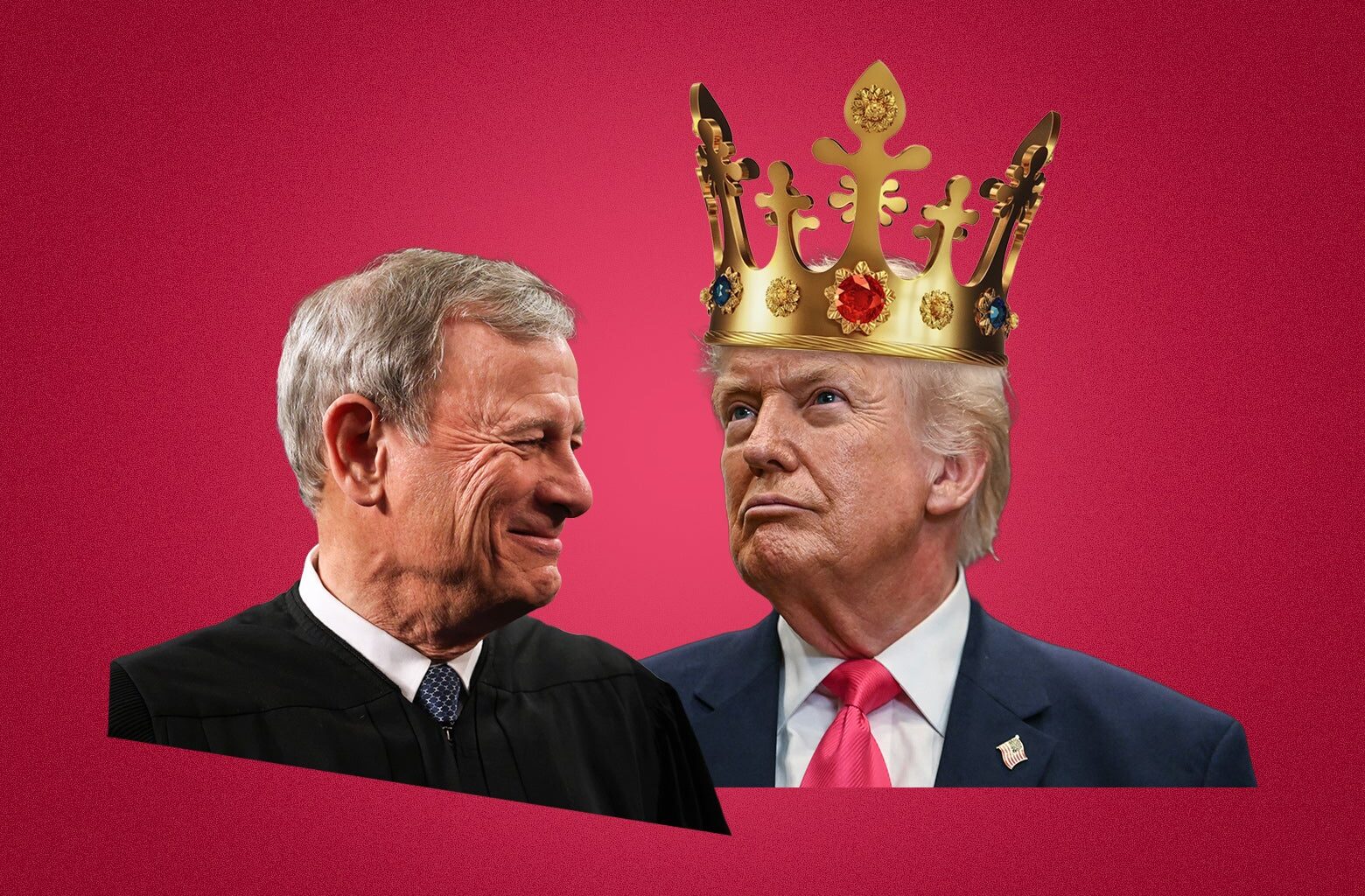
Here is a partial list of the casualties: Congress, the First Amendment, journalists, whistleblowers, the civil service, unions, and everyday investors. In short: everyone and everything that this Supreme Court deems a hindrance to Trump’s monarchical consolidation of power. As Justice Ketanji Brown Jackson put it on Monday: “Under our constitutional design, given the history of the monarchy and the concerns that the Framers had about a president controlling everything,” one might assume that courts should defer to Congress’ decision that the chief executive should not have an iron fist on the administrative state. But the collective will of the people’s representatives is no match for six unelected justices with a trendy political theory they’re itching to superimpose upon the Constitution.
The Slaughter saga began when, in March, Trump fired Rebecca Kelly Slaughter, a Democratic member of the FTC. That termination was flatly illegal: Congress prohibited presidents from sacking FTC commissioners without good cause, a restriction that the Supreme Court unanimously upheld 90 years ago in Humphrey’s Executor v. U.S. Yet today’s Supreme Court permitted Slaughter’s removal by a 6–3 vote on the shadow docket, effectively killing off Humphrey’s without admitting to it. The same majority allowed Trump to terminate more agency heads without good cause, and eventually scheduled oral arguments so it could resolve this issue for good.
In the meantime, for those keeping score, there are zero Democrats on the Federal Trade Commission, no bipartisan enforcement of antitrust laws by a balanced body of experts. There are only Trump lackeys in charge—not even a Democratic minority member who can blow the whistle on the kind of dirty dealings that can arise in the Warner Bros. merger. Trump also fired a member of the National Labor Relations Board, denying the agency a quorum and thus the ability to carry out key functions. He paralyzed the agencies that enforce civil service laws by unlawfully firing their leaders. And he claimed control over the Federal Communications Commission, placing it in the hands of a loyalist who sought to punish ABC after Jimmy Kimmel said something he didn’t like. The upshot is devastating: Congress gave these agencies significant power on the premise that they would exercise it with integrity. Trump is weaponizing them in service of his agenda, and now seeks the Supreme Court’s blessing for this subversion of checks and balances.

Mark Joseph Stern
The Supreme Court Is About to Hand Trump Insidious New Powers
Read More
The truth is that Slaughter’s outcome was never in doubt; Monday’s arguments were theater, the final step before the Republican-appointed justices cement this chapter of their constitutional revolution. These justices long ago embraced the “unitary executive,” a president with the prerogative to fire almost any high-ranking official who exercises “executive power.” That theory is built upon a series of myths that historians have thoroughly debunked, and does not reflect the text or intent of the Constitution. As Justice Elena Kagan put it, “when I was a young lawyer and this unitary executive theory really got its start and got its legs, there was a pretty simple version of the history.” That story, she noted, has been largely debunked in the decades since. Yet the conservatives swatted away this history like a stinkbug. Justice Amy Coney Barrett declared that a president in the early days of the republic “could very easily take control over” one early independent agency and asserted that it “had very, very limited authority.” Both propositions are patently false, but it doesn’t matter. Barrett didn’t want to hear any facts that might puncture her curated historical fantasy.
Nor did her colleagues on the right, several of whom have already called for Humphrey’s demise. Amit Agarwal, Slaughter’s lawyer, struggled to break through their impenetrable certitude, facing reflexive hostility at every turn. Justices Neil Gorsuch and Brett Kavanaugh seized the opportunity to rail against the scope of the modern administrative state: Gorsuch suggested that the real problem was the transfer of lawmaking power to agencies, musing that it is time to “recognize that Congress cannot delegate its legislative authority” and “reinvigorate” limits on this practice. Kavanaugh told Agarwal that “independent agencies are not accountable to the people,” claiming they “raise enormous constitutional and real-world problems for individual liberty.” The question he skated past, of course, is why those problems are resolved when the president exerts control over these agencies. Under Trump’s thumb, is the administrative state really going to show more respect for personal freedoms? Or find themselves subjected to more accountability?
That seems … unlikely. Quite the opposite, in fact: It’s a good bet that once Trump takes the reins over this set of agencies, he’ll try to go further, raising even more alarming threats to democracy and civil liberties. For instance: Trump has already tried to fire a member of the Federal Reserve, Lisa Cook, on pretextual grounds, because she resisted his call to slash interest rates. The court will hear arguments in Cook’s case next month, and the conservative justices seem to think they can protect her from removal by creating a bespoke carve-out for the Federal Reserve’s independence. Kavanaugh teed up that move on Monday, expressing his “concerns” about the Fed and asking Solicitor General John Sauer for reassurance that he could “distinguish” it from the FTC. (Sauer wouldn’t concede the point, since, of course, he is defending Cook’s illegal firing.)
This Content is Available for Slate Plus members only
He’s MAGA’s Most Unlikely Hero. Trump Loves Him. He Might Just Have Crashed Out for Good.
Trump Just Told Us What He’ll Do With the Dangerous New Powers the Supreme Court Is About to Give Him
This Content is Available for Slate Plus members only
The Supreme Court Just Took a Case That Would Have Only Recently Been Unthinkable
Chief Justice John Roberts also spent some time trying to wall off Sauer’s theory from parts of the government that he does not want Trump to destroy. For example, Congress has created a number of courts that are not part of the federal judiciary and exercise “executive power” while protecting their judges from presidential removal. That list includes local D.C. courts, the Court of Federal Claims, the U.S. Tax Court, and the Court of Appeals for the Armed Forces. These courts adjudicate vital cases that often involve astronomical sums or personal freedoms, so it seems imperative that they remain nonpartisan and independent. But Sauer’s argument, as Justice Sonia Sotomayor hammered, would let the president sack their judges. “I don’t see how your logic could be limited,” Sotomayor told him, adding that his theory would even let Trump fire low-level members of the civil service at will. Sauer wasn’t willing to concede this point, either, so Kavanaugh, Gorsuch, and Roberts took turns trying to do it for them.
Were they persuasive? Not at all. That’s irrelevant, though; if they are committed to saving these institutions from Trump, they can always formulate some reason to do so. The converse is true as well: These justices want to give Trump control over the FTC, and they have found a reason to do so. They don’t seem to care that the consequence of their decision will be more corruption, censorship, and self-dealing: a group of agencies bent to the will of a president who views the government as a tool to punish his enemies while enriching himself and his friends. One might assume that the courts exist to halt such a power grab. This one exists to enable it.

Sign up for Slate’s evening newsletter.