
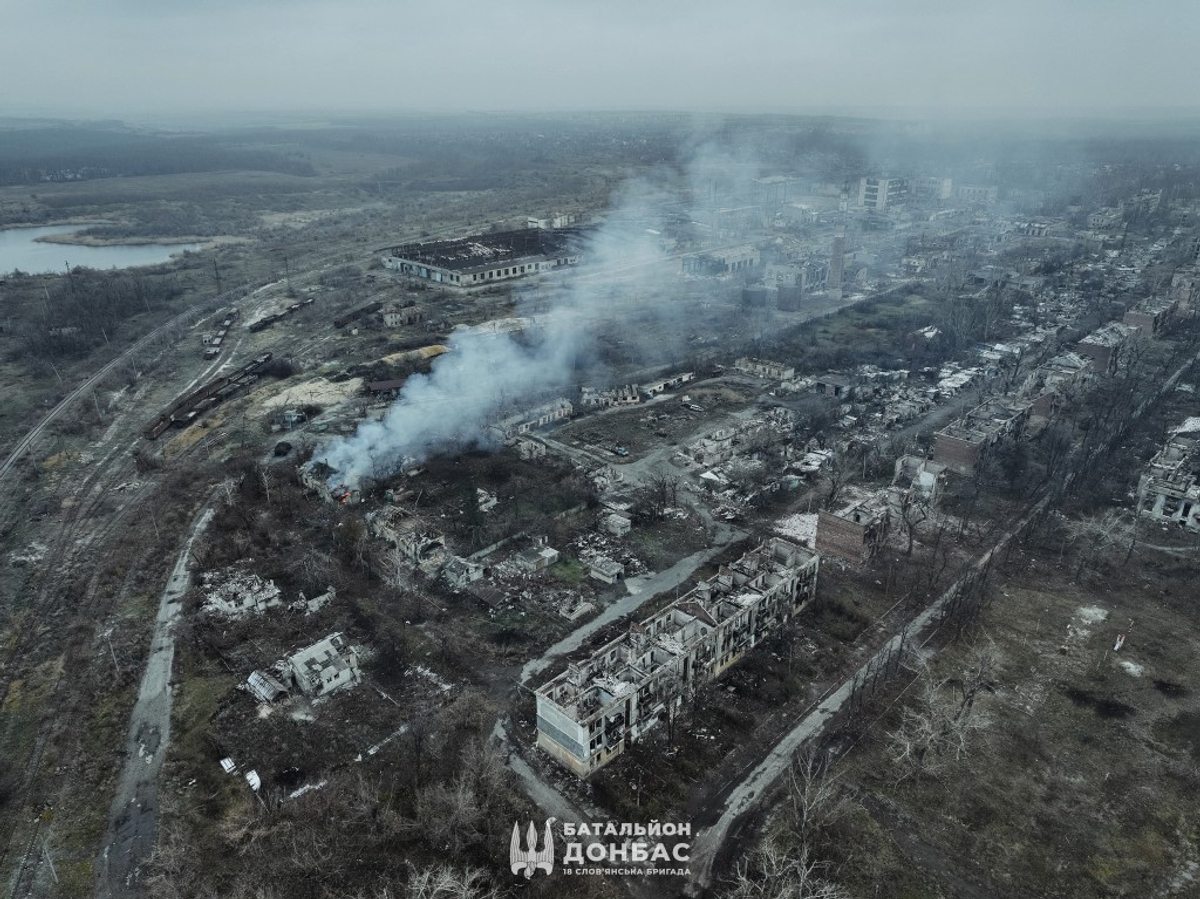
The administration of US President Donald Trump is still insisting that Ukraine should pull back from the partially-occupied Donbas region, according to sources speaking to Politico.
“On the territory issue, Americans are simple: Russia demands Ukraine to give up territories, and Americans keep thinking how to make it happen,” a senior European official involved in the talks told Politico.
JOIN US ON TELEGRAM
Follow our coverage of the war on the @Kyivpost_official.
Territorial concessions remain a major sticking point in the diplomatic process, with Kyiv and European capitals arguing for the war to be frozen along the current front lines. Roughly 30% of Donbas currently remains under Ukrainian control.
Washington has reportedly been exerting significant pressure on Kyiv and President Volodymyr Zelensky to push the proposal forward, even though Ukraine has repeatedly insisted that surrendering the region is a red line.
“Ukraine must leave the Donbas… one way or another”
“The Americans insist that Ukraine must leave the Donbas … one way or another,” the official said.
Kyiv, meanwhile, has been stressing to Washington that granting Vladimir Putin territory he has failed to seize after years of war would only embolden further aggression.
“In general, the most realistic option is to stand where we stand. But the Russians are pressuring Kyiv to give up territories,” the European official told Politico.
The official added: “Maybe Trump also wants it to happen fast, so his team is forced to explain to him they are not the ones to blame for why this is not happening as fast as he wanted it to happen.”
Other Topics of Interest
Kyiv Has ‘No Right’ to Surrender Territory, Zelensky Says
A senior Ukrainian official told the Washington Post that the peace plan “is closer to be doable for Ukraine, but not easy and not finished,” indicating that Kyiv remains willing to negotiate.
“Will America behave as a mediator?”
During a state visit to India on Friday, Putin declared that Russia would seize Donbas and other land “by force” if Ukraine refused to withdraw.
But the Institute for the Study of War (ISW) has projected that, at the current pace of operations, it would take several more years for Russia to fully occupy the entire region and Moscow’s victory is still far from guaranteed.
A 28-point peace outline drafted by US and Russian representatives and presented to Kyiv last month stated that “Crimea, Luhansk and Donetsk will be recognized as de facto Russian” and that Ukrainian troops would leave Donetsk, converting the area into a “neutral demilitarized buffer zone internationally recognized as territory belonging to the Russian Federation.”
Reuters later indicated that the demilitarized-zone concept had been shelved.
Any blueprint placing Ukrainian-held parts of Donetsk inside a DMZ, or placing them under Russian designation, would push the new dividing line nearer to Kyiv and bypass the defensive barriers that prevented Moscow from capturing the region as quickly as it intended, leaving Ukraine highly vulnerable to future attacks.
“Therefore, it is important how America will behave, as a mediator or will it lean toward the Russians?” the European official said.
“We don’t have a unified view on Donbas”
In remarks published Monday, Zelensky told Bloomberg News that negotiations over the US-led peace proposal remain blocked on “sensitive issues,” especially security arrangements and control of the Donbas.
He added that the negotiators still lack a common stance on Donetsk and Luhansk.
“There are visions of the US, Russia, and Ukraine – and we don’t have a unified view on Donbas,” Zelensky said.
“There is one question I – and all Ukrainians – want to get an answer to: If Russia again starts the war, what will our partners do?” he added, arguing that Kyiv needs strong assurances of security.
The Ukrainian President’s remarks came shortly after Trump publicly faulted Kyiv’s handling of the talks, saying he was “a little bit disappointed that President Zelensky hasn’t yet read the proposal.”
“Trump is signaling to Zelensky that the clock is ticking and Washington wants movement,” one Western diplomat told Kyiv Post of the US leader’s remarks, adding: “But he’s also broadcasting to Moscow that he’s willing to lean hard on Kyiv – and that’s raising eyebrows in European capitals.”