
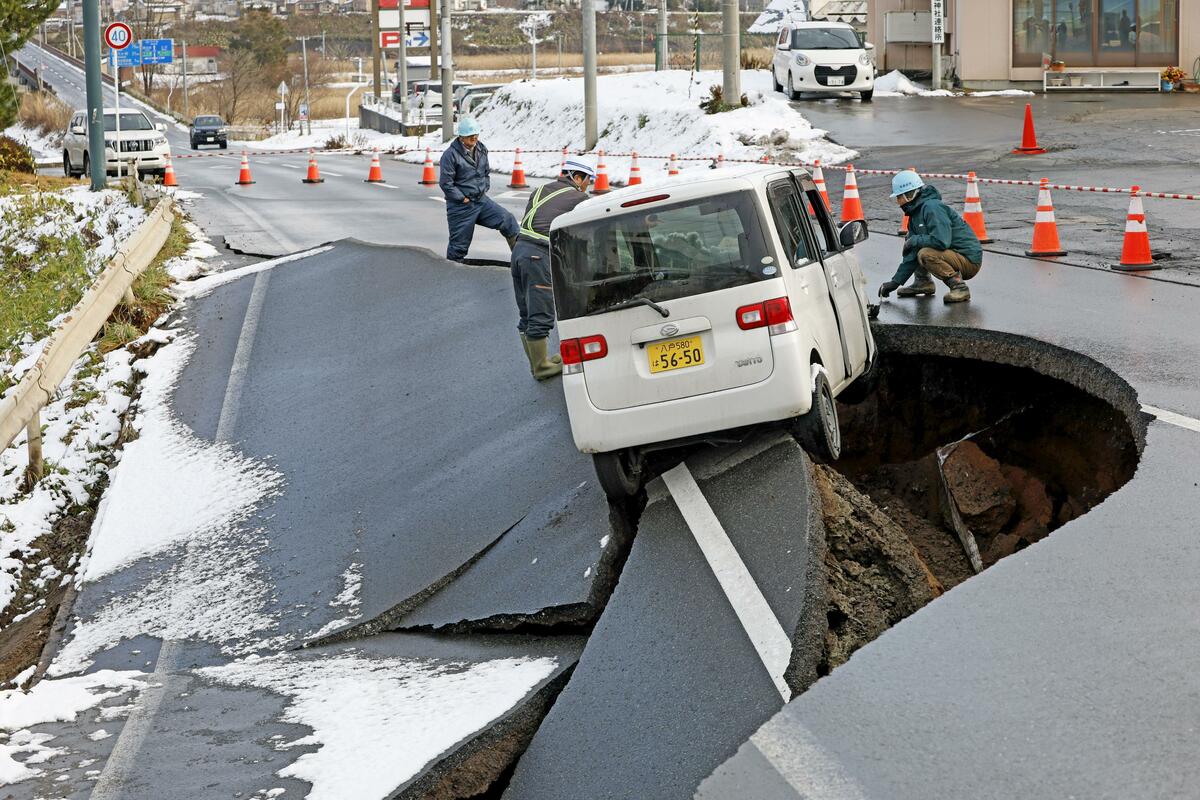
TOKYO – The number of people who sustained injuries due to a 7.5 magnitude earthquake in northeastern Japan climbed to at least 50 on Tuesday, according to a Kyodo News tally, after the late-night quake disrupted transport, water supplies and school operations.
The Japan Meteorological Agency said the huge quake, which struck at 11:15 p.m. Monday off the eastern coast of Aomori Prefecture at a depth of 54 kilometers, could be followed by a temblor of similar or greater magnitude in the coming days.
It is the first time the agency has issued such an alert, created for coastal regions of Hokkaido and Sanriku after the massive March 2011 earthquake and tsunami that devastated northeastern Japan. The alert covers 182 municipalities in seven prefectures from Hokkaido to Chiba, east of Tokyo.
JR East said Tuesday it had suspended bullet train services on the Tohoku Shinkansen Line between Morioka and Shin-Aomori stations for inspections following the quake, but operations resumed around 3:40 p.m.
Prime Minister Sanae Takaichi called on people in the region to remain alert for information from local governments and the weather agency over the next week or so and to prepare for another possible quake, including by securing furniture.
“The government asks residents to continue social and economic activities while maintaining a readiness to evacuate immediately if any shaking is felt,” Takaichi told reporters at her office in Tokyo.
The injuries were reported in Hokkaido, as well as Aomori and Iwate prefectures, while dozens remained in evacuation centers as of Tuesday morning.
Chief Cabinet Secretary Minoru Kihara said 31 of about 80 patients at a quake-damaged hospital in Mutsu, Aomori Prefecture, had been moved to nearby facilities at the hospital’s request by the Disaster Medical Assistance Team, firefighters and the Self-Defense Forces.
The hospital was partially flooded after its sprinkler system was damaged.
The government said around 1,360 homes in Aomori and Iwate prefectures were without water due to damaged pipes.
Classes were canceled at 139 public elementary, junior high and high schools in Aomori Prefecture and 48 in Hokkaido, according to the education ministry and local authorities.
Defense Minister Shinjiro Koizumi said a Maritime Self-Defense Force air base and a Ground Self-Defense Force camp in Hachinohe in Aomori Prefecture, the most severely hit, were opened to the public as evacuation centers and had taken in around 620 people and about 270 vehicles at one point.
Many people were forced to evacuate in the freezing cold when the earthquake struck, and tsunami warnings were issued. The warnings were downgraded to advisories over three hours after the quake and lifted at 6:20 a.m. Tuesday.
At a municipal center in Hidaka on the Pacific coast of Hokkaido, more than 200 people, including the elderly and young children, took refuge, trying to stay warm with distributed blankets and heaters. On Tuesday morning, the temperature was minus 7.8 C in the village.
“As an earthquake had occurred off Russia’s Kamchatka Peninsula (in July), I was determined to evacuate as soon as there was a (tsunami) warning,” said Ikuko Hotta, 74. “An earthquake in the night is scary as it is dark.”
A 75-year-old woman in Kamaishi, Iwate Prefecture, said she was about to go to bed when the earthquake struck. “I was afraid of encounters with bears, and as I also have a husband who needs support and a cat, I wondered if I should evacuate,” she said, adding she ended up moving to higher ground in a car driven by her daughter.
No abnormalities were reported at nuclear plants in Hokkaido or the northeastern prefectures of Aomori, Miyagi and Fukushima.
Tokyo Electric Power Company Holdings Inc. said it had suspended its release of treated radioactive water from the crippled Fukushima Daiichi nuclear power plant into the sea after tsunami warnings were issued, but resumed the operation at around 2:30 p.m. Tuesday.
The Nuclear Regulation Authority said, “No safety issues have been detected” at the power plant operated by TEPCO.
At a nuclear fuel reprocessing plant in Rokkasho, a Pacific coastal village in Aomori Prefecture, water leaked from a spent fuel storage pool, but it did not spread outside the building.
The agency, which revised the magnitude from an earlier reported 7.6, warned of tsunami waves of up to 3 meters following the quake. The highest tsunami waves observed were 70 cm in Iwate.
The quake logged upper 6 on the Japanese seismic intensity scale of 7 in parts of Aomori, a level at which it is impossible to remain standing or to move without crawling.
The quake occurred in an area along a trench running off the coast of Hokkaido and northeastern Japan, where major quakes can be triggered as the Pacific plate subducts beneath the Honshu main island, according to the agency.
The system for the issuance of a special weather agency alert following a massive quake along the trench, called an “Off the Coast of Hokkaido and Sanriku Subsequent Earthquake Advisory,” began operating in December 2022. Such alerts are issued following an earthquake in the area with a confirmed magnitude of 7.0 or greater.
It means the agency assesses there is a one-in-100 chance that an M8 quake or greater could occur within seven days. But even when such an alert is in effect, authorities do not call on the public to evacuate preemptively.
The alert system was created based on lessons learned from the 2011 earthquake, which triggered a powerful tsunami and the Fukushima nuclear disaster.
Two days before the M9.0 quake that registered the maximum seismic intensity of 7, an M7.3 temblor struck, producing a seismic intensity of lower 5 and generating tsunami waves of several dozen centimeters along the Pacific coast from Aomori to Fukushima.