
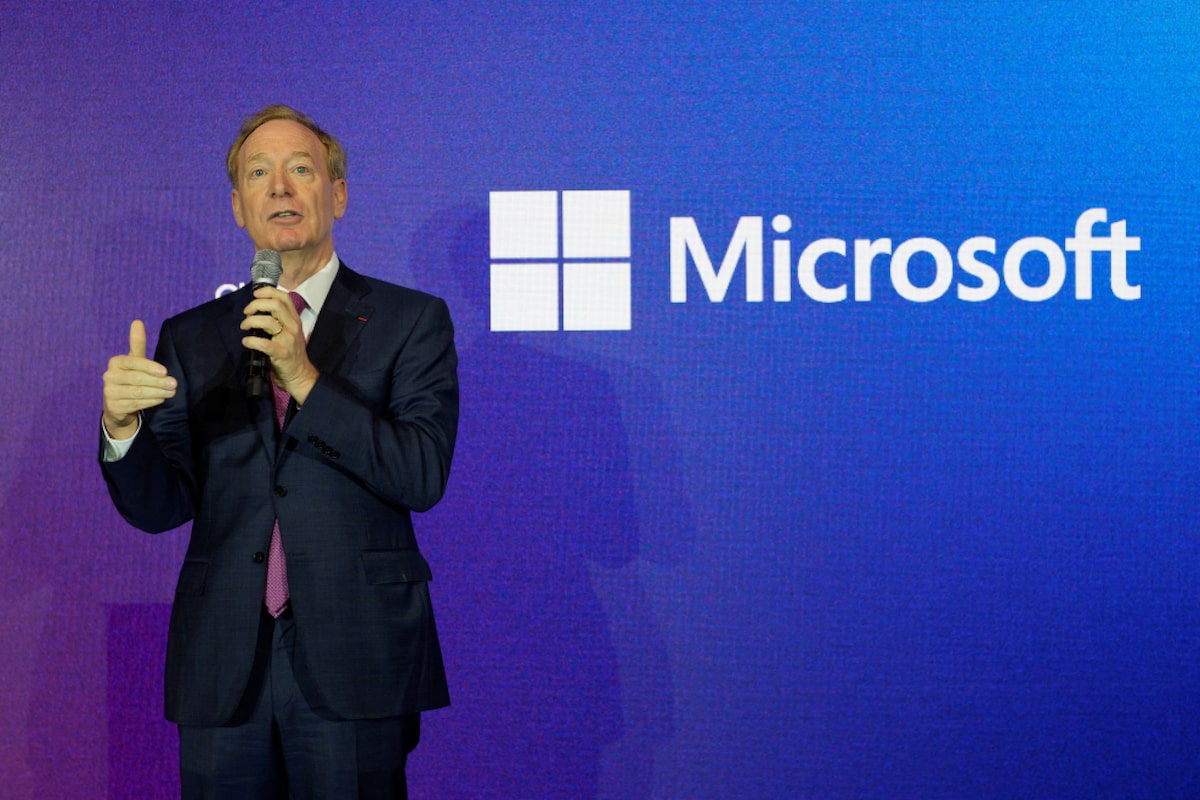
Microsoft president and vice-chair Brad Smith is in Ottawa this week to meet with government officials and employees.Thibault Camus/Reuters
Microsoft Corp. MSFT-T will spend more than $7.5-billion in Canada over the next two years as part of a data-centre expansion, while vowing to keep data within Canadian borders and resist any orders to discontinue services to government customers that could arise during uncertain geopolitical times.
The company’s president and vice-chair Brad Smith is in Ottawa Tuesday to meet with government officials and employees as part of the announcement. The funds will be used for Microsoft’s operational expenses along with capital spending to expand its data centres in Canada, including adding graphics processing units (GPUs) to handle AI workloads. Mr. Smith wrote in a blog post Tuesday that Microsoft has allotted $19-billion to Canada between 2023 and 2027.
In an interview Monday, Mr. Smith was eager to emphasize Microsoft’s commitment to digital sovereignty, which broadly refers to the control a country can exercise over its data and the infrastructure powering AI and cloud computing.
“Digital sovereignty has become a more important issue around the world,” he said. “What we’re seeing in Canada is two very distinct things. One is the change in the dialogue with the United States. The other is the increase in activity from around the world that’s targeting Canada.”
Nvidia, Microsoft invest in Anthropic as maker of Claude chatbot buys $30-billion in Azure capacity
Microsoft signs $9.7-billion cloud contract with IREN for Nvidia chips
The fraught relationship with the U.S. under President Donald Trump is forcing Canadian companies and governments to reassess their reliance on American tech giants, including Microsoft, for crucial digital services. Cyberthreats targeting Canadian entities are also boosting the need for stronger cybersecurity measures, according to Mr. Smith.
Digital sovereignty is a thorny challenge for the federal government. Ottawa wants more data centres built in Canada to support growing AI usage and to foster homegrown alternatives to the dominance of U.S. tech giants, which also include Google, Amazon Web Services and Oracle, to lessen geopolitical vulnerabilities and capture more economic benefits. Of particular concern is the ability of U.S. courts to request data from the subsidiaries of American companies, even if the data is stored within Canada.
Last year, then-prime minister Justin Trudeau launched a sovereign AI compute program to help fund data centres, while current Prime Minister Mark Carney has also embraced the construction of a sovereign cloud.
Federal AI Minister Evan Solomon has expounded on the topic and reiterated the message at a meeting of G7 industry, digital and technology ministers on Monday in Montreal. He said that Canada has to develop strategic autonomy, which means working with other middle powers such as European Union countries to “scale up” AI capabilities. “Our policy objective is to increase our trade with trusted partners, and the EU is obviously core to that strategy,” he told reporters.
Mr. Smith said Microsoft can provide government and corporate customers with control over data, despite being an American company, through technical, operational and contractual measures. Starting next year, Microsoft will add the ability to process data for its Copilot AI platform inside Canada’s borders and allow customers to run other services on their own cloud infrastructure. Customer data is also encrypted and the keys can be stored with customers.
“It’s about looking for the best combination of tools that will both protect the country’s digital sovereignty and support the economy,” Mr. Smith said.
Google Canada has also emphasized similar protection measures including data boundaries such as encryption to prevent unauthorized access.
Microsoft said it is “codifying” a promise to protect customer data, agreeing to challenge any demands to access government and commercial information where it has legal grounds to do so.
It also said it would fight any effort to cut off services to Canadian government customers. “If ever confronted with an order to suspend or halt operations in Canada, we will pursue every available legal and diplomatic avenue – including litigation – to protect access to critical infrastructure,” Mr. Smith wrote in his blog post.
It remains unclear what would happen should such a scenario play out. Mr. Trump, for example, has found some success bending institutions to his will. Hypothetically, if the U.S. President orders Microsoft to discontinue services to the Canadian government as a trade-war bargaining tactic, would Microsoft risk suffering the consequences of running afoul of the administration – or succumb to political pressure?
“Look at our track record. We have always worked diplomatically to address challenges that have arisen, while also standing firmly on the side of principles that we feel are timeless,” Mr. Smith said in response, noting the company has gone to court with U.S. administrations in the past.
Canadian-owned and operated cloud companies may be saddled with less geopolitical risk. Telecommunications carriers BCE Inc. and Telus Corp. entered the AI data-centre business this year, while Toronto-based cloud company ThinkOn Inc. has long made data sovereignty part of its pitch.
These companies are smaller than the tech giants, however. Complete digital autonomy is also “impossible,” according to a Treasury Board report, because of the “absolute interconnected nature of the digital world.”
Mr. Smith seemed to agree. “This notion of being able to cut oneself off from everyone outside one’s own borders and be entirely self-sufficient is not, in my view, a recipe for innovation or economic growth for any country,” he said.
With reports from Nicolas Van Praet