
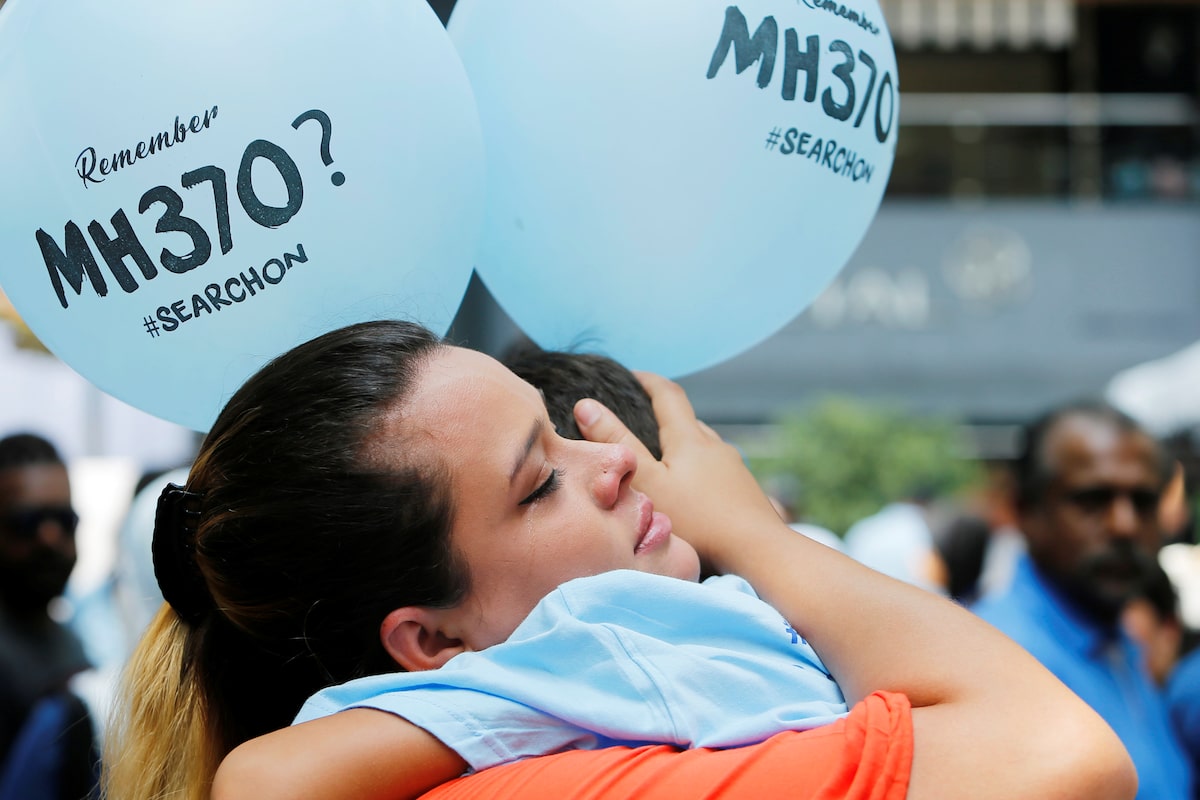
Flight MH370 vanished in the early hours of March 8, 2014, en route from Kuala Lumpur to Beijing.LAI SENG SIN/Reuters
Just weeks before a long-stalled search for Malaysia Airlines flight 370 is due to resume in the southern Indian Ocean, a Chinese court on Monday awarded damages of more than $500,000 each to the families of eight passengers on-board the missing aircraft.
Flight MH370, a Boeing 777 carrying 227 passengers and 12 crew, vanished in the early hours of March 8, 2014, en route from Kuala Lumpur to Beijing. The incident sparked a massive international search, as well as a global obsession that has spawned multiple books, documentaries and wild conspiracy theories.
In early 2015, Malaysia officially classified the plane’s disappearance as an accident, with all those onboard presumed dead. The following year, families of the missing passengers – two-thirds of whom were Chinese, along with Malaysian, European and Canadian nationals – filed lawsuits against Malaysia Airlines, many of which have dragged on for years, through mediation and settlement negotiations.
Earlier: What really happened to Flight MH370?
On Monday, a Beijing court ordered the airline to pay 2.9-million yuan ($567,906) to eight families, covering death compensation, funeral expenses, mental anguish and other losses, according to Chinese state media.
For 23 other families with cases outstanding against Malaysia Airlines, the ruling was a pyrrhic victory, as the court-held compensation would only be paid to those claimants whose loved ones have been declared legally dead.
Chinese relatives of passengers on the missing Malaysia Airlines flight MH370 during a prayer service in Beijing in 2014.WANG ZHAO/AFP/Getty Images
Jiang Hui, whose mother Jiang Cuiyun was onboard the doomed flight, said the ruling “means we must acknowledge that our loved ones are dead and must go through the cruel procedure of having death declared by a court.”
Groups representing the families of missing MH370 passengers had hoped to win a partial or advance judgment against the airline, which would require it to pay out of a fund established for such compensation, without forcing claimants to take a step that for many feels like giving up on ever finding their loved ones.
“Malaysia Airlines and the insurance companies set aside this money more than 10 years ago,” Mr. Jiang said, adding that if families were merely seeking a payout, they could have settled with the airline and received it already.
Earlier: For family of Canadians on MH370, ‘a time for despair’
“We are not just doing this for the money,” he added. “In the judgment, apart from the obligation to provide compensation, I didn’t see any criticism of Malaysia Airlines’ past actions. Things we demanded like compensation for psychological assistance, a search fund, or an apology from Malaysia Airlines – none of these were satisfied. All we got was an ice-cold number.”
Malaysia Airlines did not respond to a request for comment.
Mr. Jiang and other campaigners welcomed the news earlier this month that the search for the missing plane, suspended since 2018, will resume on Dec. 30.
MH370 made its final transmission around 40 minutes after taking off from Kuala Lumpur, as the plane neared Vietnamese airspace. Soon after, its transponders were turned off and the plane left its flight route to make a sharp turn back toward Malaysia, before heading out into the Andaman Sea and then south, after which all contact was lost.
In early 2015, Malaysia officially classified the plane’s disappearance as an accident, with all those on board presumed dead.Kim Kyung Hoon/Reuters
In 2018, a report by the Malaysian Ministry of Transport said the initial turn was carried out manually, either by a pilot or through “unlawful interference by a third party,” and there was no evidence of “malfunction or defect in the aircraft that could have contributed to the disappearance.” Initial Malaysian police investigations focused on Captain Zaharie Ahmad Shah as the most likely culprit if the plane was brought down by human action, but this has never been proven.
Investigators concluded – based on debris that has since washed up on the shores of East Africa and islands off the coast – that MH370 plunged into the Indian Ocean around six hours after takeoff, killing all those on-board. All four of the plane’s emergency locator transmitters malfunctioned, the report said, significantly hampering search efforts.
Years of searching, first by an international task force and subsequently by Ocean Infinity, have failed to turn up the primary wreckage, and in May 2018, the U.S. marine robotics company said it was with a “heavy heart” that it was calling off search efforts after scanning more than 112,000 square-kilometres of ocean floor.
To many, that seemed like an admission of defeat and an indication the plane would never be found, but late last year, Malaysia agreed to extend its US$70-million “no-find, no-fee” contract with Ocean Infinity. The search is due to resume later this month and continue for 55 days, over a “targeted area assessed to have the highest probability of locating the aircraft.”
Finding the plane would be a huge development in this decade-long story, but may not provide any satisfying answers. Cockpit recorders work on a two-hour loop and so will not contain anything from the time when MH370 made its dramatic departure from the flight route, while the flight data recorder would most likely just confirm what has already been ascertained from satellite and debris data.
At the time of MH370’s disappearance, Malaysia was ruled by the corrupt and autocratic regime of Najib Razak and initial investigations were criticized for incompetence and lacking transparency. The current government said it hopes finding the plane might bring families “closure,” but equally it may refocus attention on what evidence might not be found at sea, but in Malaysia.
With reports from Alexandra Li in Beijing