
Across the European Union, many people depend on groundwater that is increasingly affected by nitrate pollution from fertilisers and agricultural waste. Elevated nitrate levels can compromise drinking water quality and contribute to the degradation of rivers, lakes, and ecosystems.
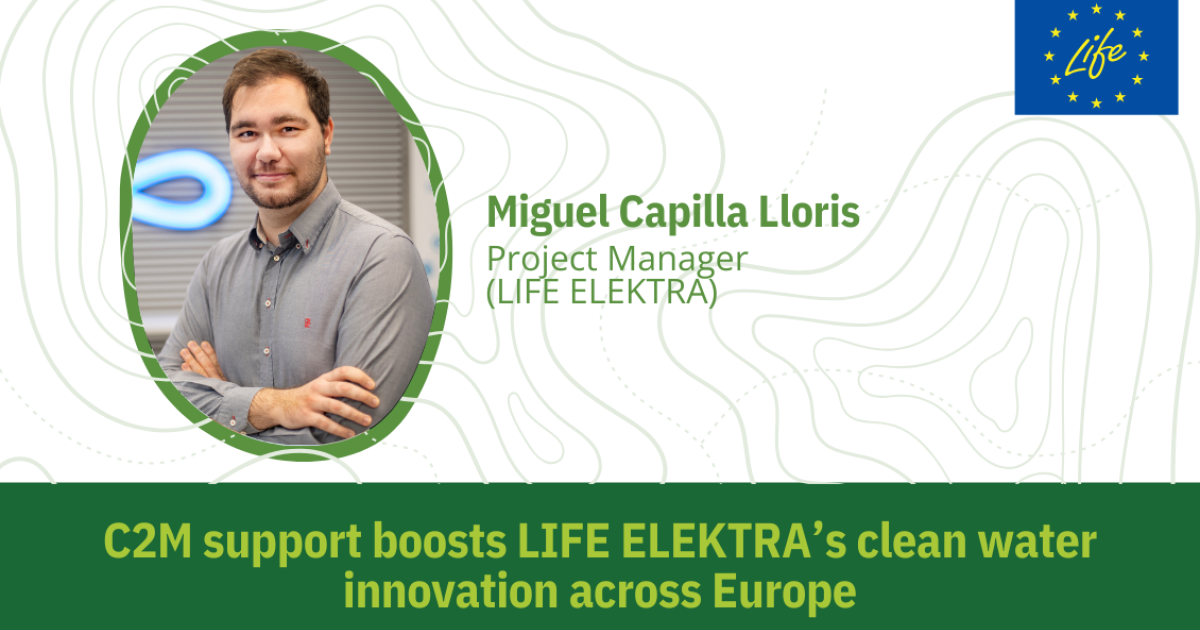
« Nitrates migrating into our water pose a serious risk to both public health and biodiversity. We need a solution that can remove these pollutants safely and sustainably, » explains Miguel Capilla Lloris, LIFE ELEKTRA’s project manager.
That’s where the LIFE ELEKTRA project comes in: « We can remove up to 99% of nitrates from polluted water, » says Miguel. « This means safer water for people and healthier ecosystems.»
The project solution also produces clean energy from recovered hydrogen and solar power, reducing carbon emissions by over 3,300 kg of CO₂ per year. Its containerised design allows rapid deployment in multiple locations, demonstrating a scalable solution to tackle nitrate pollution across Europe.
Transforming pollution into clean water and green energy
LIFE ELEKTRA developed a system that removes nitrates through an electrochemical process, powered by renewable energy. Electricity triggers a reaction that transforms harmful nitrate molecules into nitrogen gas, which is harmless and naturally present in the air.
The system also generates hydrogen as a by-product that can be reused to power parts of the plant, improving energy efficiency. In some cases, concentrated wastewater streams – i.e. rejected water from other treatment processes – are treated to minimise waste.
Its mobile, containerised units allow deployment in diverse locations, including small or remote communities without conventional water treatment.
The role of LIFE C2M support
The close-to-market (C2M) support from the LIFE Programme was essential in helping the LIFE ELEKTRA team bring their technical innovation to real-world deployment, i.e. deepening and further developing business strategy for the technology’s commercialisation , and strengthen their communications efforts.
« The close-to-market training we received gave us the foundation to better develop the strategy for implementing the LIFE ELEKTRA technology, especially when planning how to deploy it in nitrate-polluted waters », highlights Miguel Capilla Lloris.
Following the C2M group coaching on communications, visibility and outreach, as well as pitch-coaching activities, including preparation for the Water Smart Economy & Society Congress 2025 (WSES2025) in Rotterdam, Miguel described these sessions as some of the most valuable support the team has gained.
«As technical developers, we usually focus on deep, technical explanations. The close-to-market support, especially the communication and dissemination training, helped me completely change my perspective. It taught me how to explain our technology clearly to people who are not technical, which is essential if we want to bring ELEKTRA to the market.»
Looking ahead, LIFE ELEKTRA aims to scale up its mobile treatment units and validate them across sites in Spain and Malta.
Learn more about the project, which focuses on water saving, renewable energies, energy production and supply, water quality improvement, waste recycling, resource efficiency and wastewater treatment in our project fiche.
The LIFE ELEKTRA project supports key EU environmental and circular economy policy areas, including:
How LIFE helps close-to-market projects
LIFE close-to-market initiative supports LIFE beneficiaries in bringing their innovative green solutions to market. Projects gain access to a dedicated support team with extensive experience, offering business coaching, advice on business strategy development, pitching guidance and expert connections, among other activities.
Looking for support to develop your cleantech solution and bring it to market? Check out the LIFE Close-to-market page.