
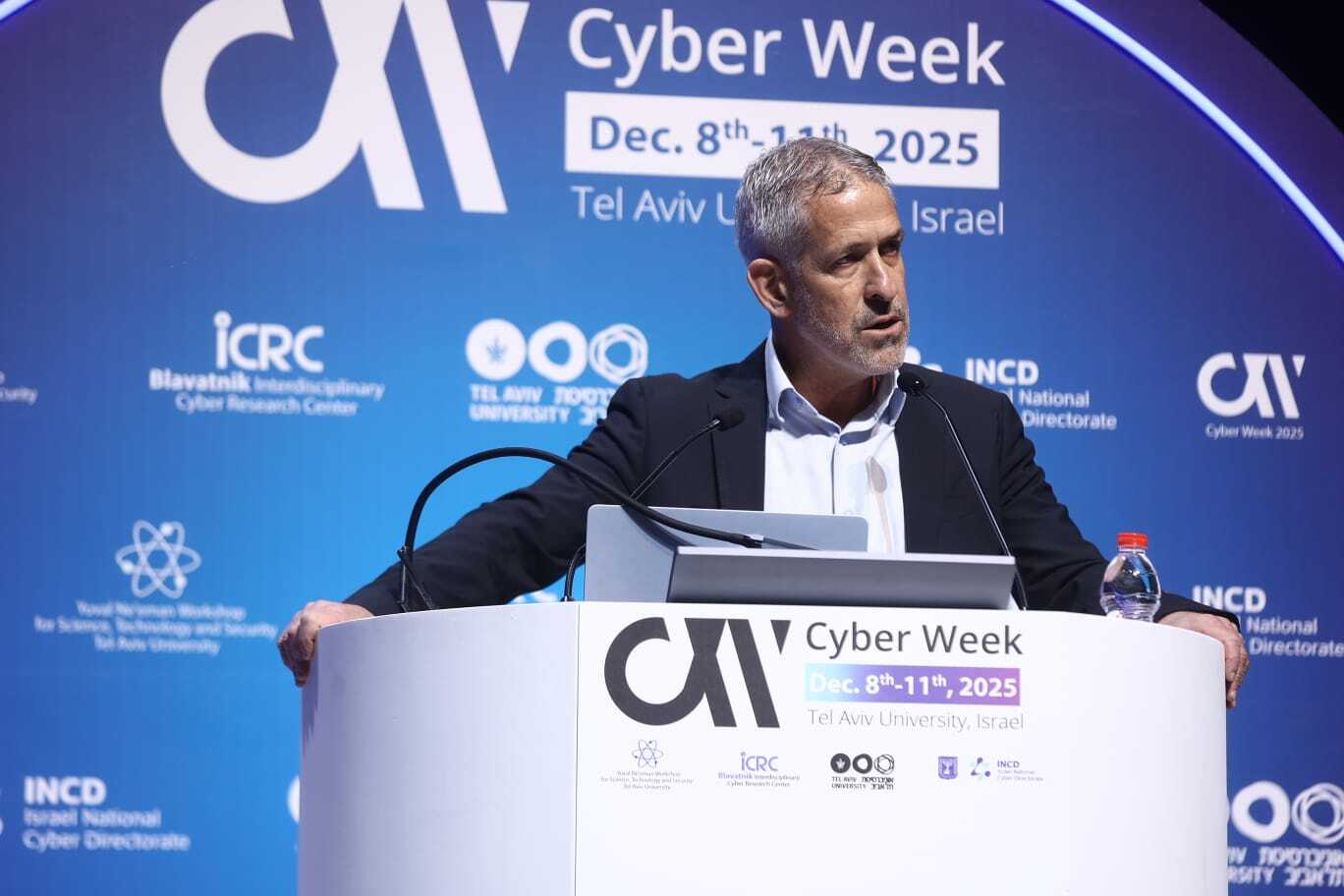
Former Shin Bet chief Ronen Bar on Tuesday called for the government to establish a state commission of inquiry into the failures surrounding Hamas’s October 7 attack, lobbing implicit criticism at Prime Minister Benjamin Netanyahu in his first public address since leaving his post in June.
Speaking at Tel Aviv University’s Cyber Week 2025 conference, Bar focused his speech on the theme of responsibility and the importance of owning up to mistakes.
Netanyahu, who has vociferously opposed establishing a state commission, shot back in his own speech at the conference Tuesday evening, claiming that the contentious government-led investigation he is backing will sufficiently probe the issue.
Bar opened his address by singling out two victims of October 7 — Staff Sgt. Ofir Shoshani, a commander in the Israel Defense Force’s Intelligence Corps who was murdered in her home in Kibbutz Kfar Aza, and Hersh Goldberg-Polin, who was abducted from the Nova music festival and murdered in Hamas captivity close to a year later.
Bar said he was reminding the audience of the people behind the statistics, as “only when you see them do you understand the meaning of responsibility and the price of making mistakes and failing.”
Get The Times of Israel’s Daily Edition
by email and never miss our top stories
By signing up, you agree to the terms
“When we thwart an attack, we can only imagine those we saved, and when we fail to thwart a massacre, we see with our own eyes who was murdered,” he said.
“Responsibility is infinite — you cannot distribute it, only take it. And in leadership, it is better to take responsibility for failures than credit for achievements,” said Bar, who admitted responsibility in the first weeks of the war against Hamas for the Shin Bet’s failure to prevent the terror group’s onslaught.
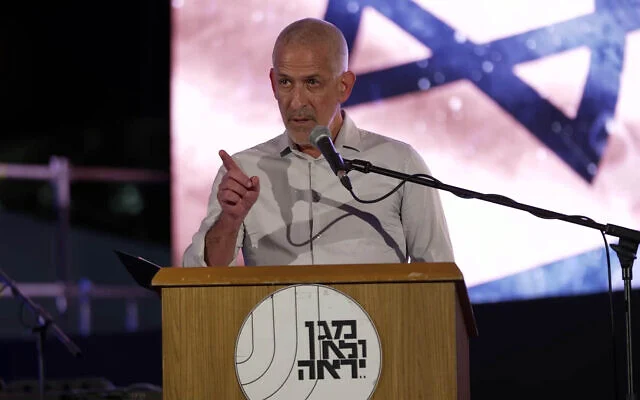
Shin Bet chief Ronen Bar announces that he will step down from his position on June 15, in an address at a memorial event for fallen Shin Bet personnel, April 28, 2025. (Screenshot)
True leadership “does not end with taking responsibility for the failure,” he said. “It ends with taking responsibility for fixing it,” and pointed to the Shin Bet’s actions on October 7, 2023, itself as its first step toward fixing its mistakes.
The next step to fix things, Bar continued, was the internal investigation into the failures of October 7 carried out within the security agency, from which he said it has “learned how to be better.”
“But the only way to conduct a comprehensive investigation into this failure, to know what really happened, to dispel the conspiracies that endanger our continued existence, to learn what to fix and to ensure that it does not happen again is through a state commission of inquiry,” he declared.
He said the commission must be one led by professionals that “sees the whole picture and knows how to tell the whole story and decide what needs to be done so that it does not happen again.”
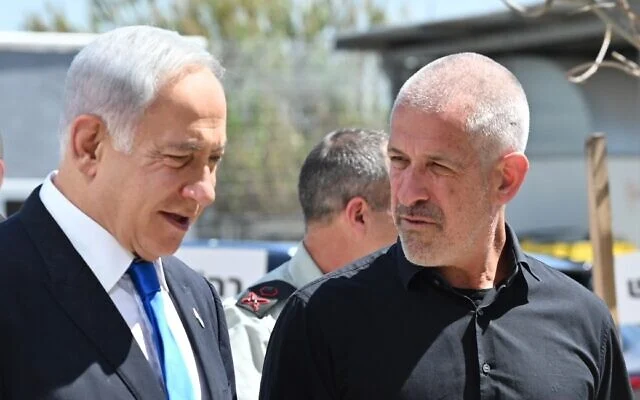
Prime Minister Benjamin Netanyahu (left) and Shin Bet chief Ronen Bar, on April 4, 2023. (Kobi Gideon/GPO)
Returning to the opening theme of his speech, Bar told the conference that Ofir and Hersh would want a state commission of inquiry, and that their families want a state commission of inquiry, and that “this is what our children expect from us.”
“Because,” he said, “the moment we did not decide to investigate the entire system, we essentially sentenced them to the next October 7.”
“So let us stop quarreling and enter this process together,” he said. “To learn, with the goal of becoming better.”
“It happened on our watch, so it is our responsibility,” Bar concluded.
Bar left his post in June after Netanyahu’s cabinet voted to dismiss him, prompting a legal battle in the High Court of Justice.
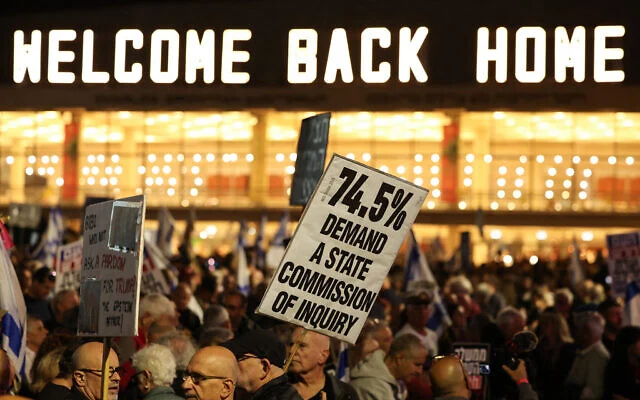
Israeli anti-government protesters lift up placards during a demonstration against the prime minister and in support of establishing a state commission of inquiry into Hamas’s October 7, 2023, attacks on Israel, in Tel Aviv on November 15, 2025. (Jack GUEZ / AFP)
Netanyahu has opposed the establishment of a state commission of inquiry into the October 7 onslaught, in which Hamas-led terrorists killed some 1,200 people, mostly civilians murdered amid horrific acts of brutality, and abducted 251. It was the single deadliest day for Jews since the Holocaust and the worst disaster in modern Israeli history.
The government is instead trying to establish its own probe, claiming that a sizable portion of the public would not accept the findings of a traditional state probe. Netanyahu echoed that argument in his speech on Tuesday.
“There was a failure here, a huge failure,” he said. “This failure must be thoroughly investigated, it must examine the political echelon, the military echelon, the security echelon, everyone. And this is only possible if we do this with a broad national examination commission, that is not tailored to one side or the other.”
He compared such an investigation to the US body popularly known as the 9/11 Commission, which conducted a probe into the September 11, 2001, attacks.
“After the greatest disaster in US history, 9/11, they established a commission composed of half Republicans and half Democrats,” he said. “Nobody had an advantage. Everyone could raise any question, and any person the sides wished to call. That is what will happen here too.”
That commission, under the Republican administration of then-president George W. Bush, was led by a Democratic former governor of New Jersey. While the members of the government’s investigative body have yet to be named, the people determining its mandate are sitting cabinet ministers.
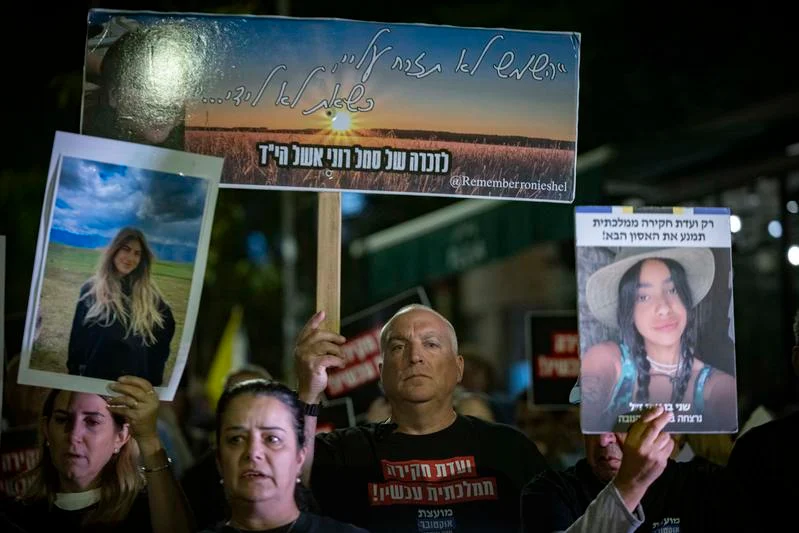
Eyal Eshel (center) and other members of the October Council outside the Prime Minister’s residence in Jerusalem, demanding the establishment of a state commission of inquiry into the October 7 massacre, November 1, 2025. (Yonatan Sindel/Flash90)
Polls consistently show that a clear majority of Israelis support a state commission. Netanyahu in 2022 himself backed such an inquiry into allegations that police improperly spied on Israeli citizens.
Opposition politicians, good governance groups and hostages’ families have all demanded the establishment of a state commission of inquiry, with some turning to the courts to force the issue.
The High Court of Justice told the government on October 15 that there was “no real argument” against the need to establish a state commission of inquiry, giving the government 30 days to submit a new update about “the fate” of such a commission.
Former prime minister Naftali Bennett, thought to be Netanyahu’s most credible challenger in next year’s election, issued a statement vowing to form a state commission of inquiry.
“There will not be a whitewashing committee,” he said. “I say to the government’s ministers — either form a state commission of inquiry now, by willing consensus, or after the elections, against your will, you’ll be dragged to a state commission of inquiry that we’ll form.”