
Your support helps us to tell the story
From reproductive rights to climate change to Big Tech, The Independent is on the ground when the story is developing. Whether it’s investigating the financials of Elon Musk’s pro-Trump PAC or producing our latest documentary, ‘The A Word’, which shines a light on the American women fighting for reproductive rights, we know how important it is to parse out the facts from the messaging.
At such a critical moment in US history, we need reporters on the ground. Your donation allows us to keep sending journalists to speak to both sides of the story.
The Independent is trusted by Americans across the entire political spectrum. And unlike many other quality news outlets, we choose not to lock Americans out of our reporting and analysis with paywalls. We believe quality journalism should be available to everyone, paid for by those who can afford it.
Your support makes all the difference.Read more
Thousands of travellers will wake up on Wednesday morning where they did not intend to be after the first severe storm of the winter swept across the UK and Ireland.
Aer Lingus and its sister airline, British Airways, cancelled dozens of flights, with some aircraft diverting or returning to their starting points because of the high winds.
The Met Office has put in place a series of yellow and amber weather warnings for wind and rain, continuing into Wednesday.
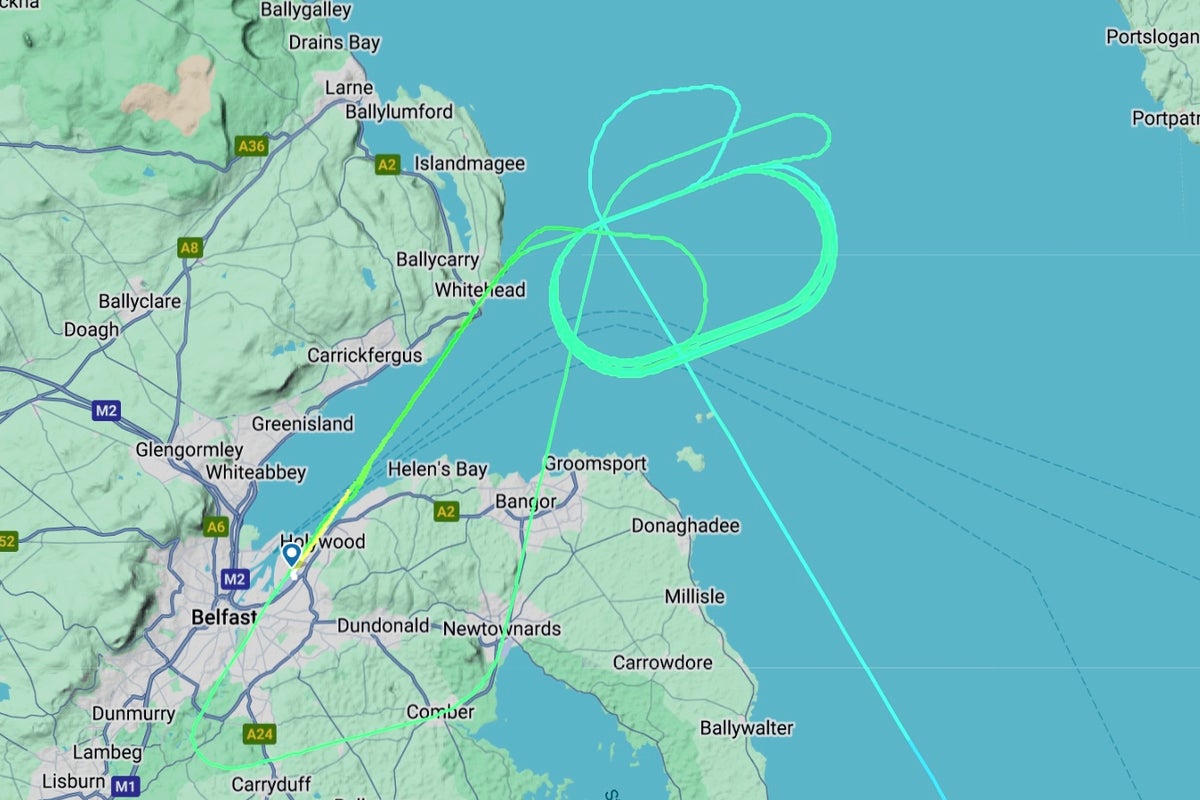
Belfast City was the worst affected UK airport, with 27 cancellations – plus a BA flight from Heathrow that went on a 2h15m ”flight to nowhere”. After holding and making a missed approach, it returned to its starting point.
One flight that did touch down – eventually – was an Aer Lingus Regional service from Manchester. The ATR72 aircraft circled for half an hour above the Irish Sea, made one approach that was aborted and flew a holding pattern for a further hour before landing successfully two-and-a-half hours after leaving Manchester. The 171-mile journey normally takes 45 minutes.
Glasgow passengers also endured a difficult day, with half-a-dozen diversions during the afternoon and evening.
Ryanair flights from Krakow and Alicante landed in Manchester, as did a Jet2 service from Lanzarote.
Three flights from the London area to Glasgow were affected: easyJet from Luton and British Airways from Heathrow ended up in Newcastle, while a BA service from London City flew back to where it started.
Ferries on the Irish Sea mostly stayed in port. P&O Ferries, Irish Ferries and Stena Line cancelled their daytime crossings linking Ireland and Northern Ireland with Wales and Scotland.
All Caledonian MacBrayne sailings in the Western Isles were affected, with many routes cancelled for the day.
Many rail passengers have faced long delays and cancellations – particularly on the West Coast Main Line, which connects London Euston with the West Midlands, northwest England, north Wales and southern Scotland.
Avanti West Coast told passengers: “We’re running a reduced timetable north of Preston further to speed restrictions applied by Network Rail.
“Fewer trains will run and journeys will take longer. There is then a risk of further disruption on the rail network due to this extreme weather.”
Within Scotland, the lines connecting Inverness with Kyle of Lochalsh and Fort William with Mallaig were both closed “because of potential wind gust speeds reaching 90mph”. Many lines will open later than usual on Wednesday morning, with disruption continuing during the day.
ScotRail passengers were told that tickets could be used up to Thursday 11 December.
Met Office yellow and amber warnings of high winds cover almost the whole of Scotland on Wednesday. Caledonian MacBrayne ferries linking Oban with Barra, Islay and South Uist are cancelled on Wednesday.