
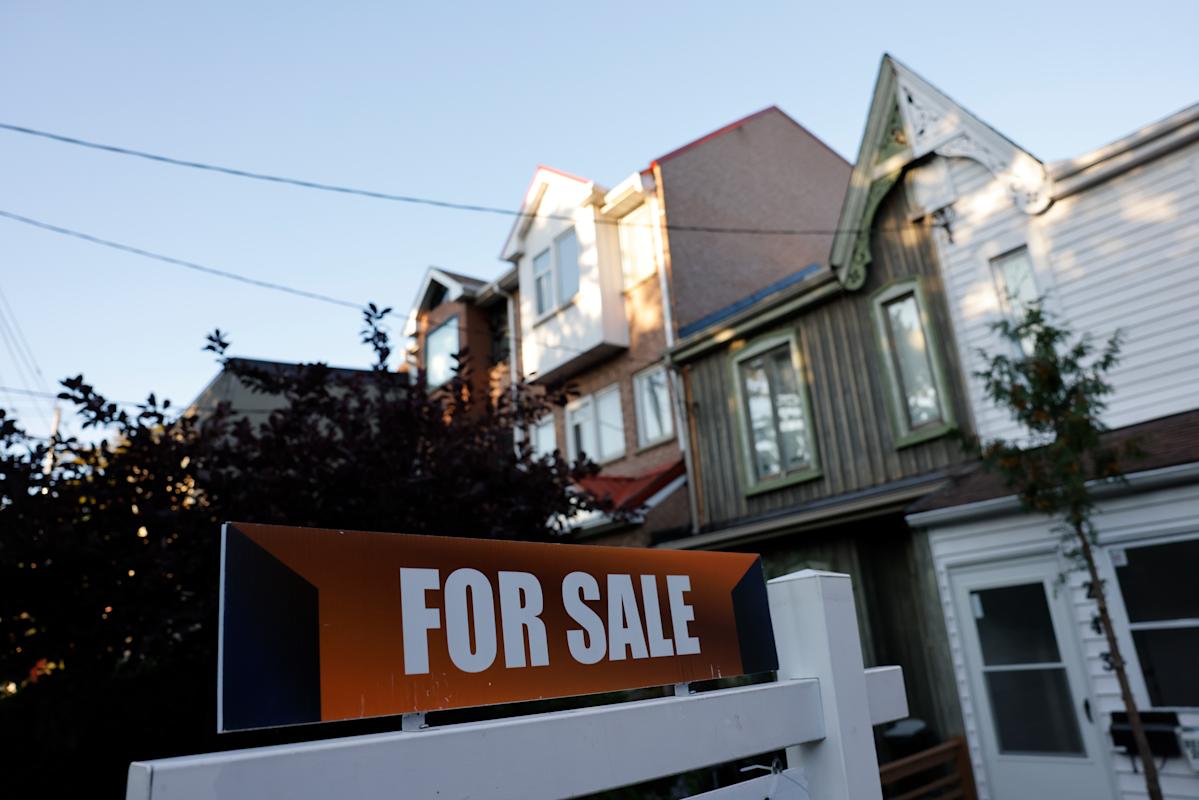
Sixteen months of interest rate cuts should have jolted Canada’s housing market back to life. Instead, the sector has barely moved — and with the Bank of Canada (BoC) expected to hold steady this Wednesday, industry experts say the trade war’s shadow, not interest rates, will dictate where the market goes next.
The BoC has lowered its policy rate by 275 basis points since June 2024, taking it from five per cent to 2.25 per cent. Mortgage rates have followed: fixed-rate borrowing has fallen sharply from mid-2024 highs, and variable rates have recently dropped lower than fixed rates.
Yet, according to data from the Canadian Real Estate Association, sales activity and average prices are more or less even with where they were in early 2024.
“This Bank of Canada rate has come down massively from its peak,” said Ron Butler, a broker at Butler Mortgage. “Sales are still terrible, and prices keep coming down. It’s definitely a massive piece of the narrative, but [the BoC] doesn’t control the market at all.”
CIBC deputy chief economist Benjamin Tal says the housing market “actually hasn’t responded” to the deep interest rate cuts, “and I think that it’s not just about interest rates.”
The cuts, he says, kept Canada out of recession, but were overwhelmed by broader economic forces. “The economy as a whole is still struggling. The fog of uncertainty regarding Trump is a major factor impacting the psyche of the consumer.”
Even if the BoC were inclined to cut again — something analysts widely doubt — Tal says the traditional link between cheaper borrowing and housing demand has weakened. “Interest rates are secondary here,” he said.
Butler, Tal and others describe a market defined by caution: prices drifting lower, sales volumes subdued, and no sense of urgency on either side of the transaction. National benchmark prices are still below where they were when the easing cycle began. Some of the heaviest declines have been in entry-level segments like condos and townhouses.
The pain isn’t distributed equally. Royal LePage CEO Phil Soper notes that while national figures look stagnant, they mask a “compression” in the market. More affordable regions like Edmonton and Montreal have seen meaningful activity, while the traditional engines of Canadian real estate — Toronto and Vancouver — are stalling, dragged down by prices that still remain out of reach for many.
The weakness in the entry-level market, says Soper, stems from the absence of the group that normally kickstarts a housing cycle. “The big missing piece… is the first-time home buyer,” he said, with surveys showing that trade-war uncertainty is holding them back.
Story continues
Existing owners who might otherwise trade up are “out of sorts,” Butler says, because their realtors are telling them their homes are worth less than they expected. And renters hoping to buy “still can’t make the math work,” he adds, with prices too high relative to incomes.
“For most first-time homebuyers, the prices still have to come down or their incomes have to go up,” he said. “That’s it.”
At the same time, Butler says the investor class has evaporated. “Absolutely no one is buying a property to rent it out, to flip it, to renovate it. Zero. Gone.” Soper adds that federal caps on foreign students and temporary workers have hollowed out the rental demand that condo investors rely on.
The result is a market with fewer buyers, more hesitation, and transactions bogged down by the kind of conditions and inspections that vanished during the pandemic boom. “The buyer is much more judicious, much more careful, much more picky,” Butler said.
All three experts point to the U.S.–Canada trade conflict as the central force weighing on economic confidence.
Tal says the freeze in business investment offers a useful parallel for understanding household behaviour. “You can cut interest rates to zero — they’re not investing because you don’t know what will happen tomorrow with a tariff,” he said. One CEO told him the only thing they needed was clarity: “Give me a number. So at least I know where I am.”
Beyond the external threat of tariffs, Tal points to a specific domestic headwind that will keep a lid on the recovery in 2026: a tougher mortgage renewal environment.
He says the renewal wave of 2025 was “much ado about nothing” because borrowers could refinance, but 2026 will be different. Homeowners renewing next year locked in rock-bottom rates in 2021, and in markets like Ontario and B.C., their home values have since dipped — removing the refinancing cushion they might have relied on.
Tal estimates this affects about 5.5 per cent of outstanding mortgages, a group he says will face a “significant” payment shock of 40 per cent or more.
Both Soper and Tal say that even without a resolution to the trade conflict, the psychological shock it imposed will fade — just as pandemic fears did in late-2020, with the market rebounding long before vaccines arrived (though that trend was also driven by a move out of cities).
“People get used to it, people adjust, people adapt,” Tal said. At the margin, that can draw some buyers back.
Tal and Soper both see U.S. political realities driving a potential end to the trade conflict next year — an outcome Tal says would lead to a marked improvement in the housing market. Change, though, is generally expected to be gradual. Butler sees no chance of a price surge next year. Soper expects transaction volumes to keep rising only gradually. Tal foresees 2026 as a “transition year” — slow in the spring, better in the fall, and still heavily shaped by whether tariff uncertainty clears.
“The uncertainty is a major factor,” Tal said. “And that’s why this fog is so thick.”
John MacFarlane is a senior reporter at Yahoo Finance Canada. Follow him on X @jmacf.
Download the Yahoo Finance app, available for Apple and Android.