
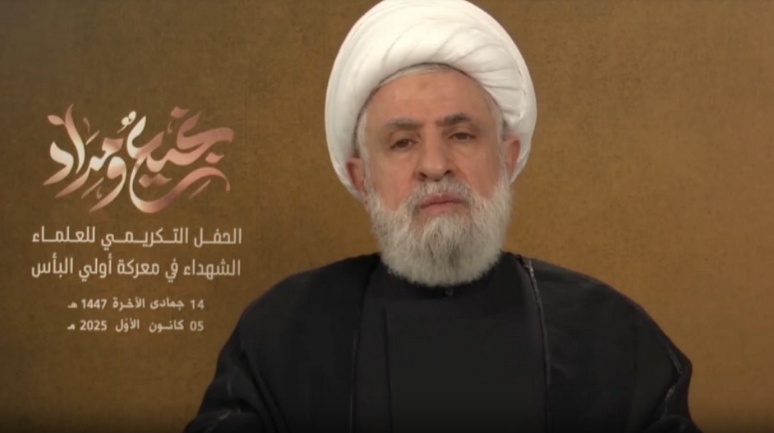
 Na’im Qassem (al-‘Ahed, December 5, 2025)
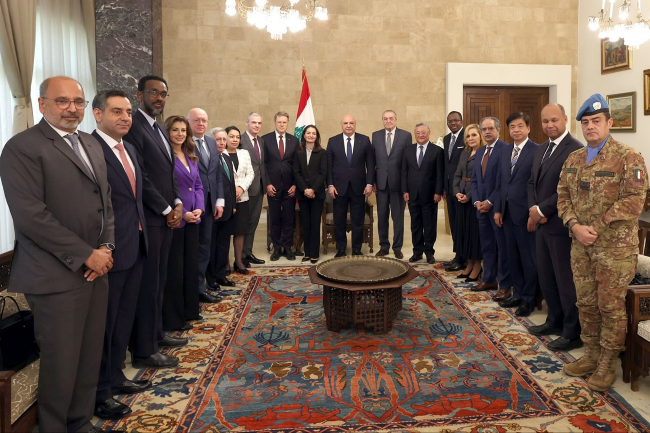
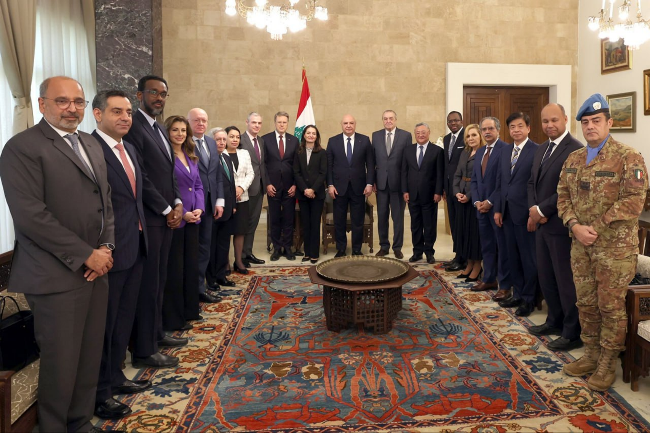 Aoun with the delegation (X account of the Lebanese presidency, December 5, 2025)
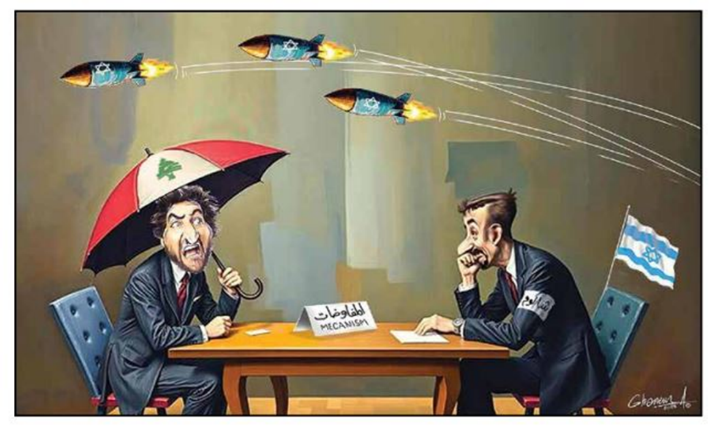 Negotiations between Lebanon and Israel (al-Jumhuriya, December 5, 2025)
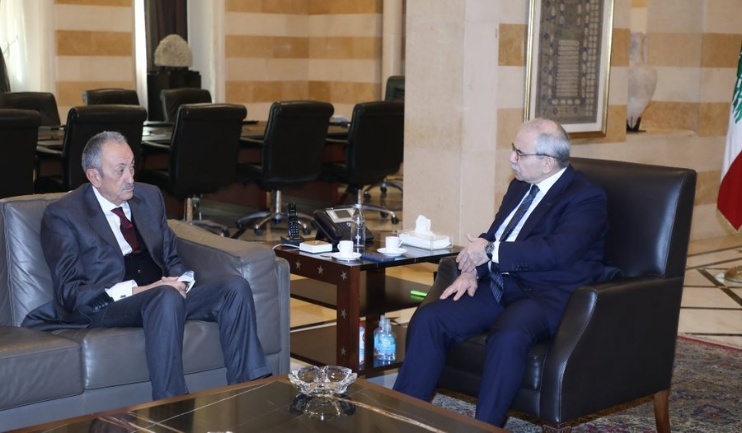 Salam meets with Karam (X account of the Lebanese prime minister’s office, December 4, 2025)
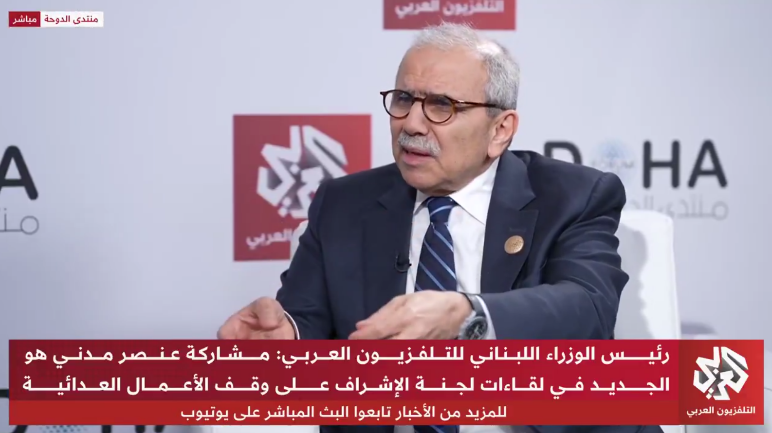 Nawaf Salam (al-Araby channel, December 6, 2025)
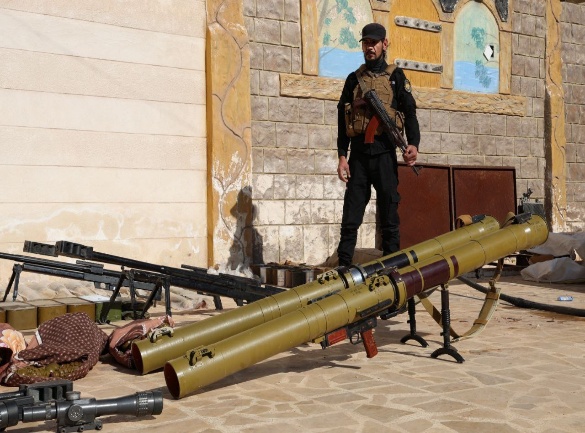 Weapons seized in the Homs area (Telegram channel of Homs Province, December 3, 2025).
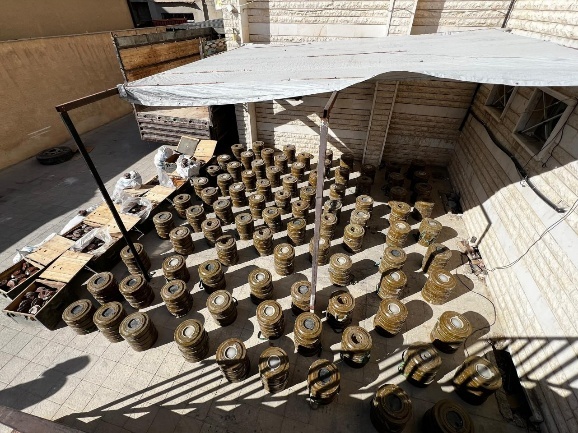 Weapons found near al-Jabah (Telegram channel of the Syrian ministry of interior, December 2, 2025)Overview[1]
The IDF continued attacking Hezbollah targets in south Lebanon to enforce the ceasefire agreement, which prohibited the organization’s presence south of the Litani. The IDF reported that in the year since the ceasefire, more than 370 terrorist operatives, most of them from Hezbollah, had been eliminated and there had been approximately 1,200 targeted ground operations to destroy terrorist infrastructure and damage the organization’s military capabilities.
The IDF continued attacking Hezbollah targets in south Lebanon, however “enforcement” actions to implement the November 2024 ceasefire agreement occurred less frequently.
Hezbollah’s secretary general, Na’im Qassem, demanded that the United States and Israel stop interfering in Lebanon’s internal affairs, including the rebuilding of the organization’s military capabilities. He said Hezbollah would continue to “defend” itself in view of the intention to eliminate its existence.
The Lebanese leadership reiterated calls to the international community to exert pressure on Israel to halt its attacks in Lebanon and to complete its withdrawal from the positions it holds in south Lebanon. Prime Minister Salam accused Israel of waging a war of attrition against Lebanon.
For the first time, Lebanon’s President Aoun appointed a civilian representative to head the delegation to the ceasefire monitoring committee, arguing the need to prioritize the language of negotiations over the language of war. Prime Minister Salam said it was still too early to discuss economic cooperation with Israel. Hezbollah did not conceal its displeasure with the appointment and accused the government of making concessions to Israel.
The Lebanese army denied Iranian claims that about one third of its soldiers belonged to Hezbollah, while UNIFIL denied Israeli accusations that the force transferred information to Hezbollah.
A survey in Lebanon showed that a majority of the public supported restricting weapons to the Lebanese army. Despite calls within the government and the political system for a state monopoly on weapons throughout Lebanon, Hezbollah claimed that did not apply to the “resistance” factions.[2] Nabih Berri, speaker of the Lebanese Parliament, reportedly demanded that Iran issue a religious ruling [fatwa] permitting Hezbollah to hand over missiles and unmanned aerial vehicles, but Tehran did not provide a clear response.
The commander of the United States Central Command praised Syrian security forces for preventing weapons shipments for Hezbollah from reaching Lebanon.
There were anti-Hezbollah and anti-government protests in towns in south Lebanon over the prolonged delay in paying compensation to those affected in the war against Israel.
Israel-Hezbollah Tensions
IDF activity
On December 4, 2025, the IDF attacked Hezbollah weapons depots located in civilian communities in south Lebanon, enforcing the understandings of the November 27, 2024 ceasefire agreement, which prohibits a Hezbollah presence south of the Litani River, and to prevent Hezbollah from reconstructing its military-terrorist capabilities and replenishing its arsenal. IDF ground forces destroyed a tunnel shaft and a weapons depot previously used by Hezbollah in south Lebanon, but Israeli attacks have become less frequent, and no targeted killings have been carried out since November 23, 2025 (IDF spokesperson, December 1–8, 2025). Hezbollah-affiliated media outlets claimed that Israel attacked “civilian” buildings in the villages of Mahrouna, al-Jibaa and al-Majdal and in the town of Baraachit (al-Manar and the Telegram channel South Lebanon – Watching the Enemy, December 4, 2025).
Hezbollah
Hezbollah continued to oppose any new agreement with Israel, claiming it would constitute “surrender” to Israeli and American demands, which “interfered in Lebanon’s internal affairs.” They warned Israel and the United States not to attack the “resistance” and reiterated their position that the state should defend its sovereignty
In a speech commemorating those killed in the “Campaign of the Brave,”[3] Hezbollah’s secretary general, Na’im Qassem, accused the United States and Israel of interfering in Lebanon’s internal affairs and said it was unacceptable for them to impose conditions. He said “it is none of your business what we decide in Lebanon and what we agree to,” just as the rebuilding of [military-terrorist] capabilities, defense strategy, or disagreements or agreements within Lebanon were none of Israel or the United States’ business. Qassem demanded that the United States and Israel meet their commitments under the ceasefire agreement, adding that the agreement addressed only what occurred south of the Litani River, and there was no reason to discuss what happened north of it. According to him, given American and Israeli intentions “to eliminate our existence,” Hezbollah would continue to “defend itself and Lebanon.” He further warned that an agreement with Israel would “poke holes the ship and sink everyone,” called on the Lebanese government to fulfill its duties, first and foremost safeguarding sovereignty, and said Hezbollah expected it to present its achievements in preventing “aggression” and advancing the “liberation processes” in south Lebanon (al-Manar, December 5, 2025).
Na’im Qassem (al-‘Ahed, December 5, 2025)
Hussein al-Nimr, responsible for the Beqa’a Valley region in Hezbollah, claimed the organization was under increasing pressure from Israel and the international community, expressed by military activity, targeted killings, and political and economic leveraging. He said international envoys represented themselves as seeking to help Lebanon, but in practice threatened Israeli escalation to pressure Hezbollah. He claimed that the proposals presented to the organization were not a settlement but “surrender,” including disarming, withdrawing from positions, and converting its military activity into political integration, which he described as “waving a white flag” (al-Mayadeen, December 1, 2025).
Hussein Jishi, a member of the Hezbollah faction in the Lebanese Parliament, claimed that despite the destruction and losses caused by the war, Israel had failed to achieve its main objectives, first of which was “breaking the spirit of the Lebanese public.” He criticized what he called “growing American interference” in Lebanon’s affairs, and said Lebanon was entitled to defend itself against any “aggression” and the Lebanese people would not accept any attempt at guardianship or external pressure (al-Manar, December 2, 2025). His colleague Ali Fayyad warned that combined pressure from Israel and the United States could push Lebanon into a security agreement that would exact a high price. He said the Lebanese state and people were capable of defending their sovereignty and no one should underestimate their power or their right to do so (al-Akhbar, December 5, 2025).
The Lebanese Government
The Lebanese leadership continued to call on the international community to pressure Israel to halt its attacks in Lebanon and complete its withdrawal from the positions it holds in south Lebanon in order to enable full implementation of the ceasefire agreement and UN Security Council Resolution 1701:
Lebanon’s President Joseph Aoun met with a delegation of ambassadors and representatives from UN Security Council member states visiting Beirut. He condemned the continued “Israeli occupation of Lebanon’s borders,” which he said hindered the deployment of the Lebanese army south of the Litani River but did not prevent it from carrying out its missions and implementing Resolution 1701. He urged the states to pressure Israel to abide by the agreement and withdraw from Lebanese territory, and noted his country’s commitment to implementing international resolutions. According to reports, the delegation voiced support for stability in Lebanon through the implementation of international resolutions and the preparedness of the states to assist in supporting the Lebanese army, completing its deployment and implementing weapons restrictions (X account of the Lebanese presidency, December 5, 2025).
Aoun with the delegation (X account of the Lebanese presidency, December 5, 2025)
Meeting with the Security Council delegation, Nabih Berri, speaker of the Lebanese Parliament, said implementing Resolution 1701 and the ceasefire required Israel to stop its “violations” and withdraw to recognized borders. He said negotiating under fire was unacceptable and claimed that “Israeli aggression” could reignite the confrontation (al-Nashra, December 5, 2025).
Meeting with the delegation, Lebanon’s Prime Minister Nawaf Salam and Foreign Minister Youssef Rajji noted the need for Israel to stop its “aggression” and immediately withdraw from the “occupied territories.” They said the Lebanese government continued to expand its authority over all its territory and it was solely responsible for defending the state. Rajji said it was important to give diplomatic solutions a chance, since military options had failed to protect Lebanon and deter Israel (al-Nashra, December 5, 2025).
Salam also used his participation in the Doha Forum in Qatar to call for intensified diplomatic efforts to exert pressure on Israel (X account of the Lebanese prime minister, December 6, 2025). Speaking at the forum, he said Lebanon was committed to the ceasefire agreement and Resolution 1701 and accused Israel of failing to abide by the agreement and withdraw from Lebanese territory ten months ago as required. He claimed Israel was waging a war of attrition against Lebanon and questioned the need for the continued presence of Israeli forces in south Lebanon. He said that just as Israel had to comply with the agreement, Hezbollah had to do so as well (Al Jazeera, December 7, 2025).
On December 3, 2025, the committee overseeing the implementation of the ceasefire met, chaired by United States special envoy Morgan Ortagus. For the first time, civilian representatives headed the Israeli and Lebanese delegations, with Lebanon represented by Simon Karam, former Lebanese ambassador to the United States. The Lebanese president stated that the appointment was made as part of efforts to safeguard Lebanon’s sovereignty and in continuation of measures led by the United States, and it had been decided upon after the Americans asked for Israel’s consent to include a non-military member in the committee and after coordination with Parliament Speaker Berri and Prime Minister Salam (X account of the Lebanese presidency, December 3, 2025). While the Lebanese leadership defended Karam’s appointment, Hezbollah did not conceal its displeasure with the decision:
President Aoun noted that in consultations with Berri and Salam they had concluded there was a need for talks headed by a civilian. He said the first meeting was not particularly productive, but would pave the way for subsequent meetings beginning on December 19, 2025. Aoun said “the language of negotiations should prevail over the language of war” (X account of the Lebanese presidency, December 4, 2025).
Prime Minister Salam met with Karam, who told him about the outcome of the meeting. Salam said that Karam’s heading the delegation was an important step in advancing the mechanism’s activity (X account of the Lebanese prime minister, December 4, 2025). During his visit to Qatar, Salam said that if necessary additional civilians would be included in talks with Israel. He said the negotiations had moved to a level higher than the military level, but he rejected statements in Israel about economic cooperation with Lebanon, saying it was still too early and would only be possible after peace had been achieved (al-Araby, December 6, 2025).
Salam meets with Karam (X account of the Lebanese prime minister’s office, December 4, 2025)
Nabih Berri, speaker of the Lebanese Parliament and a Hezbollah ally, said he did not focus on the identity of the representative but on his performance, and would recognize Karam’s appointment only if it led to a ceasefire, an end to the “violations” and an Israeli withdrawal. He claimed the talks were purely technical, reiterating the central demands of a ceasefire, the return of prisoners, a halt to attacks, and withdrawal from all Lebanese territory, claiming any other issue as irrelevant at this stage (Asas Media, December 5, 2025).
Hezbollah’s secretary general, Na’im Qassem, said that appointing a civilian to head the delegation contradicted all official statements and positions which stated that the precondition was stopping the “enemy’s aggression.” He added that the concession would not change the “enemy’s” position and that military pressure and “aggression” had only increased. He said Hezbollah regarded the appointment as another “grave mistake,” similar to the “sin” of the August 5 decision, the government decision to disarm Hezbollah (al-Manar, December 6, 2025).
Deputy head of Hezbollah’s political council, Mahmoud Qamati, claimed Karam had been appointed to reach economic and industrial arrangements at the border, eliminate the “frontline” villages and prevent Lebanese access to them, ultimately “annexing them to ‘the entity’ [Israel] under an economic guise.” He called on the state, the Lebanese people, and the “resistance”[4] to “prioritize Lebanon’s security, not that of the Zionist enemy.” Qamati claimed the government had not stood by its guiding principles by abandoning the issues of sovereignty, reconstruction, ending the “violations” and freeing Lebanese territory and prisoners (al-‘Ahed, December 7, 2025).
The editor of the Hezbollah-affiliated daily al-Akhbar, Ibrahim al-Amin, published an article on Karam’s appointment headlined “Stupidity and More Stupidity.” He claimed it could lead to a “national disaster” and reflected the Lebanese political echelon’s confusion and a lack of understanding of reality, especially in dealing with American pressure. He added that although Hezbollah did not want internal confrontation, that did not mean it ignored the government’s conduct, which he claimed was relinquishing the “resistance card”[5] preserved in previous indirect negotiations. He argued that choosing a civilian representative who met “Israeli and American standards” had a negative impact on Lebanon’s positions, and asked how a sensitive task had been entrusted to someone he claimed openly opposed the “resistance” (al-Akhbar, December 4, 2025).
The United States welcomed Lebanon’s decision to appoint a civilian head of the delegation for talks with Israel. An “American source” noted that Washington was increasing pressure on Israel in the Lebanese context and said Israel’s willingness to send a civilian representative created a positive atmosphere in Lebanon (al-Hadath, December 4, 2025).
Negotiations between Lebanon and Israel (al-Jumhuriya, December 5, 2025)
The United States special envoy to Lebanon, Thomas Barrack, warned there was a risk that Israel could enter a broader confrontation in Lebanon against Hezbollah. He claimed that Israel could not achieve its objectives by trying to crush the organization militarily and that killing operatives would only lead to the “intensification of terrorism.” He doubted the Lebanese army’s ability to disarm Hezbollah and called on the Lebanese leadership to open direct talks with Israel, stressing that “it is time to end the conflict” (Bloomberg, December 5, 2025). On another occasion, Barrack said that the Lebanese leadership itself was reasonable but the situation was complicated by Hezbollah’s unique status of being a terrorist organization and a political faction at the same time. He said Beirut feared a return to civil war and the Lebanese army was unable to disarm a significant segment of the population by force, an attempt that failed in the past. He called on Lebanon to conduct direct dialogue with Israel and not rely solely on the monitoring mechanism, while formulating a solution that would ensure the Shi’ite population did not use weapons (The National, December 6, 2025).
The Lebanese Army
The commander of the Lebanese army, General Rodolph Haykal, reviewed for the government the army’s activity and the “violations” attributed to Israel. “Sources” noted that Haykal relied on UNIFIL reports confirming that the Lebanese army was meeting its commitments under the ceasefire agreement. According to reports, Haykal said the first stage of the plan to implement the state monopoly on weapons was in its final stages and was expected to be completed by the end of the year, in accordance with the original planning (LBCI, December 4, 2025).
The Lebanese army denied reports of the “affiliation and loyalty of certain servicemen in the army to a certain entity” and clarified that all army soldiers were “unwaveringly loyal to the military institution and the nation” (X account of the Lebanese army, December 4, 2025). The statement was issued after a radio program hosted on the Iranian leader’s website featured an interview with an international relations expert and senior academic, Dr. Hossein Mohammadi Sirat, who claimed that 30% percent of Lebanese army soldiers were Hezbollah members. According to him, in the morning they serve in the army and in the afternoon they are “Basij members” (Iranian leader’s website in Persian, November 27, 2025).
The United States State Department approved the sale of medium tactical vehicles worth about $90 million to the Lebanese army to strengthen its counterterrorism capabilities. Reportedly, the deal contributes to American strategic interests and strengthens military cooperation with Lebanon, especially in the areas of mobility and rapid response to security threats. It was noted that the Lebanese army played a central role in implementing the ceasefire agreement with Israel and in ensuring the disarming of actors such as Hezbollah. The current package joins two significant support packages totaling more than $250 million approved in recent months and intended to upgrade the army’s capabilities and Lebanon’s internal security forces (al-Arabiya, December 5, 2025).
UNIFIL
UNIFIL deputy head of public information, Candice Ardell, rejected the Israeli claims that the force transferred information to Hezbollah, calling them “baseless.” She claimed UNIFIL operated in accordance with its mandate, provided only information required for its role, and was not involved in transferring sensitive information to any party. She said that the force, composed of representatives from 50 countries, was committed to preserving Lebanon’s stability and operated in a completely neutral manner, without taking sides in the conflict (al-Qahera, December 2, 2025).
Following a series of Israeli attacks in south Lebanon, UNIFIL stated that the attacks were carried out parallel with activity by Lebanese forces, which continued to seize weapons and facilities in the area. The force condemned the attacks, which it said violated Resolution 1701, and warned Lebanese actors against “any response that could escalate the situation.” Meanwhile UNIFIL reported that six men on motorbikes had approached a UNIFIL patrol near Bint Jbeil and one of them fired three shots at the rear of the vehicle. There were no casualties, and UNIFIL noted that attacks on peacekeepers were unacceptable and violated Resolution 1701, calling on the Lebanese authorities to conduct a full and immediate investigation to identify those responsible (UNIFIL Telegram channel, December 5, 2025).
Meeting with a Security Council delegation, Lebanon’s President Aoun praised the coordination between the Lebanese army and UNIFIL and said he hoped it would continue until the end of UNIFIL’s presence in south Lebanon (X account of the Lebanese presidency, December 5, 2025). Prime Minister Salam noted Lebanon’s need for a new UN assistance force after UNIFIL’s mandate ended next year (al-Nashra, December 5, 2025). Lebanese information minister Paul Morcos said Aoun had proposed the option of leaving UNIFIL soldiers in south Lebanon. He added that Lebanon welcomed any country wishing to leave its forces in the south of the country after the withdrawal of UNIFIL forces (Al Jazeera, December 5, 2025).
UNIFIL spokesperson Candice Ardell said the UN had begun reducing about a quarter of its forces in Lebanon as part of budget cuts, and the process was expected to be completed in early 2026. She claimed that over the past year no “military activity” by Hezbollah or other “non-state actors” had been identified between the Litani River and the Blue Line, nor were any attempts detected to rehabilitate military facilities or transfer unauthorized weapons in the area (Izvestia, December 3, 2025).
“Lebanese sources” claimed that UNIFIL was expected to receive an extension under Resolution 1701, but with the authority to search apartments and private property and establish checkpoints, similar to the powers of the Lebanese army and Lebanese security forces (al-Akhbar, December 8, 2025). Another report claimed that France and other European countries had a plan according to which UNIFIL forces in Lebanon, whose mandate is set to expire next year, would also supervise all of Lebanon’s borders with Syria on land and sea and remain to oversee the border with Israel as well. It was also reported that the European Union was prepared to provide funding for such forces and there had already been attempts to persuade Lebanon of the need for such forces to assist in monitoring the country’s borders with Syria and Israel (al-Akhbar, December 5, 2025).
Challenges for Hezbollah[6]
Disarmament
A new Gallup poll indicated broad public support for restricting the possession of weapons to the Lebanese army alone. According to the poll, conducted in June and July 2025, 79% of Lebanese believe that only regular forces should be authorized to hold weapons. However, the figures do not include about 10% of the population in areas under Hezbollah control. According to the poll, support for a state monopoly on weapons is especially pronounced among Christians (92%), Druze (89%), and Sunnis (87%), but not among Shi’ites, only 27% of whom support it, compared to 69% who oppose it. Nevertheless, broad trust in the Lebanese army is nearly absolute, 94%, including 98% of Shi’ites, positioning the army as one of the few unifying factors in the country (Radio Beirut International, December 6, 2025).
Given the Lebanese army’s assessment that it will complete the state monopoly on weapons in south Lebanon by the end of the current year, calls increased within the government for Hezbollah to hand over its weapons to the army in the rest of the country as well to prevent escalation and enable the country’s recovery:
Lebanon’s prime minister, Nawaf Salam, called on Hezbollah to disarm and said it was a central condition for its integration into the country’s reconstruction. He said Hezbollah’s weapons neither deterred nor protected Lebanon, and decisions on war and peace had returned to the hands of the state alone (Al Jazeera, December 3, 2025). Interviewed during his visit to Qatar, Salam said there was a contradiction between Hezbollah’s declared position regarding disarmament and its consent to accept the government disarmament decision. He asked how Hezbollah was unwilling to disarm after it had agreed to accept the Taif Agreement, Resolution 1701, and the Beirut government decision that weapons had be handed over to the Lebanese army, and also agreed to the ceasefire agreement with Israel (al-Araby, December 6, 2025). In addition, during his appearance at the Doha Forum, Salam admitted that he and President Aoun agreed that weapons in the country should be restricted, but he said they had different approaches and did not move at the same pace (Al Jazeera, December 7, 2025).
Nawaf Salam (al-Araby channel, December 6, 2025)
Lebanese foreign minister Youssef Rajji said he was sorry Hezbollah did not regard transferring its weapons to the state as a step serving Lebanon’s interest and a necessary condition for the international community to take the Lebanese government seriously. He said Hezbollah could not hand over its weapons without agreement from Iran, and the organization was now focused on preserving its power and buying time to rehabilitate its internal standing. He added that it was working to rebuild itself on various levels, including the financial level, and did not focus its activity solely on the south vis-à-vis Israel as it once had (Lebanese News Agency, December 6, 2025).
Calls were also made within Lebanon’s political system to complete the implementation of the monopoly on weapons in all parts of the country. Hezbollah’s rivals came out against the organization’s refusal to hand over its weapons to the army and accused Iran of continuing to interfere in Lebanon’s internal affairs and preventing implementation of the weapons monopoly:
Parliament member and chairman of the Kataeb Party, Sami Gemayel, warned that Iran continued to grip Lebanon in its influence and prevent any change within the Shi’ite community on the issue of security and Hezbollah’s disarmament. He said recent Iranian statements reinforced the understanding that Hezbollah remained an integral part of Tehran’s regional strategy. Gemayel said he was concerned that avoiding the issue of illegal weapons could lead Lebanon to a new confrontation, and the solution lay in strengthening state institutions and the army. He also warned against direct foreign interference, which he said posed an immediate threat to Lebanon’s sovereignty (al-Nahar, December 5, 2025).
The leader of the Christian Lebanese Forces party, Samir Geagea, sent an open letter to President Aoun and Prime Minister Salam in which he said there was no justification for delaying disarming Hezbollah’s “military and security” wings after the government decision had been made. According to him, it was not a threat but a statement by a citizen concerned about the future of his country and coming generations. He noted the need for a political declaration to be repeated publicly and in closed meetings every day, alongside political and administrative steps that would put an end to the “shameful conduct” (Lebanese News Agency, December 7, 2025).
Long-time Lebanese Druze leader Walid Jumblatt, said they supported strengthening the capabilities of the Lebanese army in all fields and everything it was doing south of the Litani River regarding restricting weapons and implementing state sovereignty on the ground. He said that after completing activity in the south it should be continued throughout the country, but added that the army had to receive additional assistance to perform its tasks (al-Nashra, December 7, 2025).
Ibrahim Murad, chairman of the World Syriac Union Party, said Hezbollah’s weapons were a tool in the hands of Iran which had destroyed Lebanon and the region, and were not “resistance weapons” but an armed force operating outside state legitimacy and leading to destruction and displacement. Murad said Lebanon could not be rebuilt nor its sovereignty restored as long as Iranian militia weapons continued to direct their lives (MTV Lebanon, December 5, 2025).
The above notwithstanding, Hezbollah continued defiant. Deputy head of Hezbollah’s political council, Mahmoud Qamati, said every state had the right to restrict weapons to itself, but that did not apply to the “resistance” factions,[8] whose role was “defending the homeland.” He added that the weapons whose control was most needed were the American weapon in the warehouses of “rebellious Lebanese parties,” which he claimed were intended for civil war (al-‘Ahed, December 7, 2025).
A “knowledgeable diplomatic source” said Parliament Speaker Berri conveyed three main demands to the Iranians: removing Lebanon from any future direct confrontation between Iran and Israel and not using Lebanon as a bargaining chip in Tehran’s negotiations with the United States; obtaining a religious ruling [fatwa] from leader Ali Khamenei that would allow Hezbollah to hand over precision missiles and UAVs in order to secure American approval to end the war; and transferring urgent funding for tens of thousands of Shi’ites in Lebanon who had lost their homes and businesses during the war with Israel. According to the “source,” Iran agreed only to provide money and did not give a clear answer to the other demands. In the report which appeared on a website opposed to Hezbollah, it was noted that Berri’s approach marked a clear dispute within the Shi’ite alliance between Amal and Hezbollah (Nidaa al-Watan, December 8, 2025).
A “security source” said that the visit of the delegation of ambassadors from the UN Security Council meant that the issue of weapons in Lebanon was now effectively on the council’s agenda. The “source” warned there was a danger that the Security Council would grant “legitimacy” to a military move against Hezbollah under the pretext of disarmament, especially given regional and international developments limiting the organization’s ability to fend off initiatives to change its status (Lebanon 24, December 4, 2025).
Preventing Arms Smuggling from Syria
The Syrian ministry of interior announced that security forces had prevented the smuggling to Lebanon of 1,250 mines which were suspected of being destined for Hezbollah in Lebanon. According to the report, four suspects were arrested and another person was eliminated in an exchange of fire. The ministry said the operation was based on prolonged intelligence surveillance which led to locating those involved and tracking them to the smuggling site in the al-Jabah area (Telegram channel of the Syrian ministry of interior, December 2, 2025).
The counterterrorism department in Homs Province also announced that in cooperation with security forces in the al-Qusayr area near the Lebanese border, a vehicle loaded with various weapons intended for smuggling to a “neighboring country” had been seized. According to reports, rocket launchers, sniper rifles, grenades and other combat equipment were found in the vehicle. The authorities they would continue surveillance and strict enforcement along smuggling routes to prevent further illegal activity (Telegram channel of Homs Province, December 3, 2025).
Right: Weapons seized in the Homs area (Telegram channel of Homs Province, December 3, 2025). Left: Weapons found near al-Jabah (Telegram channel of the Syrian ministry of interior, December 2, 2025)
The commander of United States Central Command (CENTCOM), Brad Cooper, praised Syria’s security forces for preventing several weapons shipments from reaching Hezbollah. He noted that the United States and its regional partners shared a common interest in ensuring Hezbollah’s disarmament and in maintaining peace and stability throughout the Middle East (CENTCOM X account, December 2025).
According to reports, the head of Hezbollah’s Arab and international relations committee, Ammar al-Moussawi, led an official delegation to Turkey to participate in the Jerusalem Conference, reportedly a step reflecting an effort to renew ties with Turkey and an attempt to rehabilitate relations with Syria. According to the report, Turkey is mediating between Syria, Iran, and Hezbollah to reduce tensions and ensure that the parties refrain from mutual hostile steps (al-Medan, December 6, 2025).
The Economic Challenge and Reconstruction
It was reported that a meeting between the leadership of Amal and the management of al-Qard al-Hasan Association, Hezbollah’s economic arm, revealed a significant gap in the assessments of war damage, while Hezbollah claimed damages of about $4 billion, Amal indicated damages of more than $1 billion. Reportedly, developments on the ground confirmed that Amal’s assessment was correct, and Hezbollah was forced to halt reconstruction payments as early as April 2025, which increased unrest among its support base. According to the “source,” the organization’s traditional funding sources are shrinking, Iran is reducing the flow of funds, and the organization is partially sustained by revenues collected through indirect means, such as selling iron extracted from rubble in south Lebanon and sending to other countries for smelting. It was claimed that the revenues were used to cover political needs and to finance the organization ahead of the parliamentary elections in spring 2026, and not for population rehabilitation (Nidaa al-Watan, December 4, 2025).
The growing wave of protests in border villages in south Lebanon reflects deep public frustration with the Lebanese state and Hezbollah because the prolonged delay in compensation payments to those affected by the fighting. Residents in various villages, including al-Taybeh, Deir Seryan and Houla, blocked roads and said they despaired at the lack of compensation and the inability to rebuild their lives. The coordinator of the Border Villages Residents Association, Tareq Mazraani, said the protest was expected to intensify, as residents demanded a solution to the plight of the displaced who had lost homes, livelihoods and the basic means of existence. He said the state was almost absent from the reconstruction issue, aside from partial improvements in essential services. Political commentator Ali al-Amin said the protest was caused by the villages having been “almost abandoned,” and that Hezbollah’s positions created a central obstacle to Lebanon’s ability to rehabilitate itself, especially around the issue of disarming militias. According to him, the very willingness of residents to express public protest, despite security pressure and fear of future harm to their eligibility for compensation, testified to the depth of the crisis and the loss of trust (al-Sharq al-Awsat, December 6, 2025).
[1] Click https://www.terrorism-info.org.il/en to subscribe and receive the ITIC’s daily updates as well as its other publications.
[2] Terrorist organizations
[3] The name Hezbollah gave to the war against Israel from September 2024 to November 27, 2024.
[4] Hezbollah and the other terrorist organizations operating in Lebanon.
[5] Ability to attack Israel.
[6] For further information, see the December 2025 ITIC report, Hezbollah: One Year After the Ceasefire
[7] Hezbollah terrorist operatives.
[8] Terrorist organizations.
Related Articles