

The impotence of the English attack harks back to some of the most expensive and frustrating collective bowling efforts in recent Ashes history. Previous statistical evidence highlights moments when England’s bowlers lost control and concession became the norm:
Adelaide, 2013: Australia’s 9(d)-570 was posted at an economy rate of approximately 3.6 runs per over across 158 overs, with every frontline bowler conceding big runs; albeit on a docile drop-in pitch.
Lord’s, 2023: Australia’s 416 all out was scored at a modern economy rate of 4.13 runs per over across 100.4 overs – a failure to contain the scoring over a full innings in non-hostile conditions.
Archer has been unable to back up session after session, as Mitchell Starc has done, while Wood’s body is again failing. Gus Atkinson has lacked penetration and Brydon Carse has lacked consistent control. That England’s attack failed to fire a shot in Brisbane and Perth – the two venues where they should have been best placed to exploit an Australian team with injuries and a vulnerable batting line-up – is galling.
The batting unit has mirrored the failures of the bowlers, playing far too many glory shots ill-suited to the conditions. Joe Root’s century in Brisbane was the exception, a magnificent exhibition of traditional Test-match construction. It was a demonstration of the core batting basics: an athletic stance, adapting to the bowler’s rhythm, seeing the ball out of the hand and responding appropriately by playing each ball on its merits.
Yet the rest of the line-up has abrogated this responsibility. To see the Australian lower order, specifically Starc, batting with patience and application – and looking like a top-order batsman as he drove home the advantage in Brisbane – should force the remaining England batsmen, and Australia’s Cameron Green, to ask themselves why they are incapable or not prepared to do the hard work.
The case of Harry Brook is perhaps the most disappointing. While he has looked like a superstar on flat tracks in England, he has looked anything but in the more testing Australian conditions. Unless he shows some respect for the opposition and the pitch, he risks being remembered as a Quasar comet that shone brightly for a moment before disappearing into the black hole of history.
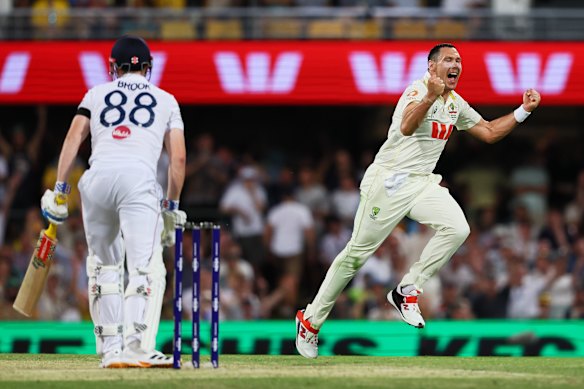
Scott Boland has prospered due to his ability to consistently hit a good line and length.Credit: AP
McCullum may not be flattered by the “Bazball” moniker, but the fact is nothing done on this tour has suggested that the descriptor is anything more than an excuse to avoid the hard work required for success. The body language and public comments of the players suggest they believe they have been unlucky, when the truth is they have pursued a failed game plan that has been exposed as more fluff than substance. When you start feeling sorry for yourself, it is a downward spiral. The adage, “What you fear is what you get,” appears to be playing out painfully for England.
This two-Test performance is one of the most catastrophic by an English bowling attack in Australia in recent memory. The doomsayers of both English and Test cricket as a whole will have a field day.
Stokes said at the end of the second Test that some of his players have failed to cope with pressure. I agree, and I don’t think those who have been found wanting can come back. Personnel changes will be required for Adelaide, but this team has been embarrassed in a most brutal way.
Loading
The bad news is that England’s attack is set to become even more exposed, as Archer is unlikely to be able to back up for all three remaining Tests and Wood has been ruled out for the rest of the series. Unless Matthew Potts or Josh Tongue can bring some leadership and sense to the bowling unit before the third Test, I have concerns for their ability to change the narrative; which is in danger of becoming the modern equivalent of a long playing record.
The better news, however, is they have three Tests; a window, albeit a shrinking one, in which to abandon the illusion of certainty and confront reality. This group has the chance to salvage the reputations and careers of many of the players and coaches involved. The remaining matches will determine if they can adapt and prove themselves competent, or if they will continue to suffer from the tragic illusion of the Dunning-Kruger effect, blinded by overconfidence until the series is lost.