
Unlock the White House Watch newsletter for free
Your guide to what Trump’s second term means for Washington, business and the world
The Federal Reserve has signalled that it could hold interest rates steady at least through September as it defies Donald Trump’s repeated calls for the central bank to dramatically lower borrowing costs.
The central bank left borrowing costs unchanged at 4.25 per cent to 4.5 per cent after a meeting on Wednesday, despite an aggressive campaign by the US president to slash borrowing costs to 1 per cent and continuing uncertainty over the impact of his trade policy on the economy.
Fed governors Michelle Bowman and Christopher Waller dissented with the decision, saying the central bank should have cut rates by a quarter percentage point. It marked the first time since 1993 that two governors formally objected to a rate decision.
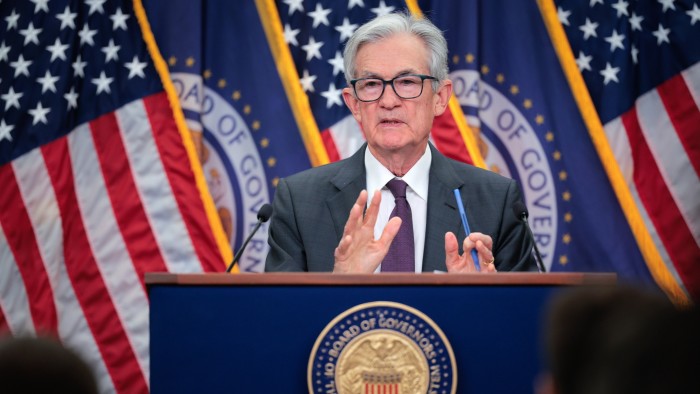
Fed chair Jay Powell said following the meeting that “it seems to me — and to almost the whole committee — that the economy is not performing as though restrictive policy is holding it back inappropriately”.
Still, he cautioned that “there’s also downside risk to the labour market in coming months”.
“The goal today was to move the odds of a September cut down to 50-50,” said Richard Clarida, a former Fed governor who is now at asset manager Pimco. “And he did that.”
Powell’s reluctance to signal a September rate cut was perceived as hawkish by many market participants, with some traders having expected him to hint that a September rate cut could be in play.
Short-term Treasuries sold off as traders ratcheted down bets on a September rate cut, sending the two-year yield jumping 0.07 percentage points to 3.94 per cent. The dollar rallied more than 1 per cent against a basket of six peers, leaving it on course for its best week since 2022.
“The market was looking for a sort of dovish bias, a clear decision on September. That was the market’s mistake. Powell has been clear they are data-dependent,” said Mike Lorizio, senior fixed-income trader at Manulife Investment Management.
Powell also said uncertainty remained over the effects of Trump’s tariffs on inflation.
The US has struck a handful of trade deals, including with the EU, Japan and the UK, but Trump has said the White House will impose high levies on many countries just after midnight on August 1.
Many of the deals that the White House has struck have also been well above the 10 per cent tariff level that some economists had assumed would be the norm, heightening potential inflation risks from the levies.
Trump and his allies insist the tariffs will only have a limited effect on inflation and say the Fed should immediately cut rates to bolster the economy and lower government borrowing costs.
Speaking before the Fed announced its rate decision, Trump said: “I hear they’re going to do it [cut rates] in September, not today. For what reason, nobody knows.”
The president had last week amplified his attack on Powell, making a trip to the Fed’s headquarters to scold the central bank chief over monetary policy and a cost overrun on a $2.5bn renovation project.
Powell could provide more clarity on what comes next at the Kansas City Fed’s Jackson Hole event in late August, when US rate-setters will have jobs data for June and July, along with readings for inflation in July.
The central bank’s decision came hours after second-quarter GDP data pointed to a slowdown, even as it beat economists’ expectations and bounced back from a first-quarter contraction.

Official figures from the Bureau of Economic Analysis on Wednesday showed the economy grew at an annualised rate of 3 per cent in the second quarter, up from a 0.5 per cent contraction in the previous period.
The number was driven higher by a sharp drop-off in imports as Trump’s levies came into effect while a rush by companies to purchase foreign goods in the first three months of the year sharply reversed.
Overall, the economy grew at a 1.1 per cent annualised rate in the first half of 2025, compared with 2.9 per cent in the second half of the previous year, according to Financial Times calculations.
Consumer spending, the crucial driver of the US economy, also cooled in the first half of 2025 compared with the end of 2024.
Recommended

“This softness in consumption could continue in the second half of the year in our view as consumers are worried about labour market prospects and businesses are being cautious with hiring,” Citigroup economists said.
Analysts at JPMorgan added that they expected growth to slow further to an annualised 0.75 per cent in the second half of the year.
“We expect a further softening of demand into [the second half] as the impacts of recent protectionism and deportations are felt,” the Wall Street bank said.