
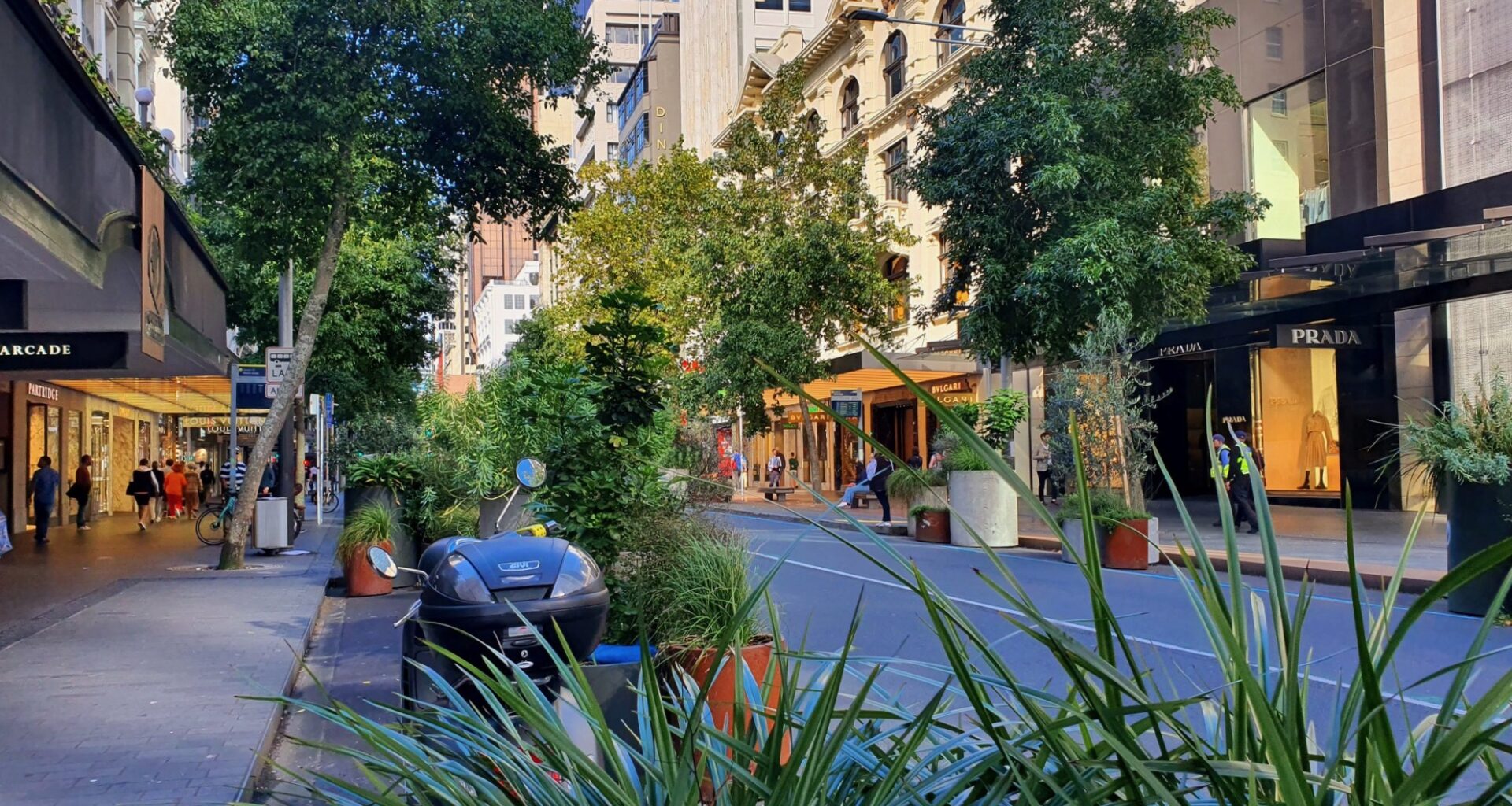
Here we are again. For the umpteenth time, more changes are being proposed for Queen Street (and Midtown).
Unfortunately, these are not good changes, and they include pouring traffic back into the short section of Queen Street that’s currently car-free, between Wakefield St. and Wellesley St. The existing restrictions would only apply 7am-7pm, thus opening up the whole street to general traffic overnight. Why??
A free-for-all, the entire length of Queen Street, all night long. Welcome back, boy racers! Start your engines!
This is an important one, but if you want to see a better Queen Street, we need to speak up, so read till the end and considering using your power and taking some action!
We’ll dig into the recent stuff, and what we can do to stop this, but I think it’s important to have some context on how we got here, and how long it has taken.
A brief list of (just some of) the many, many proposals over the years to “pedestrianise Queen Street”
The shape of Queen Street has been debated for decades and decades, as you can read here, continuing into the 21st century.
Traffic in Queen Street, looking south from Fort Street (left), 1982, Auckland Libraries Heritage Collections 1727-100
In fact, Patrick Reynolds’ first post here – in 2011! – asked why we still allowed cars on Queen Street.
Queen St, from the water to Mayoral Drive, has an unusual and unexpected feature for a city street in Auckland. It’s easy to miss but it’s true: There is not one vehicle entrance to a building from Queen St. Not one car parking building, not one loading bay, not one ramp to an executive garage under a tower block. The only way to enter a building from Queen St is on foot. There are a few very short term road side parks among the bus stops and loading bays, but really every car in Queen St is on its way to and from somewhere else. And so slowly.
People often talk about traffic with words like ‘flow’ as if it is best understood as a liquid, when really what it is actually like is a gas. Traffic expands like a gas to fill any space available to it [which is why it is futile to try to road build your out of congestion]. There are cars in Queen St simply because we let them be there, like an old habit we’ve never really thought about. l think it’s time we did.
That was published 14 years ago, when I was 13 years old!
In 2016, picking up on Patrick’s question, Matt penned a post in exploring the longterm impact of street upgrades in the 2000s. Pedestrian numbers rose significantly, while vehicle numbers dropped:
At the time of the upgrade the council estimated there were about 46,000 pedestrians, 40,000 bus passengers and 25,000 people in vehicles. Heart of the City now have fantastic data on pedestrian numbers thanks to automated counters located around the city and they show pedestrian volumes of around 60,000 per day, sometimes more. For example, on Friday 1 April the counter outside 210 Queen St (eastern side) recorded 36,128 people passing by.
[…]
Back in 2004 in the same spot and almost exactly the same day (14 Mar – 20 Mar) the counters recorded an average of 10,300 vehicles using Queen St in each direction over a seven-day period. By comparison counts this March show vehicle volumes are down 48% to an average just 5,300 per direction per day, far more than the predicted 15% reduction in volumes.
In 2018, Auckland Council voted unanimously to pedestrianise Queen Street. Said then-Mayor Phil Goff:
“Making Queen Street and adjoining streets a pedestrian and public transport zone underpins our desire to put people at the heart of our city centre and waterfront transformation. It is what a world-class city would do. As Mayor of Auckland, it is what I want to do.
“Access for Everyone is a bold step in the right direction. It is a creative urban design approach to complex challenges that will unlock the potential of one of New Zealand’s most iconic streets; it will transform Queen Street, High Street and others in the vicinity into a pedestrian haven with desirable destinations that people will enjoy and explore, allow businesses to prosper and provide a pathway to our beautiful waterfront.”
AT and some Council officials proceed to ignore this directive for two years. Meanwhile, Auckland Council developed the amazing refresh of the City Centre Masterplan (and its transport component, Access for Everyone), which drew 84% support in consultation for pedestrianising Queen Street.
As for many other cities, the arrival of a global pandemic in 2020 provided the definitive catalyst for more people-friendly streets. Temporary changes were rolled out. When Council came out with a much bolder plan (although still not a full “pedestrianisation”) a group of disgruntled businesses took Council to court in opposition.
The Queen Street Covid-19 upgrade.
Council won the court case, but subsequent backroom lobbying led to a watered down version. Even so, when it went out (again) for consultation, the vast majority of 900+ submissions opposed the limp version, preferring the bolder plans. This, eventually, led to roughly what we have today, including the current section which restricts general traffic between Wakefield St. and Wellesley St.
The EVA zone is that strip of red in the middle of the drawing. It’s not clear what the green means. Image source: Our Auckland
This ‘Authorised Vehicles Only’ section, stopped Queen Street from being used as a through-route (aka rat run) for private vehicles, and contributing to a much nicer experience for people.
It’s taken decades to get to this point, but in the last round of changes Queen Street still wasn’t fully pedestrianised as a transit mall (something that had 84% support). At the time in 2022, after a push to fully pedestrianise from Auckland Central MP Chlöe Swarbrick and the City Centre Residents Group, the excuse that came up was due to the disruption from CRL construction, and Covid, it couldn’t happen.
[Then Mayor of Auckland Phil] Goff said he fully supported the pedestrianisation of Queen St, but it needed a “progressive approach” rather than being done at once.
“If we were to fully pedestrianise Queen St all at once it would require significant roadworks and disruption which would have a severe impact on businesses that are already struggling with disruption as a result of Covid-19 and the City Rail Link.”
Yet, CRL disruption is essentially over. So why are we not talking about progressing pedestrianisation, and why are we instead are going backwards?
Running alongside all of this has been the failure since 2020 to develop and implement traffic circulation plans for the City Centre, which are the foundation of Access for Everyone along with proper loading and servicing plans. So, while good stuff has been happening, it hasn’t been as connected as it should to the broader vision outlined in the City Centre Masterplan and Access for Everyone. There’s a fundamental disconnect in the system, which is hobbling the delivery of the vision the public demands.
Hence the Project K debacle, and AT now spitting out these weird last-minute changes for Queen Street.
So what exactly is being proposed now?
Check out Auckland Transport’s presentation to yesterday’s Waitematā Local Board Workshop here.
There are three key proposals:
Shifting the Queen Street Authorised Vehicle-only lane from 24/7 restrictions, to 7am-7pmImplementing 7am-7pm bus lanes on Wellesley Street, as a part of the Wellesley St Bus Improvements, Stage 1 projectAdjusting access to Elliott Street and associated wayfinding
All of these are set to be implemented around mid-March 2026, when the Stage 1 of the Wellesley St Bus Improvements project is completed.
For starters, the bus lanes on Wellesley Street should be 24/7. This is the primary east-west bus corridor in the City Centre, so, if for some reason 24/7 can’t be done, at a minimum the bus lane hours should align with prime time for Te Waihorotiu Station (7am-10pm), to ensure buses aren’t caught up among general traffic, taxis and ride-shares.
But it’s the proposal for Queen Street that’s truly obnoxious. Enabling general traffic to use this section from 7pm to 7am means unrestricted access all night. It will actively encourage more cars along the full length of Auckland’s main street.
Auckland Transport is proposing to ‘launch and learn’, which means making the changes, and then consulting. But launch and learn is something you use for projects that align with agreed official strategies, to allow people to feel comfortable with change – it’s not for random regressive actions.
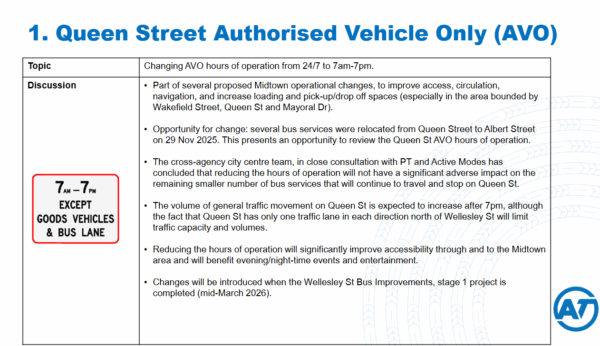
This out-of-nowhere backsliding is in blatant opposition to the longstanding vision and strategy for the City Centre, enshrined in the City Centre Masterplan and its transport component Access for Everyone. Like successful circulation plans everywhere, the idea is to re-route through-traffic, so you can prioritise people and local access.
Moreover, this regressive step ignores the reality that with CRL opening next year, thousands more people will be flooding into the City Centre via train.
At the Waitematā Local Board Workshop yesterday, staff from AT kept alluding to how certain “stakeholders” wanted to allow more general traffic, to “increase economic activity”. Apparently, due to the past disruptions and the current difficult economic situation, these “stakeholders” they’d consulted wanted a break from restrictions, and more freedom for vehicles.
So apparently this will solve all of that:
Proposed new signage for the AVO stretch on Queen Street…
Now, who was “consulted” to arrive at this conclusion? AT didn’t specify, and there really wasn’t a lot of concrete detail on how they even got here, so I’ve sent a polite LGOIMA request. But I can say for sure consultation only involved a very small number of people and it hasn’t included the City Centre Residents Group, general public, or seemingly the Waitematā Local Board itself.
However, what AT is doing by watering down the AVO lane appears to match what Viv Beck, the Chief Executive of Heart of the City, has been pushing for a long time – by bringing back vehicle access. Yet, despite Beck’s claim cars need to be brought back for businesses to succeed, its the places where we have created people friendly places are thriving.
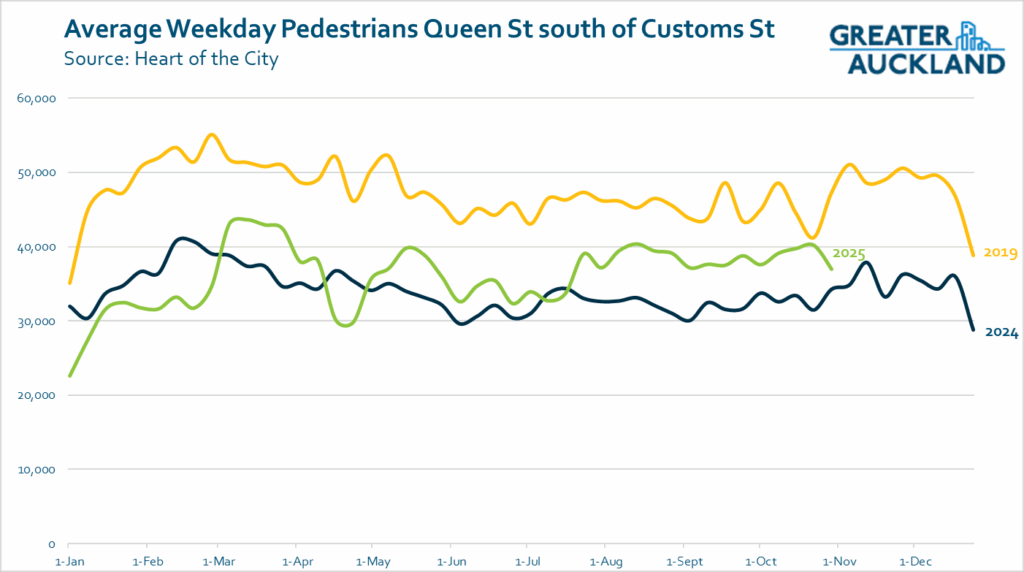
As you can see, 2025 numbers Downtown in the City Centre are tracking better than 2024, and starting to return to pre-Covid levels, because people are flocking to the wonderful places that have been created there:
Yet, when you look at pedestrian numbers around Midtown, things are not improving from 2024, let alone nearing pre-Covid numbers:
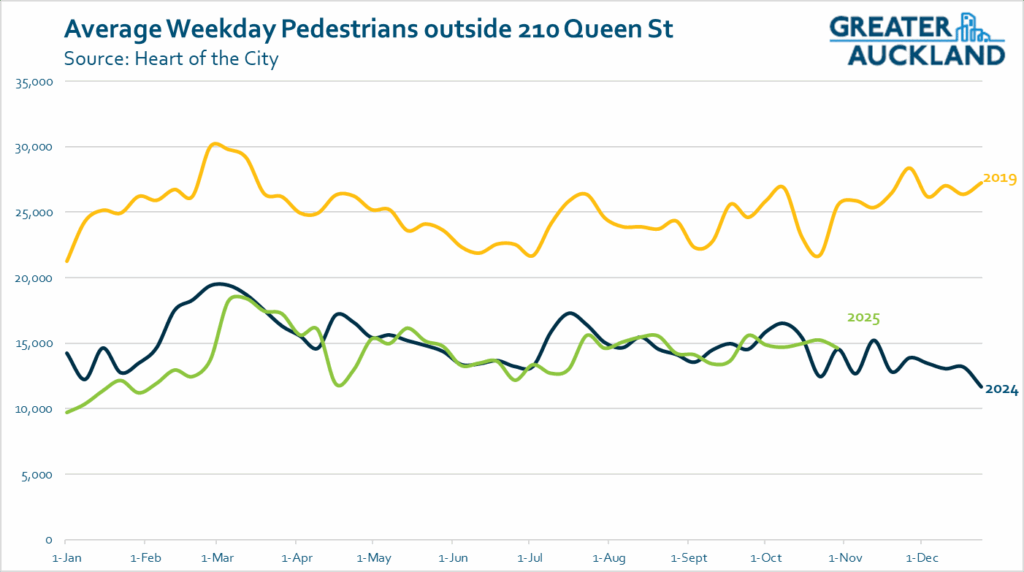
The point, is the places where we have implemented the vision of the City Centre Masterplan are succeeding economically. The places where we have no yet fully embraced the City Centre Masterplan, like Midtown, are still struggling.
And I also think its a lot more likely the constant, negativity, complaining, and denigration of the City Centre from Beck and others has been a big part of driving people away from Queen Street and Midtown, than the minor changes to make it more people friendly.
But, in the words of one Karangahape Rd business owner at a meeting last month: “If people like my nan in Dunedin read in the paper that Queen St isn’t safe, are they going to visit?”
In recent weeks The Post has been receiving complaints from well placed internal sources and Auckland Council suggesting there are ructions over Heart of the City’s approach.
[…]
A source who asked not to be named, who works with the City Centre Advisory Panel, said Heart of the City seemed to have “a curious way of marketing”.
“Their whole MO is to say ‘all the shops are shut, you’ll be stabbed and there’s no one here.’”
Another Auckland Council insider said in their view Heart of the City was “driving people away from the city”.
There may be reasonable concerns being expressed (such as needing proper pick up drop off plans for ubers and taxis to serve people from places like The Civic, or mobility access needs), but if there are, these are being used by a small number of people to try and scupper the core aims of transport in the City Centre and with the Masterplan.
This is starting to sound horribly familiar. Remember the Project K/ Mercury Lane debacle?
As with that example, it’s vital to remember what the public at large has said, over and over again, when consulted on what to do with Queen Street, and ask ourselves…
What and who is Queen Street for?
Do we want a green and lovely environment that attracts and encourages people to linger, mingle, dine and shop? Or a noisy road, chock-full of cars, with ride-share cars roving endlessly, and boy racers pumping up and down the strip?
Do we want a valley of clean, breathable air? Or one that fills our lungs with exhaust fumes and tire particulates?
Do we want our city buses to run like clockwork? Or endless servings of “bus sausage”, unreliable and delayed by traffic, inching along at peak hour?
Do we want easy access for services, deliveries, mobility transport? Or do we want all of those important trips stuck behind single-occupant vehicles just passing through and/or jockeying for parking?
With the City Rail Link about to pour thousands of people hourly into the heart of the city, do we want to roll out the red carpet, a pedestrian paradise? Or let them stumble into a traffic sewer?
And what’s our vision for visitors to our country’s main street, whether they arrive by land or by sea? Will we welcome them to an attractive and inviting golden mile? Or a congestion-clogged nightmare?
Don’t we want Queen Street to see the same success as George Street in Sydney, where pedestrianisation and a transit mall (with light rail) has seen enormous success?
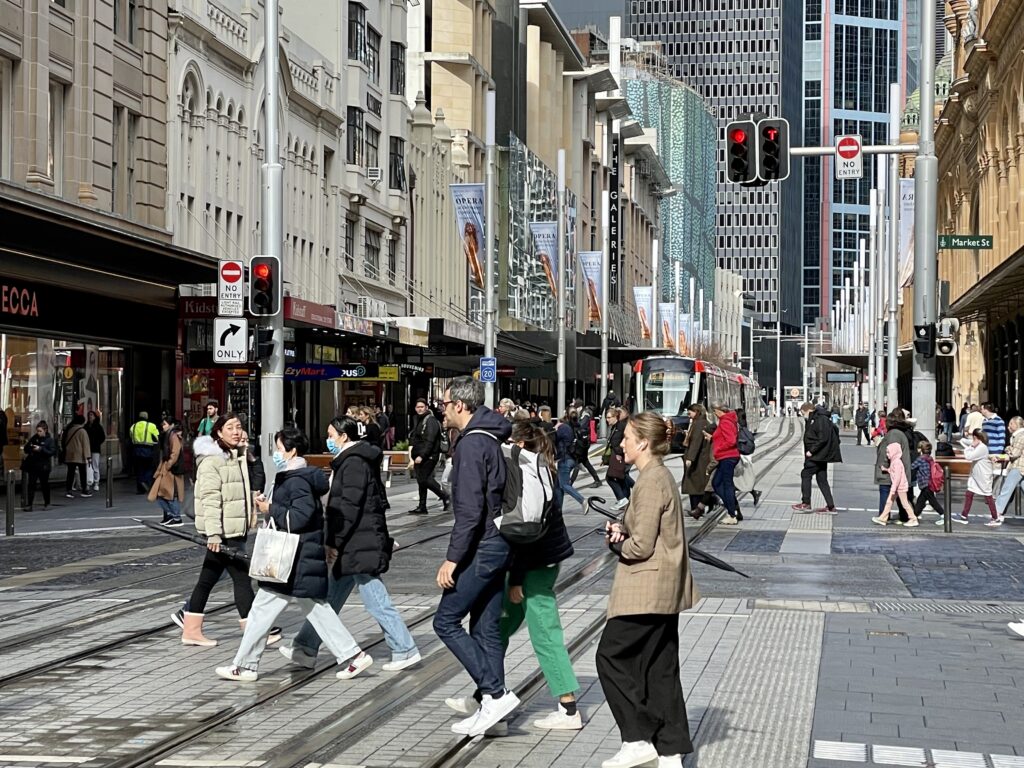
What can we do about this?
A collective public outcry worked for Project K, and I see no reason it won’t work here.
It’s simply not acceptable that well-supported strategies and plans can be suddenly undermined, for an unknown amount of time, due to the backroom demands of a small number of people (some of whom will likely complain regardless of what happens).
Whatever legitimate points they may or may not have, these should be aired and resolved publicly. In this case, delivering the core transport strategy of the City Centre – Access for Everyone – would likely resolve any legitimate concerns on issues like pick up and drop off, or mobility access.
If you’re alarmed at the prospect of all-night all-comers traffic along Queen Street, and backsliding on progress to appease a handful of voices, and keen to raise your voice, email the following:
We think these elected members may need some convincing on why this is needed:
Mayor Wayne BrownDeputy Mayor Desley SimpsonCouncillor Mike Lee (Waitematā & Gulf Ward)Councillor Andy Baker (Chair of the Transport and Infrastructure Delivery Committee)Councillor Maurice Williamson (Council appointee to Auckland Transport Board)
We think these elected members are supportive of ensuring people friendly spaces, but could use more examples of why you want a more pedestrian friendly Queen Street
Councillor Shane Henderson (Deputy Chair of the Transport and Infrastructure Delivery Committee)Councillor Richard Hills (Chair of the Policy, Planning and Development Committee)Councillor Julie Fairey (Deputy Chair of the Policy, Planning and Development Committee)
Also include Auckland Transport
Chief Executive of Auckland Transport Dean Kimpton
And, Waitematā Local Board Members:
Who likely support people friendly spaces:
Chairperson Alex BonhamDeputy Chairperson Anahera RawiriCaitlin WilsonKara KennedyPeter Elliott
And those who may need more convincing:
It’s completely fine to just email all of them at once (and a lot easier).
Here are their emails (you can click here to include all in one email or copy and paste from the list):
mayor.wayne.brown@aucklandcouncil.govt.nz
desley.simpson@aucklandcouncil.govt.nz
mike.lee@aucklandcouncil.govt.nz
andrew.baker@aucklandcouncil.govt.nz
shane.henderson@aucklandcouncil.govt.nz
maurice.williamson@aucklandcouncil.govt.nz
richard.hills@aucklandcouncil.govt.nz
julie.fairey@aucklandcouncil.govt.nz
chief.executive@at.govt.nz
alexandra.bonham@aucklandcouncil.govt.nz
anahera.rawiri@aucklandcouncil.govt.nz
greg.moyle@aucklandcouncil.govt.nz
sarah.trotman@aucklandcouncil.govt.nz
caitlin.wilson@aucklandcouncil.govt.nz
kara.kennedy@aucklandcouncil.govt.nz
peter.elliott@aucklandcouncil.govt.nz
As always, be polite but eloquent about your frustrations regarding these changes, the abrupt way they have been handled, and their failure to align with the agreed strategy for the City Centre. Talk about the vision of Queen Street you want to see, and what prioritising people over cars enables; whether it be clean air, a quiet environment, safe streets, or anything else you think important.
Many people on this list support more people-friendly streets, but they need to know the public backs them to hold the line for a better Queen Street.
These are the key asks:
Keep the existing 24/7 restrictions on general traffic for this section of Queen StreetAt minimum Wellesley Street bus lanes should be 7am-10pm, ideally 24/7Implement logical pickup and drop off (PUDO) plans for ubers and taxis around MidtownEnsure mobility access is enabled around Midtown, without allowing a free for all of private vehicles
Remember that ultimately, the vision is that the whole of Queen St will be traffic free… a transit mall for people, with set times for deliveries and clever pick-up drop-off spots around every other corner. Actually implementing this would also make it a lot more intuitive to get around for everyone (including drivers). You can and should voice support for this vision in your email. We’ve known for decades this is what people want, and we know from examples in Auckland and overseas that it benefits everyone.
Emailing is really, really, important for things like this, and it’s easy. Most of the time, elected members and AT only hear from people who oppose things. This is a great time to reiterate our support for the good stuff, and for sticking to the well supported strategy for the City Centre.
Project K proved we can make a difference when we take a minute to speak up!
This post, like all our work, is brought to you by the Greater Auckland crew and made possible by generous donations from our readers and fans. If you’d like to support our work, you can join our circle of supporters here.
Share this