

Listen to this article
Estimated 5 minutes
The audio version of this article is generated by text-to-speech, a technology based on artificial intelligence.
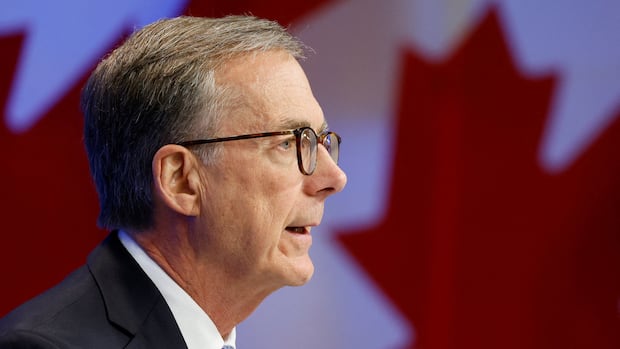
The Bank of Canada held its key interest rate at 2.25 per cent on Wednesday, a move that was widely expected after an encouraging round of third-quarter data showed the Canadian economy has withstood some trade war-induced turmoil.
The current rate is at “about the right level” to give the economy a boost through a “structural transition,” while also keeping inflation close to its two per cent target rate, central bank governor Tiff Macklem said in his opening remarks.
“Nevertheless, uncertainty remains high and the range of possible outcomes is wider than usual. If the outlook changes, we are prepared to respond,” he said.
During the Bank of Canada’s October meeting, the governor warned that the Canadian economy would suffer structural damage from U.S. tariffs, and that monetary policy alone would not be able to fix it.
Since then, the economy has proved hardier than expected, with GDP and jobs growth beating expectations in the third quarter and the unemployment rate dropping to 6.5 per cent in November.
Inflation is hovering just above two per cent, and the Bank of Canada’s core measures of inflation (which strip out volatile components, like gas or tax changes) are trending closer to three per cent.
However, consumer spending and business investment were fairly flat in the third quarter. While that will likely change in the fourth quarter, the bank anticipates that overall economic growth will slow before it picks up again in 2026.
“The general tone of the communique suggests that the threshold for a cut is relatively high and would require a significant deterioration of the outlook,” wrote Charles St-Arnaud, chief economist at Servus Credit Union, in a note to clients.
Why the economy has fared better than expected
While the steel, aluminum, auto and lumber sectors have been pummelled by U.S. tariffs, which is weighing more broadly on business investment, “the economy is proving resilient overall,” Macklem said in his remarks.
The governor pointed to recent revisions made by Statistics Canada to the country’s economic growth figures in 2022, 2023 and 2024 as a possible explanation for that resilience.
“The revisions suggest the Canadian economy was healthier than we previously thought before we were hit by the U.S. trade conflict,” he said. “In particular, they suggest both demand and economic capacity were higher coming into this year.”
WATCH | Why the Canadian economy has proven resilient: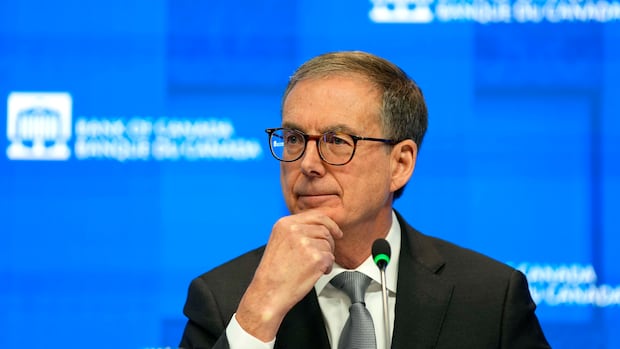
Bank of Canada governor explains why economy has been resilient
Bank of Canada governor Tiff Macklem explains why the Canadian economy has withstood some of the pressures foisted on it by the U.S. trade war.
Another point of stability is that, while certain key sectors are grappling with steep tariffs, the rest of the economy “continues to operate largely tariff-free” with the U.S., Macklem pointed out.
“The average tariff rate on Canada from the United States is one of the lowest in the world — about six per cent,” he said. “We haven’t seen spillovers to the rest of the economy.”
‘Canadians are feeling squeezed’
Consumers who are struggling with the cost of living might not be feeling that resilience in the day-to-day, Macklem acknowledged. “Many Canadians are feeling squeezed,” he said.
A recent survey from the Angus Reid Institute showed that 59 per cent of Canadians see the cost of living and inflation as their major economic issue of concern, and that 39 per cent are having trouble keeping up with their household grocery bills.
(The survey was conducted from Nov. 26 to Dec. 1, 2025, among a random sample of 4,025 Canadian adults who are members of Angus Reid Forum. The survey has a margin of error of plus or minus 1.5 percentage points, 19 times out of 20.)
However, both Macklem and senior deputy governor Carolyn Rogers stressed that the bank does not want price levels to drop overall — that could lead the economy into a serious recession.
“Although it sounds good, the idea of prices coming down, that happens when the economy is struggling,” explained Rogers.
WATCH | Senior BOC deputy explains why broad price drops are a bad sign: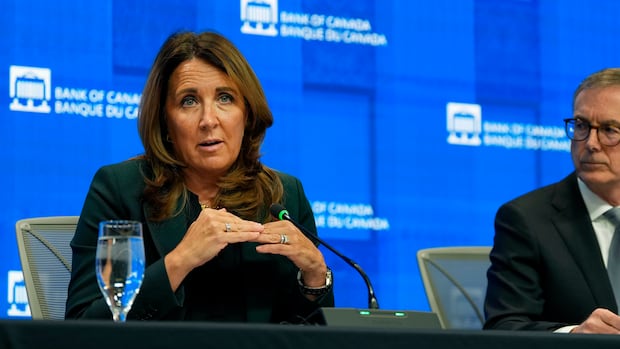
Prices come down ‘when economy is struggling,’ says Rogers
Carolyn Rogers, senior deputy governor at the Bank of Canada, explains why an overall drop in price levels would do more harm than good for the Canadian economy.
Deflation — the inverse of inflation — encourages consumers and businesses to put off purchases because they will be cheaper if they wait. It can also force businesses to cut costs, including wages.
“So what we need to do is keep inflation at target and support the structural shift that the economy’s going through,” she said.
“As the economy grows, it will support wage increases and that will help, over time, fix that sense of affordability being tough for Canadians.”