
Unlock the Editor’s Digest for free
Roula Khalaf, Editor of the FT, selects her favourite stories in this weekly newsletter.
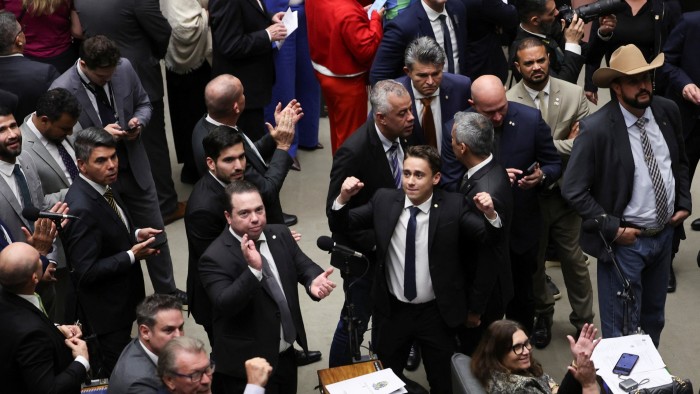
Brazil’s lower house of Congress has passed a bill that could take as much as 25 years off the prison sentence of ex-president Jair Bolsonaro, who is behind bars for planning a coup d’état.
The bill, which needs approval from the Senate and faces a likely veto from President Luiz Inácio Lula da Silva, could allow Bolsonaro to leave jail in just over two years, according to the text’s rapporteur. The hard-right populist was handed a 27-year sentence in September for plotting to illegally stay in power after losing the 2022 election.
The bill’s rapporteur, Paulinho da Força, said the measure, which was passed in the early hours of Wednesday morning, aimed to “pacify Brazil”.
The proposal, which will now go to the Senate, would also grant leniency to co-authors of the coup plot and to Bolsonaro supporters who took part in the attempted insurrection almost three years ago.
Lula — whom the plotters allegedly planned to assassinate — has previously said he would veto an amnesty law, though Congress can override the president with a simple majority. However, even if lawmakers pushed the bill through, legal experts said it could be struck down by the supreme court, which judged the coup and insurrection cases.
In scenes reminiscent of the US Capitol attack two years earlier, on January 8 2023, hundreds of Bolsonaristas stormed and ransacked the country’s Congress, supreme court and presidential palace. They called on the military to depose Lula, days after the leftwinger had been sworn in.
 Jair Bolsonaro was jailed for 27 years in September. The former president’s allies have called for a full pardon for all involved © Evaristo Sa/AFP/Getty Images
The controversial bill follows a campaign by families of the January 8 perpetrators, who argued that the penalties were overly harsh. More than 1,000 people have been convicted, with sentences of up to 17 years. The supreme court said in August that 112 people were in prison, 44 under house arrest and a further 29 in pre-trial detention.
The development also shows the legacy of the tumultuous events, which followed a bitterly divisive election narrowly won by Lula, remains far from settled in Latin America’s largest country. A poll by Genial/Quaest in October found 47 per cent against an amnesty, with 35 per cent in favour.
“This is very bad for Brazil, signalling that next year we will have a highly polarised election”, said Eduardo Grin, professor at the Getulio Vargas Foundation, adding that the bill had a chance of passing in the Senate.
Bolsonaro’s allies have called for a full pardon for all involved. The former army captain has suffered from health issues since being stabbed in 2018.
Ahead of presidential elections next year, Bolsonaro’s senator son Flávio last week said he had his father’s backing to be the rightwing candidate. Financial markets fell on his announcement, suggesting that investors give him little chance of success and prefer a more moderate conservative to take on the 80-year-old political veteran Lula.
Flávio has said he will withdraw from the race if his father is on the ballot, an outcome considered unlikely. Before his conviction, Bolsonaro was already banned from standing for office until 2030 due to campaign offences.