
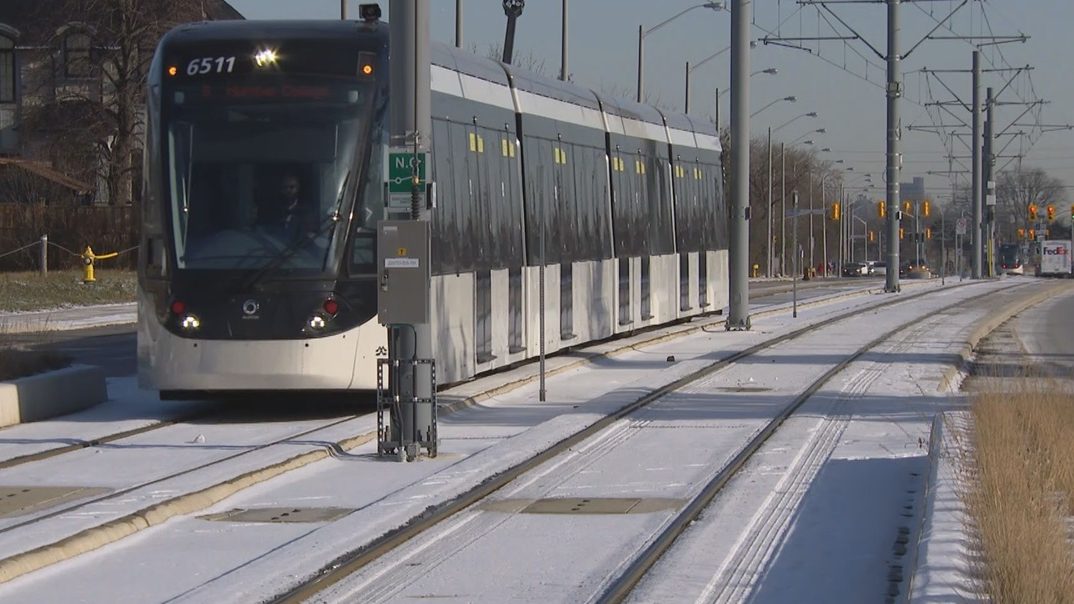
The opening of the new Line 6 Finch West LRT on Sunday was both “a celebration” and “an abysmal failure,” City councillor and TTC Commissioner, Josh Matlow, said on Wednesday morning ahead of a TTC Board meeting.
Matlow was among transit riders, advocates, and TTC Board members who gathered before the meeting to make an impassioned call to speed up the snail-paced line, calling it “absurd” that the so-called “rapid” transit vehicles are, in many cases, going slower than the buses they are supposed to replace.
“The city needs to implement full signal priority on the Finch and Eglinton LRT,” Matlow said.
“Otherwise, we will have spent billions on transit infrastructure only for vehicles to be slower than the buses they’re meant to replace. That’s why I’m calling for investments in signal priority across major transit corridors — LRTs and streetcars — so we can finally get transit moving.”
Matlow said that change wouldn’t be difficult, or expensive, to implement.
The issue, he argued, is a “dysfunctional” relationship between Metrolinx, the City and the TTC.
“This is not complicated,” he stressed. “The hardware is there, it would take simply flicking a switch, but there needs to be an agreement between the TTC and Metrolinx to do that, and that’s what we are asking for and we want it done today.”
Andrew Pulsifer, Executive Director for transit advocate group, TTCriders, also argued strongly for transit signal priority, calling it a “straightforward win for riders.”
“It’s unacceptable that people waited years for the Finch LRT, only to be stuck at red lights or crawling behind turning cars. Riders deserve better, and the City must move quickly to fix this.”
Mayor Olivia Chow and TTC Chair Jamaal Myers seem to agree.
On Tuesday, Chow said she would be introducing a motion this week “asking for transit signal priority, removing speed caps where possible and increasing service frequency.”
“The (Finch LRT) train is not as fast as it can be, absolutely,” Chow conceded at City Hall on Tuesday morning.
“I’m hearing the feedback. I rode the train, and I know it can be faster.”
Myers, meanwhile, has a motion going before the TTC Board today calling on the City and Metrolinx to work together on urgent improvements to speed up the line, including transit signal priority, and service frequency.
“Rapid transit must be rapid,” Myers reasoned. “If our LRTs move too slowly riders will stay in their cars, congestion will worsen and the billions of dollars invested in public transit will not deliver the expected results.”
He also wants changes to city-wide streetcar system — something he’s hoping to accomplish in a separate motion that asks the TTC CEO to work with the City Manager and report back “on options for removing on-street parking and restricting left turns during high-peak periods on key routes, reviewing the distance between streetcar stops and internal policies governing transit speeds on surface routes …”
“We need faster streetcars, stronger signal priority and a clear signal that a full streetcar carrying dozens of people takes priority over curbside parking and individual vehicles making left hand turns,” he argued.
Myers said a recent TTC Board review found that Toronto’s streetcars are the slowest in the world, and said the “political will” currently exists to change that.
Excitement fades for frustrated Finch LRT riders
The opening of the new Finch LRT line was met with great excitement that quickly faded for riders who found themselves enduring rides that took nearly an hour to complete the full 11-kilometre stretch between Finch West subway station and Humber College station.
“I was eager to ride it for the first time on Sunday after waiting for years,” said Nicholas Christou, a transit rider who lives near Finch.
“My excitement turned into disappointment when it took 53 minutes to get from Finch West Station to Humber College. It was painfully slow and, at best, felt no different than the Finch bus stuck in traffic.”
Butterfly Gopaul Jane, a Finch neighbourhood resident and community organizer, said it was another failure for an often-stigmatized part of the city.
“We’ve continued to be failed structurally and systemically … and we have a working poor, Black, racialized, newcomer neighbourhood that relies on good transit,” she said.
“It’s a failure for a public line, and billions were put into this line, and people aren’t moving. It took an hour for this line to move from one end to the other, it’s shameful.”