
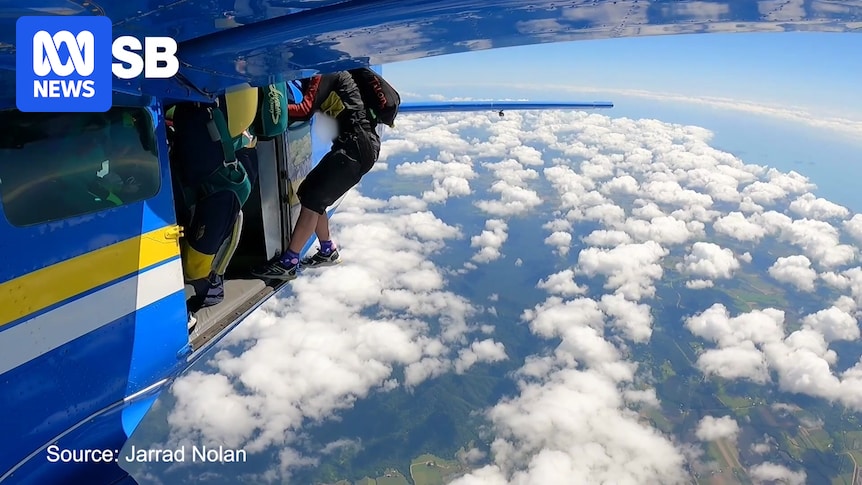
Australia’s transport safety investigator has released video footage of a skydiver cutting himself free from his parachute after it became snagged on a plane wing in mid-air.
The video was released as part of the findings of an Australian Transport Safety Bureau (ATSB) investigation into a skydiving incident over Mission Beach, 140 kilometres south of Cairns, on September 20.
A Cessna Caravan aircraft and pilot, both hired by the Far North Freefall skydive club, took off from Tully.
The parachute jump was part of the “Big Ways at the Beach” multi-day event in which experienced parachutists completed large group formations.
The ATSB said 17 parachutists were on board, ready for a “16-way formation jump” from 15,000 feet (4,572 metres).
However, as the first parachutist climbed out of the aircraft’s roller door, the handle of his reserve parachute snagged on a wing flap.
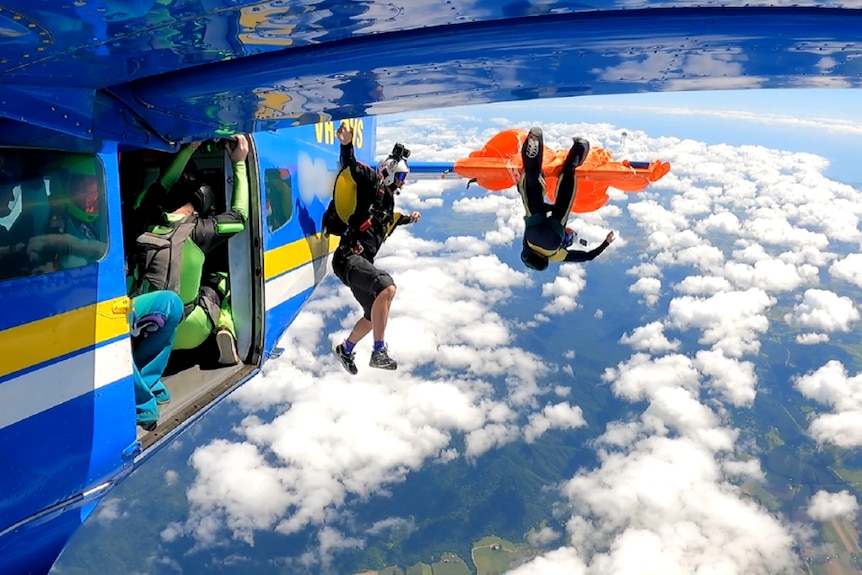
The two skydivers were pulled out of the plane door after one of their parachutes accidentally released. (Supplied: Jarrad Nolan via ATSB)
The skydiver was wearing a camera, while another was mounted on the plane’s wing, filming the incident from multiple angles.
The vision shows the parachute being deployed and the man being dragged from the aircraft, and the chute becomes snagged on the wing, leaving the man hanging.
Another parachutist fell from the plane in the process.
While hanging from the plane, the man began to cut himself free with a hook knife, sending himself into freefall.
He released his main parachute and landed safely, sustaining only minor injuries from the incident.
Pilot felt plane off balance
ATSB chief commissioner Angus Mitchell said the snagged parachutist “pitched up” the whole aircraft, dramatically reducing its speed.
Mr Mitchell said the pilot believed the aircraft had stalled and applied power in response.
“Upon being told there was a skydiver hung up on the tailplane, they reduced power again,” he said.
As the pilot attempted to maintain a straight and level flight, 13 of the parachutists jumped from the aircraft, while two remained.
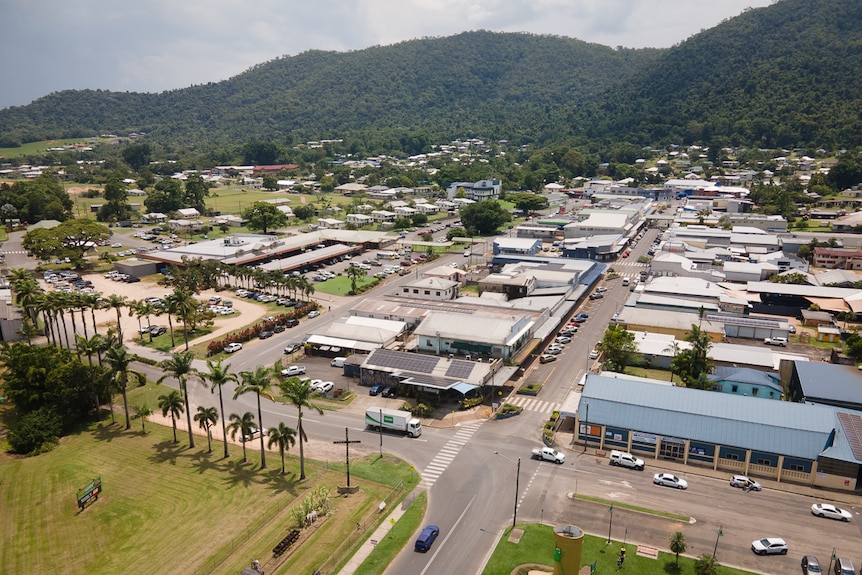
The skydiving trip organised by the Far North Freefall skydive club took off from Tully. (ABC News: Brendan Mounter)
“The pilot assessed they had limited pitch control, given the substantially damaged tailplane, which still had a portion of the reserve parachute wrapped around it,” Mr Mitchell said.
Despite the damage, the pilot managed to gradually descend while declaring “MAYDAY” to Brisbane Air Traffic Control, while preparing his own emergency parachute in the case of a failed landing.
“In difficult circumstances, the pilot managed to control the aircraft and land safely at Tully,” Mr Mitchell said.
Investigation findings
The investigation found that, while not directly contributing to the incident, the pilot and aircraft operator had not ensured the aircraft was “loaded within its weight and balance envelope”.
The report also found the pilot did not use oxygen at the flight level, as required to reduce the risk of hypoxia.
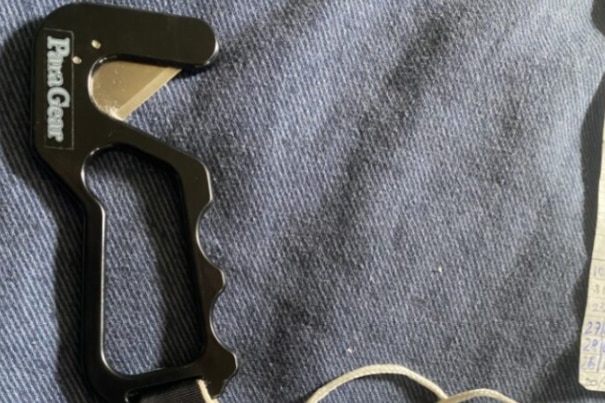
The skydiver cut themself free using a hook knife while hanging in mid air. (Supplied: ATSB)
Under safety regulations, planes are given safe, pre-calculated weight limits and placements that ensure aircraft remain stable, controllable and perform as designed.
It prevents issues like premature take-off rotations or loss of control.
“Fatal parachuting accidents have occurred in the past due to aircraft being loaded outside centre of gravity limits,” Mr Mitchell said.
The investigator said the incident highlighted the importance of conducting weight and balance calculations prior to each load.
The investigation also involved contacting the Australian Parachute Federation (APF), which has since been in the process of developing a guide for load masters detailing the role and responsibilities during an emergency.
The APF assessed that the bulky handle design “may have increased the risk of snagging if not adequately protected”.