
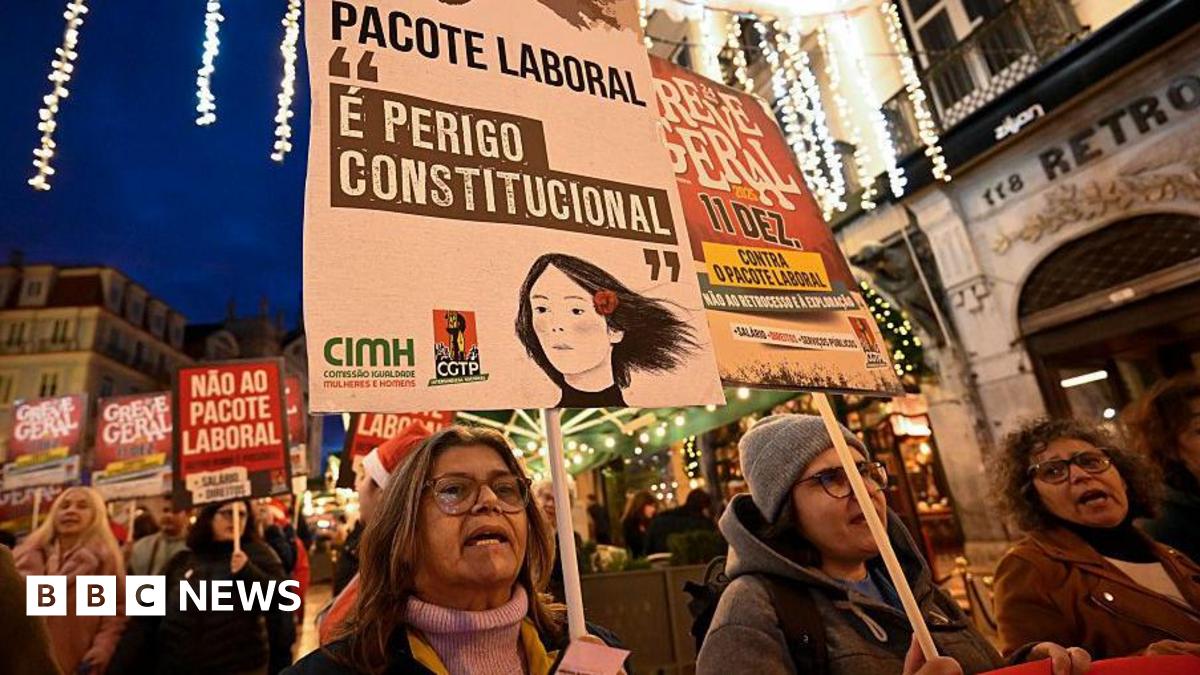
The CGTP has condemned the package as “an assault on the rights of all workers, particularly women and young people”, while the UGT calls it “so out of step, in a context of economic growth, financial stability and a strong labour market, that… it reflects a clear bias in favour of employers”.
The UGT also complains that formal talks between unions, government and business were “unbalanced, restrictive and detrimental to workers”.
Montenegro’s governing coalition lacks a majority in parliament, and is seeking support for the bill not only from the small, free-market Liberal Initiative (IL) but from hard-right Chega, which since May’s general election has been the second-largest party.
Its leader, André Ventura, has expressed reservations about the way some measures might affect family life, but looks open to negotiations.
Before the election, Montenegro had ruled out deals with Chega, and the unions and the third-biggest party, the Socialists, say the prime minister’s mask has slipped.
They also warn that politicians on the right want to amend Portugal’s 1976 constitution to loosen employment safeguards considered among Europe’s strongest.
The issue has also become caught up in the campaign for January’s presidential election, with several candidates arguing that the labour reform bill flouts Portugal’s 1976 constitution.
Under Portugal’s “semi-presidential” system, the head of state can decline to sign bills approved by parliament. Bills can instead be sent to the Constitutional Court for review or the president can exercise a veto that, while it can be overturned by a majority of elected MPs, delays the process, ensuring further discussion.
With the government seeking to overhaul so much of the labour code, such scrutiny might stoke voter unease about its radicalism, particularly since the plans were not in the coalition’s election manifesto.
Unlike many strikes here, Thursday’s day of action is not limited to the public sector.
At Portugal’s largest factory, VW-owned Autoeuropa, south of Lisbon, almost 1,000 employees voted unanimously last week to back it.
“I believe there is no worker in this country unaffected by the negative measures in this reform,” said UGT secretary-general Mário Mourão, after the Autoeuropa gathering. “It must be responded to appropriately.”